

Are Ceramic or Clay Custom Poker Chips Better?
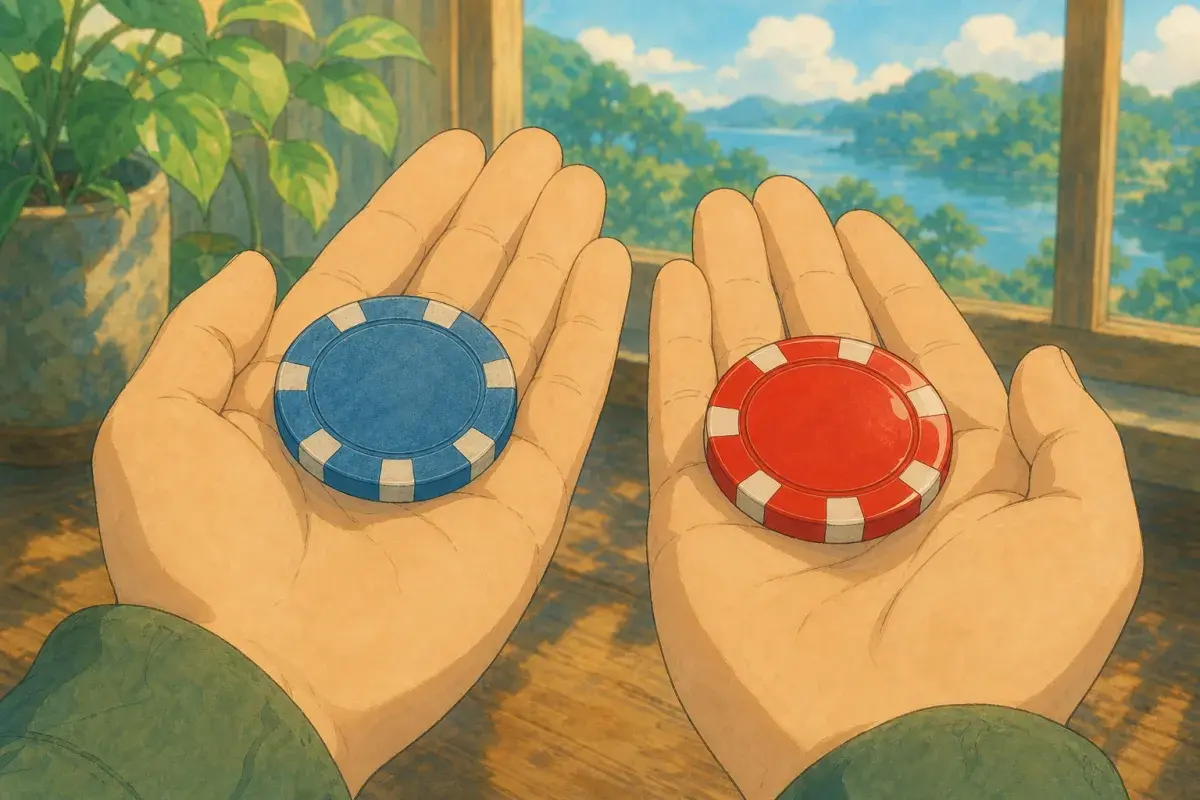
If you have spent any time on poker forums, you have seen the debate: ceramic devotees swear by durability and bold graphics; clay loyalists talk about sound, grip, and "real casino" feel until the sun comes up. Both sides are partly right — and partly talking past each other.
Below is a balanced breakdown of where each line shines, where each compromises, and how to match material to your actual table — not someone else's preference.
Hear and See the Difference First
Written specs cannot convey the stack sound or the way light catches a bevelled edge versus a flat rim. We filmed our custom clay and custom ceramic lines in a single side-by-side short: same table, same shuffle rhythm, no voiceover — just motion, finish, and the acoustic gap most buyers care about.
Press play below (or watch on YouTube if you prefer full-screen):
Ceramic vs Clay
See & hear ceramic vs clay
Close-up stacking and shuffling — both lines side by side. No voiceover, just sound, motion, and finish.
Press play to hear the stack & shuffle
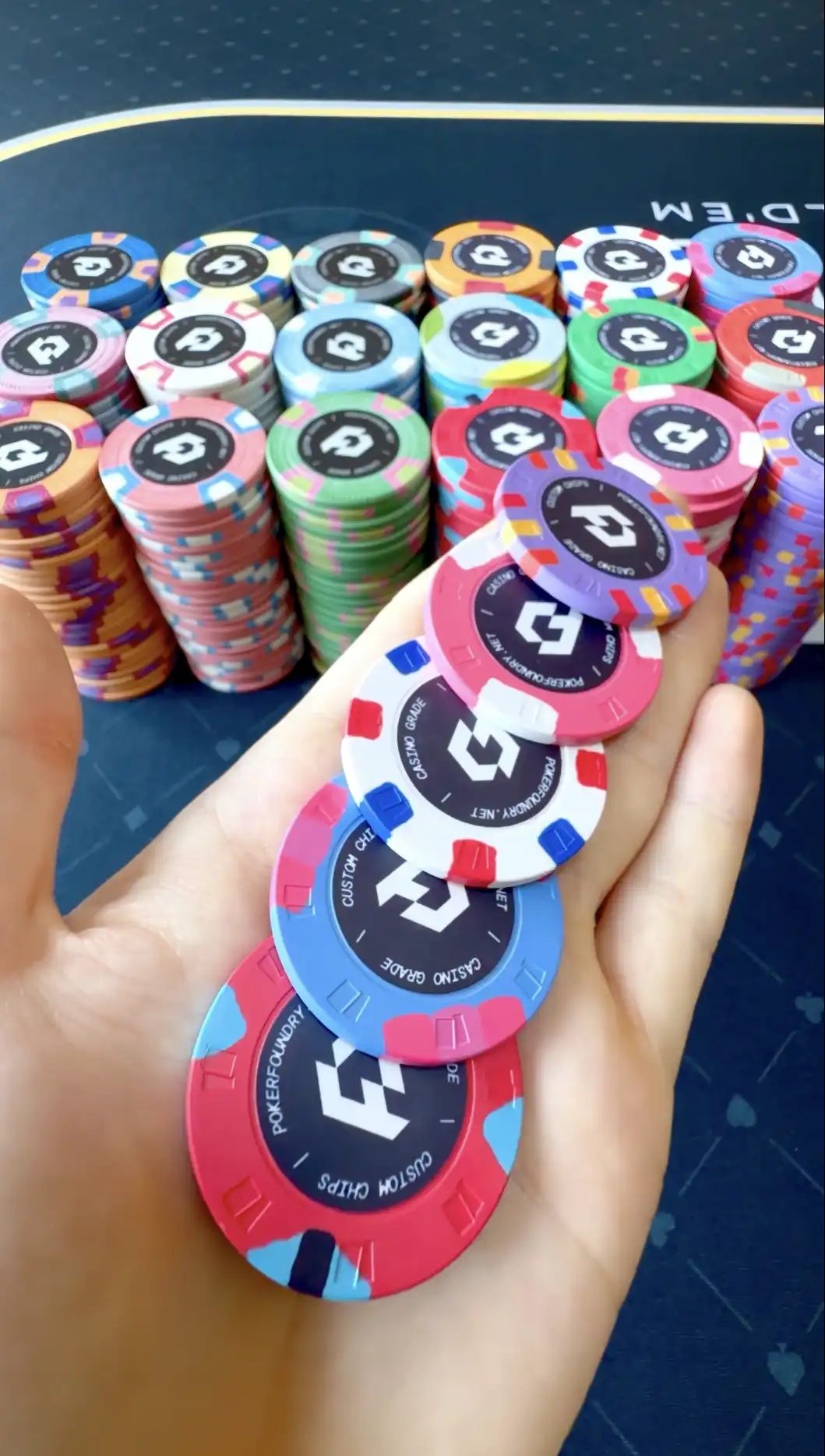
What to listen for: clay produces a deeper, resonant clack when stacks meet the felt — the profile most players associate with live cash games and WSOP broadcasts. Ceramic reads slightly brighter and sharper in the same motion; still premium, but a different acoustic signature. What to look for: the bevelled clay edge versus the flat ceramic rim, and how artwork is applied (printed paper inlay on clay, direct print with no separate label on ceramic).
If you are still torn after thirty seconds of that clip, the sections below translate those impressions into decisions.
What People Really Mean When They Ask "Better"
"Better" usually hides one of five priorities. Clarify yours before you order:
| If you care most about… | Lean toward |
|---|---|
| Feeling like a casino cash game | Clay |
| Surviving years of heavy club shuffling | Ceramic |
| Smallest text and logo detail in the design | Clay (label inlay) |
| Artwork that won't show an inlay border | Ceramic (direct-to-chip) |
| Lowest per-chip cost (small order, under ~1,200 chips) | Ceramic (from £0.73/chip) |
| Lowest per-chip cost (large order, ~1,200+ chips) | Clay (volume tiers; use quote tool) |
None of these rows crown an overall winner — they map priorities to material strengths.
Durability and Lifespan
Ceramic advantage: Our ceramic line is rated to 50,000+ impact cycles; clay is rated to 25,000+. In lab terms, ceramic lasts roughly twice as long under repeated drop and shuffle stress. The composite body and direct face print are built to resist edge wear and fading when chips are splashed, riffling-shuffled, and slammed into racks week after week.
Clay reality: Clay composite chips are still professional-grade — years of home or club play before most owners notice meaningful wear. What changes over time is often character: bevels can soften slightly, edges round with aggressive handling, and the surface develops a subtle patina serious players sometimes prefer. That is not failure; it is the trade-off of a grippier, more textured material.
Practical takeaway: If your chips will see multiple tables, long sessions, and staff who shuffle hard, ceramic's longevity edge matters. If you play weekly with friends who treat stacks gently, clay's 25,000+ rating is more than enough — durability alone should not push you to ceramic.
Casino Feel, Sound, and Handling
Clay advantage: Custom clay poker chips use a classic bevelled edge, a slightly textured face, and a printed label inlay recessed into the centre. Together they reproduce the handling profile of most live poker rooms and televised tournaments — the weight in the palm (10g ± 0.2g), the way stacks "lock," and the deep click when the pot gets pushed. Players who grew up watching casino poker often describe clay as "what a chip should be" before they articulate any other spec.
Ceramic trade-off: Custom ceramic poker chips are smoother with a flat edge (39mm diameter vs 40mm on clay — a subtle but noticeable difference in the hand). They shuffle cleanly and stack precisely; many tournament operators love them. They simply do not mimic the exact tactile recipe of a compression-moulded clay composite. Some hosts love that modern profile; purists may always prefer clay.
Neither is fake: Both are casino-weight composites used in professional environments worldwide. "Clay" chips are not pure clay (that would be brittle); "ceramic" chips are not porcelain dinner plates. The names describe manufacturing families, not geology homework.
Print Quality: Two Different Kinds of "Better"
This is where confusion peaks — because durable print and high-fidelity print are not the same thing.
Clay — higher fidelity label artwork
Artwork on clay is applied as a high-resolution printed label inlay set into the chip face. The inlay process excels at fine lines, small denomination text, intricate logos, and subtle gradients — reproduction sharpness that direct-to-chip ceramic printing generally cannot match at the same scale. If your design has dense typography or a detailed crest, clay is often the safer artistic choice. See our poker chip artwork design guide for file prep tips.
Ceramic — more durable print under play
Ceramic uses direct-to-chip full-colour printing — no separate paper label. The graphic is bonded to the chip surface, which is why ceramic is rated to 50,000+ impact cycles vs 25,000+ for clay. Clubs running branded tournament sets for years often choose ceramic when they want maximum rated durability .
Neither cheats the other: Ceramic can look stunning and bold; clay can look museum-precise. If your brief is "photorealistic crest with 6pt text," favour clay. If your brief is "heavy weekly play, smallest viable order, or ," favour ceramic.
Look, Edge Profile, and Table Presence
Clay reads traditional: bevel catches light, matte composite texture, visible inlay area framing the artwork like a casino chip. On the felt, stacks read as "classic room."
Ceramic reads contemporary: flat rim, uniform silhouette, artwork flowing across the face without a separate inlay border. On the felt, stacks read as "designed set" — popular for corporate events, stream-friendly home games, and clubs wanting a sharp modern identity.
"Better looking" is subjective. Browse the gallery or chip inspiration pages to see finished sets in both materials before you commit.
Cost: Ceramic Is Cheaper on Small Orders — Clay Wins at Volume
Do not assume ceramic is always the cheaper chip. The "from" prices on our site — ceramic from £0.73 per chip, clay from £0.79 per chip — reflect entry-level quantities at minimum order (300 ceramic / 500 clay), not the unit cost on every order size.
Small orders (roughly under 1,200 chips): Ceramic is usually the cheaper line. A 500- or 800-piece home-game set is a typical example — ceramic's per-chip rate stays lower at those volumes.
Large orders (roughly 1,200 chips and above): That advantage flips. Clay drops into a lower volume price tier above 1,000 pieces; by the time you are stocking a club or multi-table tournament inventory, clay often undercuts ceramic per chip on a like-for-like instant quote — even though clay's headline "from" price looks higher.
| Order size | Which line is usually cheaper |
|---|---|
| Under ~1,200 chips | Ceramic |
| ~1,200 chips and up | Clay (confirm in quote tool) |
It is a common mistake to treat ceramic as the budget pick for 1,000–5,000-piece club orders because the entry price is lower. At that scale, clay's volume pricing frequently wins. The crossover sits around 1,200 chips and shifts slightly with delivery region and how your order is split across denominations — so always quote both materials at your real quantity rather than extrapolating from "from" prices.
Cheaper does not mean worse. Both lines are casino-grade 10g ± 0.2g composites. You are matching material to feel, artwork, and order size — not buying a lesser product when you choose clay at volume.
Advantages and Disadvantages at a Glance
Custom clay poker chips
Advantages
- Closest feel and sound to most live casino clay composites
- Bevelled edge and textured grip players expect in cash games
- Sharpest reproduction of fine detail via printed label inlay
- 10g casino-standard weight; 40mm diameter
- Develops authentic character with long-term play (if you like that story)
- Often the better per-chip value on orders above roughly 1,200 chips
Disadvantages
- Lower rated impact cycles (25,000+) than ceramic
- Separate paper inlay label (more care around edges in deep cleans)
- Higher entry price on small orders (from £0.79/chip); becomes competitive or cheaper than ceramic above ~1,200 chips
- Bevel and edge can show wear faster under aggressive shuffling
- Not the right call if you want a flat-edge modern silhouette
Custom ceramic poker chips
Advantages
- Higher durability rating (50,000+ impact cycles)
- Direct-to-chip print survives heavy use with strong colour hold
- No separate paper label — direct print on the chip
- Flat edge, clean modern stack profile
- Lower entry price on small orders (from £0.73/chip)
Disadvantages
- Smoother feel — less "classic casino" than clay to many players
- Slightly brighter, sharper stack sound (not wrong, just different)
- Fine text and intricate detail generally less crisp than clay inlay
- 39mm diameter — subtly smaller in hand than clay
- Purists chasing WSOP-style tactile nostalgia may always prefer clay
- Per-chip cost can exceed clay on large orders (~1,200+ chips) despite the lower "from" price
Match Material to Your Use Case
| Scenario | Why clay can fit | Why ceramic can fit |
|---|---|---|
| Weekly home game, feel-first players | Authentic click and bevel | — |
| Poker club, multiple tables weekly | Strong inlay branding | Extra durability per chip |
| Tournament series, bold denominations | — | Hard-wearing print, modern look |
| Corporate branded event | Premium inlay logo | Direct print; 300 MOQ |
| Detailed crest / small type in artwork | Inlay fidelity | — |
| Tight budget, under ~1,200 chips | — | Lower entry per-chip price |
| Tight budget, ~1,200+ chips | Volume pricing often wins | Compare both in quote tool |
| Mixed cash + tournament room | Cash tables: clay | Tournament: ceramic |
Some operators order both: clay for cash where feel is king, ceramic for tournament inventory where volume and print longevity matter. That is a feature, not indecision.
Common Myths Worth Clearing Up
"Ceramic chips are fragile porcelain." They are not. Quality ceramic composites are engineered for gaming impact — the durability ratings above are measured in cycles, not wishful thinking.
"Clay chips are 100% clay." Virtually all "clay" casino chips are clay composite — clay plus binders and polymers for weight and strength. Pure clay would chip and crack.
"One material is always what casinos use." Major rooms use both families depending on vendor, game type, and branding. Your home game does not need to copy a single Las Vegas table to be legitimate.
"Better chips always cost more." Weight and construction matter more than material name. Both our lines are 10g ± 0.2g casino standard — avoid lightweight plastic masquerading as premium regardless of label.
"Ceramic is always cheaper." It is not. Ceramic wins on small orders; clay often wins above roughly 1,200 chips. Quote both at your real quantity.
Common Mistakes When Deciding Ceramic vs Clay
| Mistake | Why it hurts | Fix |
|---|---|---|
| Treating "better" as one answer | Feel-first and durability-first buyers need different lines | Use the priority table above |
| Assuming ceramic is always cheaper | Clay wins per chip above ~1,200 | Quote both at your quantity |
| Ignoring order size | Club orders priced from entry "from" rates mislead | Compare volume tiers, not headlines |
| Skipping the feel test | Specs miss stack sound and edge profile | Watch the side-by-side video in this guide |
So Which Should You Order?
There is no single winner — only a better fit:
- Choose custom clay poker chips when casino-equivalent feel, bevelled-edge sound, maximum artwork fidelity, or a large-order budget (~1,200+ chips) drive the decision.
- Choose custom ceramic poker chips when no separate label, 50,000+ impact rating, 300-chip minimum, or lower entry cost drive the decision.
Still comparing line by line? Our clay vs ceramic guide walks the same ground in table format. How to choose custom poker chips orders the full decision path from quantity to artwork. UK buyers should read the complete buying guide.
When you are ready to spec a set, get an instant quote — or rewatch the side-by-side short and trust your ears.