

Ceramic vs Clay Poker Chips: Which Should You Choose?
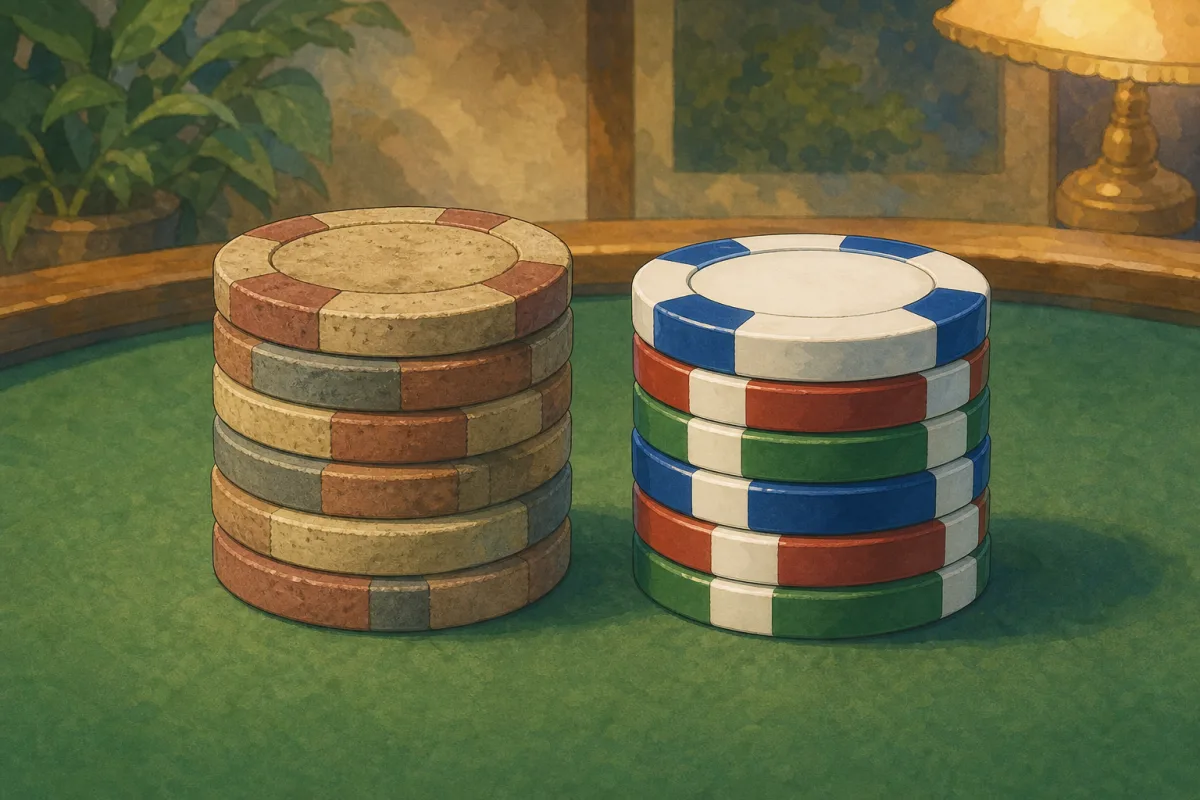
Ceramic or clay poker chips? Both share a casino-grade 10g spec but feel and print differently. Match the line to your artwork, order size, and how hard the set will be used.
If you are ordering custom poker chips for the first time - or upgrading from cheap plastic sets - the ceramic vs clay poker chips decision is the first fork in the road. Both materials appear on professional casino floors. Both are available in fully custom versions. They feel, sound, and price differently - and picking the wrong line means either paying for durability you do not need or missing the feel your players expect.
This guide is the full comparison for ceramic vs clay poker chips - specs, video, pricing crossover, and a direct answer to "which is better?" in the material matrix below. For what each material is made of at factory level, see what are poker chips made of.
Ceramic vs Clay Poker Chips: Quick Specs
Use this table when forum threads list opinions without numbers - both lines are 10g casino-grade with the same printable face area:
| Spec | Clay composite | Ceramic composite |
|---|---|---|
| Edge | Bevelled (classic casino) | Flat (modern) |
| Artwork | Printed label inlay | Direct-to-chip print - no separate label |
| Fine text / crests | Sharpest | Good for bold graphics |
| Rated durability | 25,000+ impact cycles | 50,000+ impact cycles |
| MOQ here | 500 chips | 500 chips |
| From price (USD) | $1.28/chip | $1.10/chip |
| Custom body + edge spots | No - label inlay only | Yes - Full Chip Customisation in quote |
| Usually cheaper when | ~1,200+ chips (volume tiers) | Under ~1,200 chips (often lower per-chip at MOQ) |
Bottom line: Ceramic vs clay poker chips is not a quality gap - it is a construction and priority gap. Clay sounds and feels closer to a live room; ceramic survives heavy weekly shuffling without a paper inlay to worry about. Both beat 11.5g–14g slug composites from Amazon on weight consistency and print fidelity - see our poker chip weight comparison and casino-grade value sweet spot if you are upgrading from retail.
Ceramic vs Clay vs Retail Plastic (What Most Reviews Skip)
Forum threads compare ceramic vs clay but rarely mention the third option most buyers own first - thin plastic or 11.5g slug composite sets from big-box retailers.
| Material | Weight | Edge | Artwork | Typical lifespan |
|---|---|---|---|---|
| Retail plastic / slug | 11.5g uneven | Generic mould | Stickers peel | 1–2 seasons |
| Clay composite (custom) | 10g ± 0.2g | Bevelled | Label inlay | 25,000+ cycles |
| Ceramic composite (custom) | 10g ± 0.2g | Flat | Direct print | 50,000+ cycles |
Why casinos use composites, not pure clay: Live-room chips are clay composite blends - same category as our clay line. Ceramic appears on floors that want full-face graphics without a separate inlay. Home hosts choosing between the two are already past retail; you are picking casino-grade construction, not "plastic vs clay."
Which guide should you read?
Once you have picked a line, these guides take you deeper:
| Your question | Read this |
|---|---|
| Ceramic vs clay poker chips - specs, feel, cost tables, and which fits your table | This guide |
| Ordering clay only - specs, 500 MOQ, inlay artwork | Clay poker chips guide |
| Ordering ceramic only - specs, 500 MOQ, direct print | Ceramic poker chips guide |
| Full order path - quantity, artwork, quote | How to choose custom poker chips |
| UK delivery and GBP pricing | Custom poker chips UK buying guide |
Ceramic vs Clay Poker Chips: 60-Second Decision Tree
Answer yes or no in order - first match wins:
- Do you need the sharpest small text, crest, or photo on the inlay? → Clay (custom clay chips)
- Is this your first order and budget is tight? → Ceramic (500 MOQ, from $1.10/chip - often the lower per-chip rate below ~1,200 chips)
- Will chips shuffle hard weekly across multiple tables for years? → Ceramic (50,000+ impact cycles; no separate label)
- Do players care most about bevelled-edge sound and casino nostalgia? → Clay
- Do you need custom body colour and edge spots per denomination? → Ceramic Full Chip Customisation in quote step 2 - not available on clay
- Are you ordering ~1,200+ chips for a club? → Quote both - clay volume tiers often win despite higher "from" price
- Still tied? → Watch the video below, then use the material matrix for priority scoring
| If your top priority is… | Lean |
|---|---|
| Feel and stack sound | Clay |
| Durability and no paper label | Ceramic |
| Fine artwork fidelity | Clay inlay |
| Lowest entry order size | Same - both 500 chips minimum |
| Custom rim colours per value | Ceramic Full Chip Customisation |
Which is better for your table?
There is no single winner, only a better fit. "Better" usually hides one of a few priorities, so match the line to what you actually care about:
| If you care most about… | Lean toward |
|---|---|
| Feeling like a casino cash game | Clay |
| Surviving years of heavy club shuffling | Ceramic |
| The smallest text and logo detail | Clay (label inlay) |
| Artwork with no visible inlay border | Ceramic (direct-to-chip) |
| Lowest per-chip price on a small order | Ceramic (from $1.10/chip) |
| Lowest per-chip price at ~1,200+ chips | Clay (volume tiers; check the quote) |
| Custom body colour and edge spots per denomination | Ceramic with Full Chip Customisation (edge spots guide) |
Match the material to how you host
| Host type | Default material | Why | When to flip |
|---|---|---|---|
| Weekly 6–9 seat cash host | Clay | Bevel and inlay read "casino night" to regulars | Three or more tables shuffling hard → ceramic durability |
| Monthly social host, first custom order | Ceramic | Lower per-chip rate at 500 chips, no separate label | Design is a photo-heavy crest → clay inlay |
| Poker club (1,200+ chips) | Clay at volume | Per-chip tiers often beat ceramic at that size | Tournament-only inventory → add a ceramic line |
| Tournament series with colour-ups | Ceramic | 50,000+ cycles, bold direct print | Cash side game that night → mix both |
| Corporate or stream-friendly branding | Ceramic + Full Chip Customisation | Flat edge, custom body and edge spots | Logo-only with tiny type → clay |
| Upgrading from an 11.5g retail set | Clay | Biggest feel jump from hollow composites | Price leads and you are near the 500-chip floor → ceramic |
Weight is not the differentiator between the two lines - both are 10g ± 0.2g. If you are comparing 8g, 11.5g and 14g retail marketing weights, read poker chip weight comparison before a heavier number overrides material choice.
Common myths about clay and ceramic
- "Ceramic chips are fragile porcelain." They are not. Gaming-grade ceramic composites are engineered for impact, rated to 50,000+ cycles.
- "Clay chips are 100% clay." Almost all "clay" casino chips are composite clay - clay plus binders for weight and strength. Pure clay would chip and crack.
- "One material is what casinos use." Live rooms use both families depending on vendor, game, and branding.
- "Ceramic is always cheaper." It wins on small orders; clay often wins above roughly 1,200 chips. Quote both at your real quantity.
What Are Clay Poker Chips?
Custom clay poker chips are made from a clay composite material - the same type used in most live poker rooms and World Series of Poker events. They're characterised by:
- Classic bevelled edge - the distinctive angled ridge around the chip rim
- Natural, slightly textured surface - not glossy, not plasticky
- 10g casino-standard weight - sits in the hand with genuine authority
- Printed label inlay - your custom artwork is applied as a high-resolution printed inlay set into the chip face
The sound of clay chips - that satisfying click when they hit the felt - is unmistakable. It's what most serious home game players and poker club operators are chasing.
Clay chips are best for: Players who want the most authentic casino feel. Poker clubs and live tournament operators. Anyone who grew up watching WSOP Main Event coverage and wants that chip.
What Are Ceramic Poker Chips?
Custom ceramic poker chips are made from a ceramic composite material and use a fundamentally different printing method:
- Flat edge profile - clean, uniform edge with no bevel
- Direct-to-chip full-colour printing - artwork is printed directly onto the chip surface, not via a separate inlay
- 10g casino-standard weight - identical to clay
- No separate label - artwork printed directly on the chip surface
Ceramic chips have a cleaner, more modern profile - the flat edge and smooth surface give the chip itself a sharper look. However, the print quality on a ceramic chip is generally less precise than the high-resolution label inlay used on clay chips. If fine artwork detail matters, clay may actually have the edge.
Ceramic chips are best for: Players who want no paper inlay label (more durable in heavy use), a flat modern edge, or the lower per-chip rate on small orders. Anyone who prioritises rated durability and cost over classic casino feel.
Ordering clay only? Our custom clay poker chips guide walks specs, 500 MOQ, inlay artwork, and pricing bands without re-reading the full comparison tables. Ordering ceramic only? The twin guide: custom ceramic poker chips covers 500 MOQ, direct print, and when ceramic casino chips beat clay.
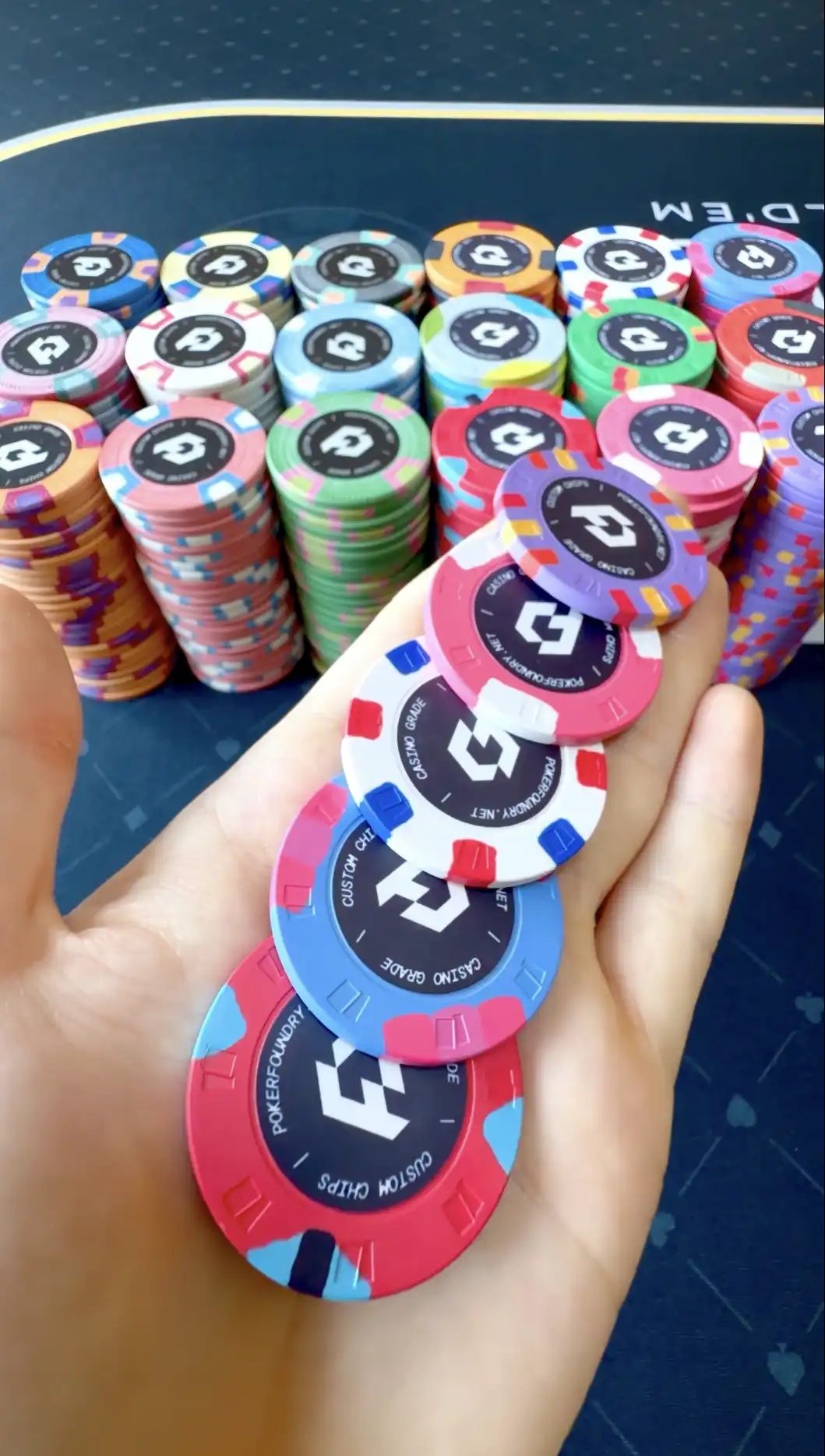
Now that you know how each line is built, see and hear them side by side - same stacks, same shuffle, both materials in one clip:
Ceramic vs Clay
See & hear ceramic vs clay
Close-up stacking and shuffling — both lines side by side. No voiceover, just sound, motion, and finish.
Press play to hear the stack & shuffle
Head-to-Head Comparison
| Feature | Clay | Ceramic |
|---|---|---|
| Weight | 10g ± 0.2g | 10g ± 0.2g |
| Edge | Classic bevel | Flat |
| Artwork method | Printed label inlay | Direct-to-chip |
| Print area | Same custom face area | Same custom face area |
| Finish | Natural matte | Smooth matte ceramic |
| Sound | Classic casino click | Slightly sharper |
| Durability | 25,000+ impact cycles | 50,000+ impact cycles |
| Customisation | Label inlay only - factory body & rim | Label artwork or Full Chip Customisation (custom body + edge spots) |
| Feel | Slightly textured, authentic | Smooth, clean |
| Best for | Casino feel; finest inlay detail | No label; durability; 500 MOQ |
| Price from | $1.28/chip (500-chip minimum) | $1.10/chip (500-chip minimum) |
| Price at volume | Often cheaper ~1,200+ chips | Cheaper under ~1,200 chips |
Which Costs Less?
Small orders (under roughly 1,200 chips): Ceramic - from $1.10 per chip (500-chip minimum) vs clay from $1.28 per chip (500-chip minimum) at entry quantities.
Large orders (roughly 1,200 chips and up): Clay - volume tiers mean clay often undercuts ceramic per chip on a like-for-like quote, even though clay's "from" price looks higher.
Do not assume ceramic scales better for 1,000–5,000-piece club orders. Run your quantity through the instant quote tool and compare both lines side by side.
| Order size (approx.) | Usually cheaper line | Why |
|---|---|---|
| 500–1,000 chips (first home set) | Ceramic | Both have a 500 minimum; ceramic is often cheaper below ~1,200 chips |
| 650–1,000 chips (weekly home game) | Often ceramic | Volume still below clay crossover |
| ~1,200+ chips (club / multi-table) | Often clay | Clay volume tiers undercut ceramic per chip |
The crossover is not exact - shipping region and denomination split move it. Quote both; do not extrapolate from "from" prices alone.
Customisation: label artwork vs full chip
Both lines put your logo, denominations, and colours on the chip face - but what you can brief beyond the face differs:
| Clay | Ceramic | |
|---|---|---|
| Default | Label inlay - custom artwork on our standard casino-style body and rim | Label artwork - custom face print on stock body colours |
| Body & edge spots | Factory standard - not briefed per order | Full Chip Customisation in the quote - custom body colour and edge spot bands per denomination |
Clay still has visible edge spots on the physical chip - they come from the factory mould, not your brief.
On ceramic, your artwork prints on the chip face. Stock body and rim colours are included - pick from our standard combinations. Choose Full Chip Customisation in the quote if you want a different body colour and edge spots for each denomination. See our custom poker chip edge spots guide for the options.
Which Custom Chip Is More Durable?
Ceramic chips are rated to 50,000+ impact cycles vs 25,000+ for clay. In practical terms, both will outlast any home game or poker club schedule for years. Durability shouldn't be a deciding factor for most buyers - but both lines still benefit from proper cleaning and care to protect artwork and feel over time.
Which Looks Better?
This is subjective, and depends on what you mean by "better." Ceramic chips have a cleaner, more modern profile - the flat edge and smooth surface give a sleek overall look. Clay chips with a well-executed inlay can actually achieve finer print detail, since the label inlay process produces sharper, more precise artwork reproduction than direct-to-chip ceramic printing.
If you want a chip that looks contemporary and minimal, ceramic wins. If you want the finest artwork precision, clay's inlay process has the advantage.
Not sure how your crest or ring text will read on the chip face? Try Label Studio before you order.
Which Feels Better?
Clay. If authentic casino feel is your priority, there is no contest. The bevelled edge, the slightly textured surface, the way they sound when they hit the felt - clay composite chips reproduce the live poker room experience more closely than any other material at this price point.
Stack height check: At 10g and 39mm diameter, both lines stack ~18 chips per inch - roughly 36 chips in a standard two-column rack row. Weight feels identical in the hand; the difference is edge profile (bevel vs flat) and surface texture (matte inlay vs smooth ceramic).
Can I Order Both?
Yes. Some poker clubs and home game hosts order clay chips for cash games (where feel matters most) and ceramic chips for tournament play (where visual impact and durability matter more). See mixing clay and ceramic poker chips for split-order patterns that work - and traps to avoid on one table.
After material: supplier and quoting workflow
Ceramic vs clay answers construction - not which brand or how you get a price. Once you pick a line, serious hosts compare MOQ, lead time, and instant quote vs email workflows on our serious home game short list.
| Question | Where to go |
|---|---|
| Priority scoring (feel vs durability) | The material matrix above |
| Who shows pricing online? | Instant quote suppliers compared |
| Named manufacturer comparisons | vs BR Pro, vs Sun-Fly, vs Chipco, vs Classic Poker Chips |
| Is Poker Foundry your fit? | Is Poker Foundry right for you? |
Common Mistakes When Choosing Clay vs Ceramic
| Mistake | Why it hurts | Fix |
|---|---|---|
| Choosing from photos alone | Feel and sound matter as much as looks | Watch the video above; use the material matrix for priority scoring |
| Assuming ceramic is always cheaper | Clay volume tiers win above ~1,200 chips | Quote both materials at your real quantity |
| Ordering fine text on ceramic | Direct print is less crisp than clay inlay | Dense logos or small type → lean clay |
| Expecting clay to feel like pure clay | Commercial chips are clay composite blends | Both lines are engineered composites - that is normal |
| Briefing custom chip body design on clay | Factory cannot run per-order mould colours | Customise label inlay; accept standard body/rim - or choose ceramic Full Chip Customisation |
| Assuming ceramic always includes custom body/edge spots | Default line is label artwork on stock bodies | Add Full Chip Customisation in quote step 2 when you need custom chip body and edge spot design |
Next Steps
- Choose clay if you want the most authentic feel and classic casino aesthetics → custom clay poker chips - deep dive: clay poker chips guide
- Choose ceramic if you want no separate label, higher rated durability, or a 500-chip minimum → custom ceramic poker chips - deep dive: ceramic poker chips guide
- Both are casino-grade and fully custom - ceramic from $1.10 per chip (500 minimum), clay from $1.28 per chip (500 minimum)
Still not sure? Compare both on custom poker chips, then get an instant quote and browse our gallery to see both chip types in action. Ordering to the UK? See the UK buying guide. Upgrading from retail plastic? Read upgrade from plastic to custom poker chips.