

Custom Poker Chips: Tournament Denominations for Home Games and Clubs
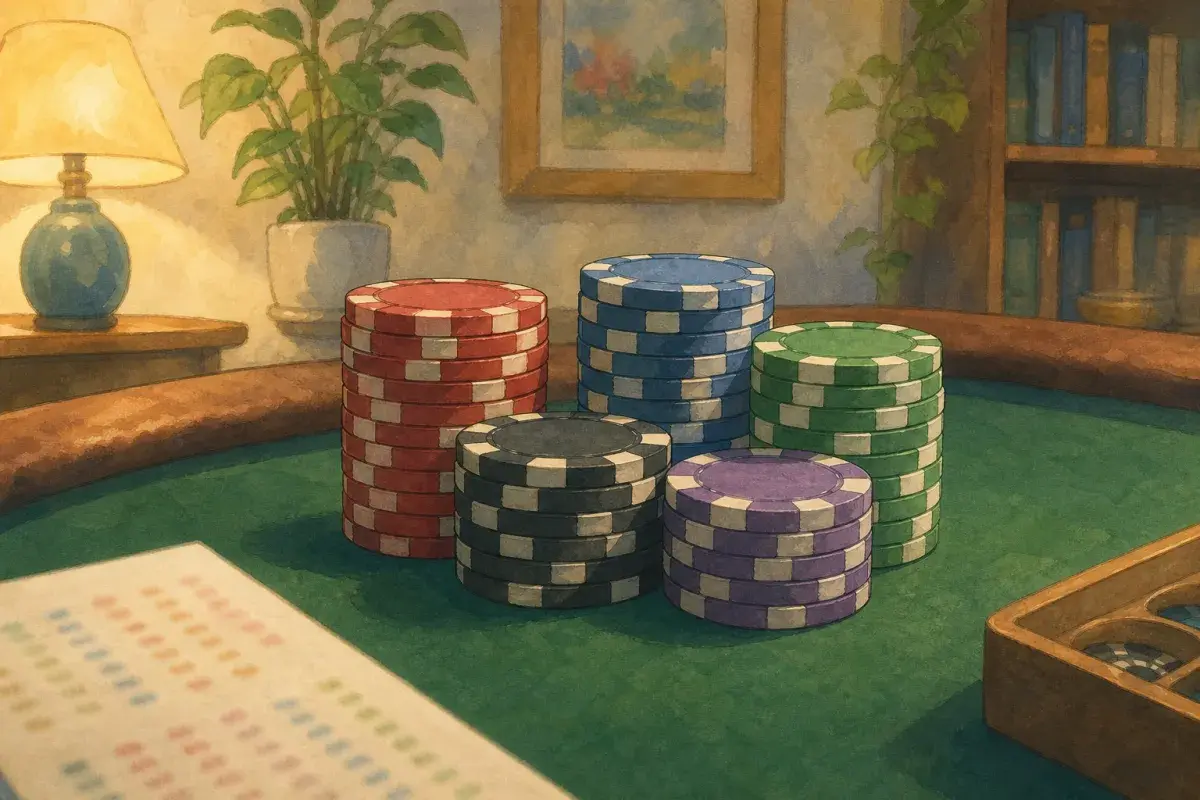
Getting poker tournament chip denominations right is one of the biggest differences between a smooth event and a messy one. Too few values and players struggle to make change; too many and the table becomes cluttered and confusing.
This guide is for home game hosts and poker club organisers who want a practical tournament structure. You will learn how to choose denominations, build balanced starting stacks, and plan colour-ups that keep your game moving. For total inventory size, pair this with our home game chip count guide; for club-scale orders, see custom poker chips for poker clubs.
Start with the structure, not the colours
Most organisers pick chip colours first and values second. Do it the other way around: define your tournament structure, then map denominations to it.
Build from these inputs:
- Player count: Affects total chips and table logistics
- Starting stack: Sets your lowest useful denomination
- Blind level length: Determines how quickly chips need to consolidate
- Tournament length goal: Helps choose how many denominations you need
- Re-entry policy: May require more low/mid chips in reserve
As a rule of thumb, tournament denominations should move in clean jumps (often x4 to x5). That keeps betting simple and reduces awkward change situations.
A proven denomination ladder for most events
For most small-to-mid tournaments, this core ladder works well:
| Denomination | Why it helps |
|---|---|
| 25 | Useful in opening levels and early antes |
| 100 | Main early game workhorse |
| 500 | Bridges early and middle stages |
| 1,000 | Core middle-game chip |
| 5,000 | Keeps stacks manageable late |
If you run deeper structures or larger club fields, add 25,000 as a sixth denomination.
This approach gives you flexibility without overcomplicating inventory. It also translates well to custom orders because you can assign each denomination to a distinct chip design for quick visual recognition.
Recommended setups by game type
Below are practical starting points you can adapt.
6-10 player home tournament (single table)
- Starting stack: 10,000
- Denominations: 25, 100, 500, 1,000, 5,000
- Per-player chip count target: 40-50 chips
- Blind levels: 15-20 minutes
This gives enough play early without dragging late levels.
20-60 player poker club tournament
- Starting stack: 15,000 to 25,000
- Denominations: 25, 100, 500, 1,000, 5,000, 25,000
- Per-player chip count target: 45-55 chips
- Blind levels: 20-30 minutes
The additional high denomination helps as re-entries and late-game pots increase.
Build a clean starting stack
A good stack is not just about total value. It should support fast betting, easy change, and minimal counting errors.
Use this sequence:
- Set your starting value (for example 10,000)
- Allocate plenty of low chips for the opening levels
- Add enough mid chips for transition levels
- Limit high chips early so players still make meaningful betting decisions
- Check total physical chips per player stays near 40-50
For many home games, a practical 10,000 stack is built mostly from 100 and 500 chips, with enough 25 chips for the first levels and a small number of 1,000 chips to reduce clutter later.
Plan colour-ups before the event starts
Colour-ups (removing low denominations) should be scheduled, not improvised.
Good practice:
- Remove the lowest denomination once it is no longer needed for blinds/antes
- Announce colour-up rules before the first hand
- Exchange fairly (or race-off odd chips when needed)
- Keep one person responsible for consistency across tables
A simple example:
- When your lowest active amount reaches 100, colour up 25s
- When your structure no longer uses 100-level precision, colour up 100s
This keeps stacks readable and speeds up every hand in late stages.
Common mistakes to avoid
| Mistake | Why it hurts | Fix |
|---|---|---|
| Too many denominations | Confusion and slow decisions | Stick to 4–6 values max |
| Too few low chips | Change-making delays early | Allocate plenty of 25s and 100s |
| No high chips ready | Messy late-level pots | Add 5,000 (and 25,000 for clubs) |
| No colour-up plan | Overcrowded stacks mid-event | Schedule removals; announce before hand one |
| Unclear value communication | Disputes and misbets | Post values; print on custom chips |
If players have to repeatedly ask, "What is this chip worth?", your structure needs simplifying.
Choosing custom denominations for your set
If you are ordering a custom tournament set, design it around the structure you will actually run, not a generic retail mix.
For most organisers, that means:
- Picking one chip design per denomination
- Prioritising clear contrast between adjacent values
- Ordering enough low and mid values for early levels and re-entries
- Adding higher denominations for club events and deeper structures
Poker Foundry supports both custom clay chips and custom ceramic chips, so you can tailor feel and artwork while keeping a practical denomination plan. If you have not settled on material yet, start with how to choose custom poker chips — clay vs ceramic affects feel, print style, and minimum order size.
Final checklist before you lock your tournament values
Before finalising denominations, confirm:
- Your blind schedule and total event duration are aligned
- Each player starts with around 40-50 physical chips
- You have a written colour-up plan
- Chip values are clearly displayed for all tables
- Re-entry stacks use the same denomination logic
Nail these fundamentals and your tournament will feel more professional from level one.
Ready to price a custom set built around your structure? Get an instant quote and configure your tournament chip denominations in under a minute.