

How Many Custom Poker Chips Do You Need for a Home Game? (2026 Guide)
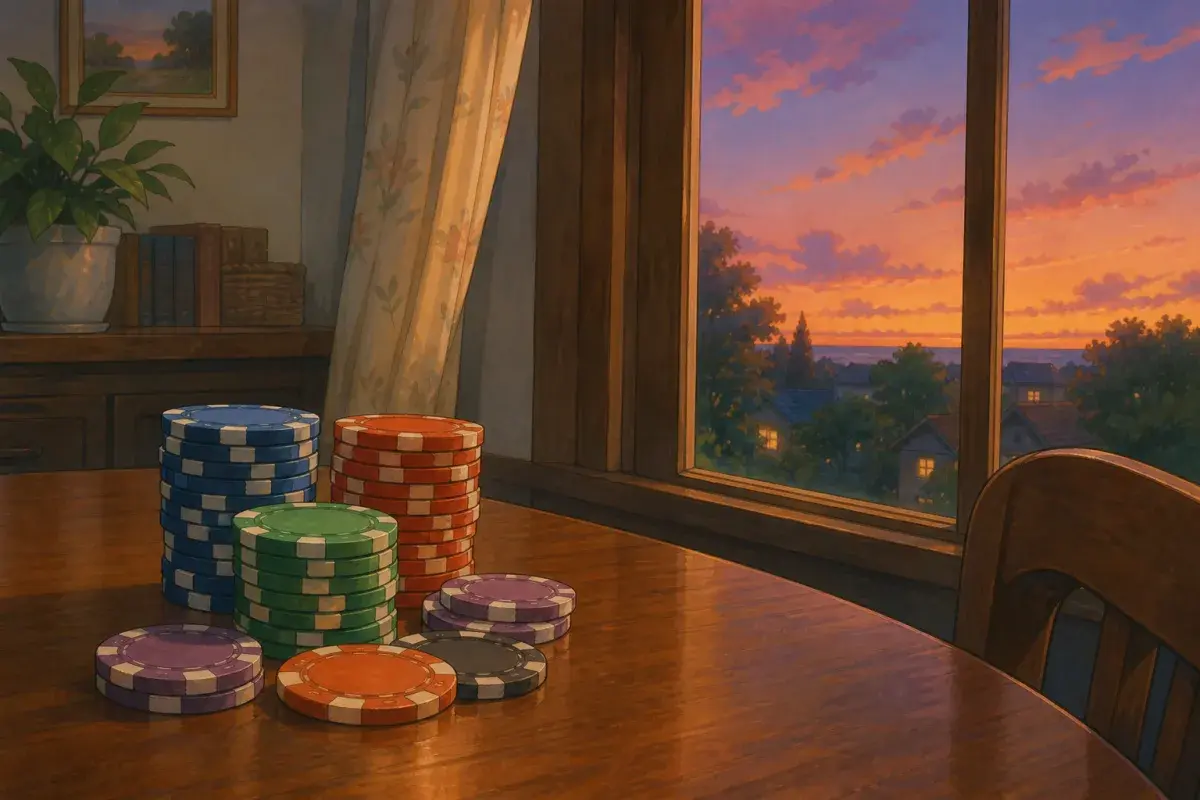
This guide gives you tables by player count, explains cash vs tournament sizing, and shows how to split denominations — so you can buy once (or order a custom set) with confidence.
The One Rule That Covers Most Home Games
Chips per player × number of players + bank = total set size.
| Factor | Guideline |
|---|---|
| Chips per player (minimum) | 50 |
| Chips per player (comfortable) | 75–100 |
| Bank / rebuy reserve | 20–30% of total chips |
| Denominations (cash game) | 3–5 colours, values 4×–5× apart |
| Denominations (tournament) | 3–4 non-cash values, ~50 chips in starting stack |
If you only remember one number: ~700 total chips for a typical 6–9 player weekly game — enough dealt to the table and enough left in the bank. Smaller groups (4–6) can run well on 500; full tables and heavy rebuys push you toward 1,000.
How Many Chips by Player Count
These ranges assume a standard Texas Hold'em home game — cash or tournament — with typical buy-ins and at least one rebuy allowed.
| Players | Minimum total chips | Recommended total | Notes |
|---|---|---|---|
| 2–4 | 200–250 | 300 | Short-handed cash; 300-chip retail sets work |
| 4–6 | 300–400 | 500 | Most common home game size |
| 6–9 | 500–600 | 650–750 | Weekly game; ~700 gives real bank headroom |
| 8–10 | 550–650 | 750–1,000 | Full table; bank matters more |
| 10+ / two tables | 1,000+ | 1,500–2,000 | Match denominations across tables |
Example: Seven players × 60 chips each = 420 in play. Add 25% bank (~105 chips) → ~525 chips minimum. Round up to 650–700 so rebuys and breaking high denominations do not drain the table mid-session.
Example: Eight players × 60 chips each = 480 in play. Add 25% bank (~120 chips) → ~600 chips minimum. Round up to 700–750 — a 500-chip set would put almost everything in starting stacks with almost nothing left for the bank.
Cash Game vs Tournament: Different Maths
The total chip count is similar; how you assign denominations is not.
Cash games
Players buy in for real money (or house currency). You need:
- Low denominations for small bets and blinds
- Mid denominations as the "workhorse" — most pots are built from these
- High denominations for rebuys and deep stacks — fewer chips, higher value
A common £0.50 / £1 home game with £50 buy-ins might use:
| Denomination | Chips per player | Value per player |
|---|---|---|
| £1 (white) | 20 | £20 |
| £5 (red) | 16 | £80 |
| £25 (green) | 8 | £200 |
| Total | 44 | £300 |
That is a deep stack — scale down if your group buys in lighter. The point is the ratio: plenty of £5s, fewer £25s, and almost no need for £100 chips at this stake.
Use the 4×–5× rule between denominations (£1 → £5 → £25 → £100). Values too close together (£5 and £10) mean constant breaking of chips and slower play.
Tournaments
Tournament chips have no cash value — only a notional amount. Standard home tournament starting stacks are 5,000 or 10,000 points, dealt as roughly 50 chips per player.
A clean 5,000 starting stack for 8–10 players:
| Denomination | Chips / player | Value / player |
|---|---|---|
| 25 | 20 | 500 |
| 100 | 20 | 2,000 |
| 500 | 10 | 5,000 |
| Total | 50 | 5,000 |
For 10 players: 50 × 10 = 500 chips in starting stacks. Hold 100–150 extra for rebuys and add-ons → 650–750 total minimum.
Plan colour-ups at breaks (remove 25s, later remove 100s) so stacks stay manageable late in the tournament. For full tournament denomination ladders and colour-up timing, see our tournament chip denominations guide.
300 vs 500 vs 1,000: Which Set Size Should You Buy?
| Set size | Best for | Limitation |
|---|---|---|
| 300 chips | 2–6 players, casual cash, rare rebuys | Tight for 7+ players; little bank buffer |
| 500 chips | 4–6 players, light rebuys, short-handed cash | Too lean for most 6–9 player weekly games — little bank left over |
| 650–750 chips | 6–9 players, weekly home game, mixed cash/tournament | Sweet spot for headroom without overbuying |
| 1,000 chips | Full 10-seat table, tournaments, frequent rebuys | Higher cost — but one inventory covers everything |
| 1,000+ chips | Clubs, multi-table nights, events | Overkill for a 6-handed fortnightly game |
Retail sets often ship fixed splits (e.g. 100 white, 50 of each other colour) that do not match how you actually play. That is the main reason hosts outgrow a 300-chip tin from the high street — not because 300 is wrong in theory, but because the denomination split is generic. If you are sizing a jump from plastic, read upgrade from plastic to custom poker chips.
Do Not Forget the Bank
The bank is the pile of chips not dealt to players at the start — used for:
- Rebuys and add-ons
- Breaking high denominations when a player needs change
- Colour-ups in tournaments
Rule of thumb: if you deal 75% of your chips at the start, keep 25% in the bank. Running every chip into starting stacks feels efficient until someone rebuys and you are raiding the £25 pile mid-hand.
Common Home Game Sizing Mistakes
| Mistake | Why it hurts | Fix |
|---|---|---|
| Buying 500 for 8–9 players weekly | No bank left for rebuys | Aim 650–750 (~700) |
| Denominations too close (£5 and £10) | Constant breaking slows play | Space values 4×–5× apart |
| Ignoring the bank | Every chip in starting stacks | Hold back 20–30% |
| Retail fixed splits | Colours do not match your stakes | Custom order with your exact denomination mix |
Denominations: How Many Colours Do You Need?
| Game type | Denominations | Example ladder |
|---|---|---|
| Casual cash (low stakes) | 3 | £1 / £5 / £25 |
| Regular cash (medium stakes) | 4–5 | £1 / £5 / £25 / £100 |
| Home tournament | 3–4 | 25 / 100 / 500 (+ 1,000 for deep stacks) |
| Mixed cash + tournament | 5–6 | Separate printed values per game type |
You do not need a unique colour for every value casinos use. Most home games run smoothly on three or four denominations plus an optional high chip.
If guests constantly ask "what is this chip worth?", printed denominations on custom chips remove the friction — especially when you have new players at the table.
When a Custom Set Makes Sense
You have done the maths and landed on something like:
- 700–1,000 chips
- 4–6 denominations with specific counts per colour (e.g. 200 × £5, 150 × £25, not a generic retail split)
- A design that matches your club or home game brand
That is the point where a custom order beats another off-the-shelf set. Casino-grade clay and ceramic chips both support full-colour artwork and printed denominations — from £0.73 per chip (ceramic, 300-chip minimum) and £0.79 per chip (clay, 500-chip minimum) at entry quantities.
Our instant quote tool lets you enter quantity and see an itemised total in under a minute. If you are still choosing material, read how to choose custom poker chips or the clay vs ceramic comparison. After your set arrives, cleaning and care habits keep chips game-ready for years.
Quick Checklist Before You Order
- Count your usual players — use the table above, not your aspirational 12-seat dream
- Cash or tournament? — different denomination ladders
- Rebuys? — add bank buffer (20–30%)
- Write your denomination split — how many of each colour, not just total count
- Price it — get a quote at your target quantity before assuming retail set pricing applies
Next Steps
For most home game hosts: ~700 chips for a 6–9 player weekly game (50–75 per player, 4 denominations, 25% bank). Smaller tables (4–6) can start at 500; seat 10 or run rebuy tournaments and plan for 1,000.
Once your set arrives, store chips dry in a lined case away from lofts and sunny windows — see how to store custom poker chips for UK climate and case tips.
Ready to price a set built to your exact split? Get an instant quote — or browse the gallery to see how other home games and clubs have set theirs up.
Buying chips as a surprise for someone who hosts? Our custom poker chips gift guide walks through cash vs tournament sizing, denominations, and lead times — without needing to play poker yourself.