

Poker Chip Values: Colour Chart and Buy-In Splits for Cash Games
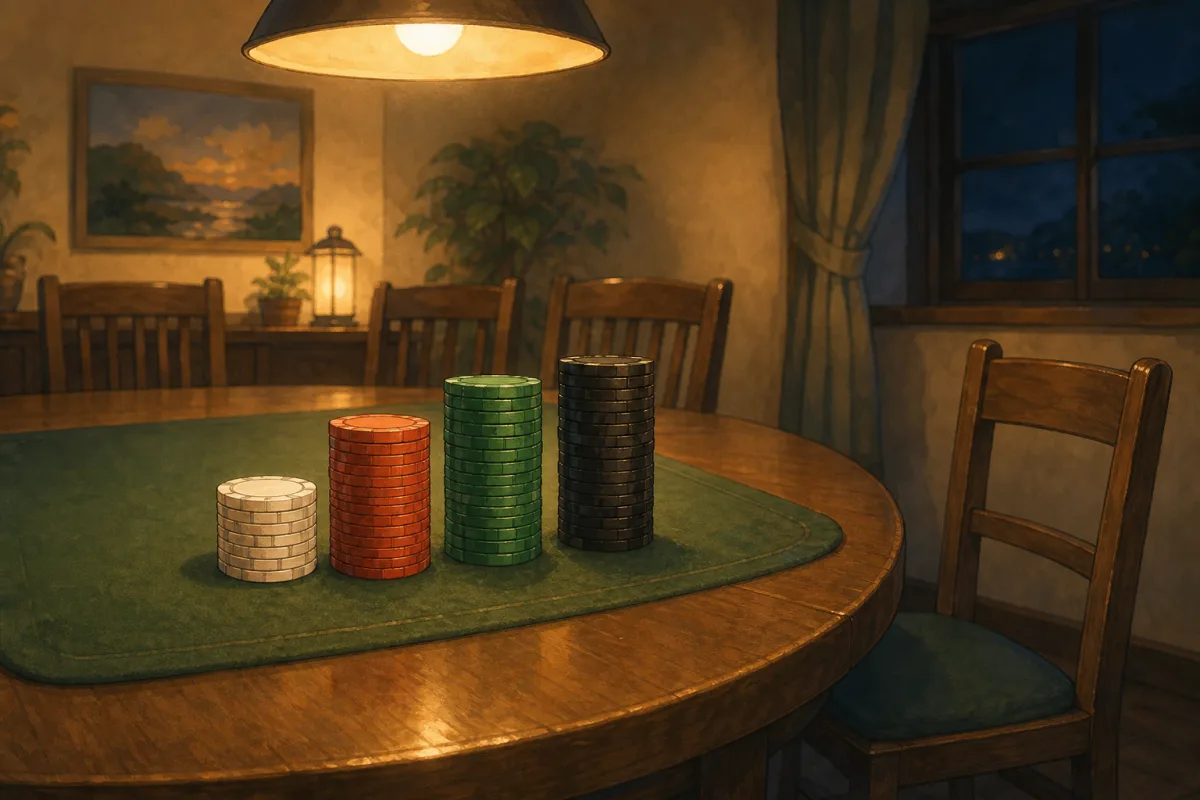
Poker chip values are the dollar amount each colour is worth tonight, not what a collector would pay. Here is the US cash chart and the buy-in splits to print.
Poker chip values are where hosts either save money or waste it. Retail sets ship equal counts per colour with no printed values, so every new guest asks what white is worth. This guide is the cash-game values pillar: a chart you can post at the table, $20 and $50 buy-in splits, and how to order denominated custom chips at factory MOQ.
For total chip inventory - how many pieces for four, five, six, eight, nine, or ten players - start with our how many poker chips for a home game guide. Seat-specific maths: 4 players · 5 players · 6 players · 8 players · 9 players · 10 players. First-set buyers: poker chips for beginners.
Poker chips amounts and value by colour
Hosts searching poker chips amounts usually need both answers at once: how many chips of each colour and what each colour is worth.
| Colour | Standard US cash value | Typical role |
|---|---|---|
| White | $1 | Blinds, limps, change |
| Red | $5 | Workhorse - most pots |
| Green | $25 | Rebuys, deeper stacks |
| Black | $100 | High buy-ins only |
| Purple | $500 | Rare at home |
Rule: colour is a convention, not a guarantee - print $1 / $5 / $25 / $100 on custom chips or post this chart before hand one. Tournament nights reuse the same hues for unitless points (green 25, black 100) - never mix cash and tournament values in the same pot without a published conversion.
Amounts per player at $1/$2 ($200 buy-in): 20 white ($1) + 16 red ($5) + 8 green ($25) = 44 chips, $300 face. Multiply by seats, then add 20–30% bank - that is your order quantity, not an equal split of a retail tin.
What Are Poker Chip Values?
Poker chip values answer one question: how much is this piece worth at your table right now? In a cash game, that is real money - a red chip might be $5. In a tournament, chips are scoring tokens with no cash value until payout - a green chip might be 25 points, not $25.
Three rules every host should post before dealing:
| Rule | Cash game | Tournament |
|---|---|---|
| What values mean | Dollars (or local currency) | Unitless points |
| Who sets them | House rule or printed on chip | Structure sheet + printed face |
| Can guests cash out? | Yes - at agreed rates | Only via published payout table |
Retail sets ship colours without numbers. That is why guests ask “what is white worth?” every session until you print denominations on custom chips or tape a values chart to the wall. Denominated poker chips - each colour printed with $1, $5, $25, or your stakes - remove that friction permanently. The sections below give both - a chart you can reference and buy-in splits you can scale to a factory order.
What Are Poker Chips Worth? (Two Different Questions)
Searchers type "what are poker chips worth" for two reasons - and Google often mixes them. Routing rule: if you mean tonight's face value by colour, stay on this page; if you mean should I buy custom vs retail, open the worth-it guide instead.
| Question | What it means | Read this |
|---|---|---|
| What is each chip worth at my table? | Denomination value - e.g. red = $5 tonight | This guide - charts and buy-in splits below |
| Are custom chips worth the money vs retail? | Purchase ROI - durability, feel, MOQ | Are custom poker chips worth it? |
| What are old casino chips worth? | Collectible resale - rare rooms, discontinued moulds | Not our lane - check auction guides; we sell new custom sets |
At the felt: poker chip values are whatever the host posts before the first hand. A white chip is not automatically $1 until you say so - casinos print values on the face for that reason. Home hosts who rotate guests should print denominations or keep a values chart visible.
Quick denomination answer for US cash: $1 / $5 / $25 / $100 on the standard ladder - never mix tournament point chips (25 / 100 / 500) into a cash pot without a published conversion. Full dual-format inventory rules: one set for tournament and cash.
Gambling chips value: cage, home table, and collectibles
Gambling chips value is a phrase that pulls three different answers - and mixing them up costs hosts money:
| Question | What "value" means | Where to read |
|---|---|---|
| What is this chip worth tonight? | Face value at your table - e.g. green = $25 | This guide - charts below |
| What does the casino pay at the cage? | Printed denomination on house chips only | Cage window - not home blanks |
| What is an old chip worth on eBay? | Collectible resale - rare rooms, discontinued moulds | Auction guides - not Poker Foundry |
Casino gambling chips carry printed denominations and house serials - the cage cashes their chips at face until the room retires a mould. Home blanks have no intrinsic value until the host posts a ladder. Custom denominated chips bridge the gap: guests read $5 on the face like a cage chip, but you set the ladder.
Are poker chips worth money? at a home game means can I cash this colour out for dollars tonight? - yes, at your posted rate. It does not mean will this stack appreciate on Collectors.com (usually no for modern custom sets). Purchase ROI lives in are custom poker chips worth it?.
Poker chip values chart vs generic guides (what most articles miss)
Most poker chip values articles stop at "white $1, red $5" - accurate but incomplete for hosts ordering a set. Guides from poker.org, Spruce Crafts, and hobby blogs explain the ladder; they rarely help you buy the right counts. This page adds what those other guides typically skip:
| Gap in generic guides | What we cover |
|---|---|
| Equal counts per colour in retail tins | Per-player splits for $20 and $50 buy-ins |
| No MOQ maths | Scale to 500 ceramic / 500 clay with bank reserve |
| Cash vs tournament on one shelf | Separate dollar vs point maps - no silent conversion |
| Micro stakes | 25c / $1 / $5 ladders - not just casino $1/$5/$25/$100 |
| Custom order path | Label Studio → instant quote with exact qty × value |
Decision rule: if you already know the ladder and only need how many of each colour, jump to the $20 / $50 / $100 buy-in tables below. If guests still ask “what is white?”, print denominations or tape the chart - colour convention alone is not enough with rotating players.
Print the host chart in the next section, or skip the wall chart entirely by printing values on each chip face.
Denominated poker chips vs colour-only blanks
| Approach | Guest experience | Best when |
|---|---|---|
| Printed denominations on custom chips | Read the face - no house-rule arguments | Rotating players, two stake levels, clubs |
| Colour-only retail blanks | Everyone memorises your ladder | Same eight players, one stakes forever |
| Wall chart + blanks | Works until someone sits out and a guest joins | Tight budget, transitional upgrade |
Custom clay inlays handle small ring text and crests; ceramic suits bold centre numerals and 500-chip minimum orders. Full printing workflow: poker chips with denominations.
Poker Chip Values Chart (US Cash Games)
A poker chip values chart is the fastest way to stop mid-pot questions. Tape it to the wall, share it in the group chat before hand one, or print values on each chip face so the chart lives on the stack itself.
Copy-paste host chart (US cash - post at the table):
| Colour | Value | Role |
|---|---|---|
| White | $1 | Blinds, change, small bets |
| Red | $5 | Workhorse - most pots |
| Green | $25 | Rebuys, deeper stacks |
| Black | $100 | High buy-ins only |
Tournament chart (unitless points - not dollars):
| Colour | Value | Role |
|---|---|---|
| Green | 25 | Starting stacks |
| Black | 100 | Mid levels |
| Purple / blue | 500 | Colour-up target |
| Yellow / gold | 1,000 | Late levels |
Use this as a reference chart for US home cash games. Casinos may vary purple, blue, or yellow at higher limits - always confirm at the cage before you sit.
| Colour | Standard cash value | Typical role |
|---|---|---|
| White | $1 | Blinds, small bets, change |
| Red | $5 | Workhorse - most pots |
| Green | $25 | Rebuys, deeper stacks |
| Black | $100 | High buy-ins, thick stacks |
| Purple | $500 | Rare at home; high-stakes only |
Tournament values (unitless - not dollars):
| Colour | Typical tournament value | Notes |
|---|---|---|
| Green | 25 | Starting stacks |
| Black | 100 | Mid levels |
| Purple / blue | 500 | Colour-up target |
| Yellow / gold | 1,000 | Late levels |
Never cash out tournament point chips at dollar face value without a published conversion. Full dual-format inventory: one set for tournament and cash.
Why charts matter for custom orders: When you quote 200 × $5 and 80 × $25, the factory prints those values on each colour. Guests read the chip - not a whiteboard rule that changes when stakes move. Mock denomination text in Label Studio before you get an instant quote.
Extended colour reference (cash and tournament)
Some rooms add colours above black or use blue / yellow for mid-stakes home games. This table covers what you will see in guides, on TV, and in custom orders:
| Colour | Typical cash value | Typical tournament value | Notes |
|---|---|---|---|
| White | $1 | - | Cash only; rarely used in tournaments |
| Red | $5 | - | Cash workhorse |
| Blue | $10 | 50 | Cash: often skipped (use $5→$25). Tournament: common low-mid step |
| Green | $25 | 25 | Cash rebuys; tournament starting stacks |
| Black | $100 | 100 | Mid-high cash; tournament mid levels |
| Purple | $500 | 500 | High cash; colour-up target |
| Yellow / gold | - | 1,000 | Tournament late levels |
| Orange / grey | $5,000+ | 5,000+ | Rare outside high-stakes rooms |
Home-game shortcut: pick three or four cash values from the left column and ignore the rest until your stakes justify them. Tournament hosts mirror the right column - see tournament chip denominations.
Home vs Casino: When Chip Values Differ
Casino values look universal on TV, but your dining table is not the Bellagio cage. Know where conventions diverge:
| Situation | Casino | Home game |
|---|---|---|
| Colour → value | Printed on chip; cage confirms | Often house rule until you print values |
| Micro stakes | May use $0.50 / $1 chips | 25c / $1 splits are common |
| $10 chip | Sometimes in low-limit rooms | Usually skipped - jump $5 → $25 |
| Tournament chips | Never cashed at face | Same - points only unless you publish conversion |
| Colour-ups | Dealer-driven at breaks | Host posts a swap table at each break |
Practical rule: if your group changes stakes seasonally, print values on custom chips for each colour you use. A $1/$2 winter game and 25c/50c summer game can share one inventory when white = $1 in winter and white = 25c in summer - but only if everyone reads the chip face, not memory from last month.
The 4×–5× Rule (and Why Casinos Skip $10)
Each denomination should be four to five times the one below it. The standard US casino ladder is $1 → $5 → $25 → $100 → $500 - notice no $10 or $50. Those gaps are intentional: close values force players and dealers to break chips constantly.
| Jump | Ratio | Works? |
|---|---|---|
| $1 → $5 | 5× | Yes - standard |
| $5 → $25 | 5× | Yes - standard |
| $25 → $100 | 4× | Yes - standard |
| $5 → $10 | 2× | No - too tight for home cash |
| $1 → $2 → $3 | Mixed | Avoid - three lows that overlap |
Keep it simple: three or four denominations cover 5c/10c through $5/$10 if you pick the right ladder for each blind level. Your job as host-banker is easier when guests can post a raise without asking for change.
Standard US Colour Ladder (Cash Games)
These are conventions - not laws - but they are what most players expect:
| Colour | Typical value | Role |
|---|---|---|
| White | $1 | Blinds, small bets, change |
| Red | $5 | Workhorse - most pots |
| Green | $25 | Rebuys, deeper stacks |
| Black | $100 | High buy-ins only |
| Purple | $500 | Rare at home; high-stakes only |
You do not need every casino colour. A $1/$2 home game often runs on white / red / green alone. Add black when buy-ins routinely exceed $400.
Map Denominations to Your Blinds
Pick denominations from blind size and typical buy-in, not from how many colours came in a retail tin.
Micro stakes (5c/10c – 25c/50c)
| Blinds | Denominations | Notes |
|---|---|---|
| 5c/10c | 5c / 25c / $1 / $5 | Skip 10c - use extra 25c instead |
| 10c/25c | 25c / $1 / $5 / $20 or $25 | $20 vs $25 is host preference |
| 25c/50c | 25c / $1 / $5 / $25 | Classic home ladder |
Buy-in target: 100 big blinds is a comfortable default (e.g. $50 at 25c/50c). Deal mostly 25c and $1 chips - highs are for rebuys, not starting stacks.
Low stakes ($0.50/$1 – $1/$2)
| Blinds | Denominations | Typical buy-in |
|---|---|---|
| $0.50/$1 | $1 / $5 / $25 | $100 (100 BB) |
| $1/$2 | $1 / $5 / $25 / $100 | $200 (100 BB) |
$1/$2 home game poker chip values (printable host chart)
Most US home cash nights run $1/$2 with $100–$300 buy-ins. Post this poker chip colour values block before hand one - or print $1 / $5 / $25 / $100 on custom chips so the chart lives on each stack:
| Colour | Value | Role at $1/$2 |
|---|---|---|
| White | $1 | Small blind, change, limps |
| Red | $5 | Standard opens and calls |
| Green | $25 | Rebuys, 3-bet pots |
| Black | $100 | Deep stacks only - skip if cap is $200 |
Buy-in → per-player split (100 BB default):
| Buy-in | Blinds | Split per player | Physical chips |
|---|---|---|---|
| $100 | $0.50/$1 | 20 × $1, 12 × $5, 2 × $25 | 34 |
| $200 | $1/$2 | 20 × $1, 16 × $5, 8 × $25 | 44 |
| $300 | $1/$2 | 20 × $1, 20 × $5, 8 × $25 | 48 |
Eight-player order maths at $1/$2, $200 cap (split above + 25% bank):
| Value | Per player | × 8 | + bank | Order qty |
|---|---|---|---|---|
| $1 | 20 | 160 | 40 | 200 |
| $5 | 16 | 128 | 32 | 160 |
| $25 | 8 | 64 | 16 | 80 |
| Total | 44 | 352 | 88 | ~440 |
That sits under 500 clay MOQ - pad with extra $5 chips. Get an instant quote at 440+ with denominations printed on each colour.
$1/$2 per-player starting split (deep stack, ~44 physical chips):
| Denomination | Chips / player | Value |
|---|---|---|
| $1 | 20 | $20 |
| $5 | 16 | $80 |
| $25 | 8 | $200 |
| Total | 44 | $300 |
Scale down chip counts if your group buys in lighter - keep the ratio (plenty of $5s, fewer $25s).
Mid stakes ($2/$5 – $5/$10)
| Blinds | Denominations | Typical buy-in |
|---|---|---|
| $2/$5 | $1 / $5 / $25 / $100 | $500–$1,000 |
| $5/$10 | $5 / $25 / $100 / $500 | $1,000–$2,000 |
At $5/$10, drop $1 entirely - opens with $5 and $25 as the workhorse pair. $100 and $500 handle rebuys; most inventory still sits at $5 and $25.
Standard Poker Chip Set Distribution for a $50 Buy-In Home Game
Searchers ask for a standard poker chip set distribution for a $50 buy-in home game because retail cases ship equal counts per colour - typically 50 white / 50 red / 50 green / 50 black - which does not match how hosts actually deal $50 at 25c/50c. That equal split leaves you short on 25c and $1 chips and overweight on $5 and $100 you never open.
| Retail tin (wrong for $50 night) | Host split (correct for 100 BB) |
|---|---|
| 25% of each colour | ~49% low (25c), 37% mid ($1), 15% high ($5) |
| Guests fight for change | Opens and rebuys run without breaking every pot |
| No printed values | Denominated poker chips show 25c / $1 / $5 on the face |
Distribution rules for a $50 buy-in home game:
| Distribution element | Rule |
|---|---|
| Buy-in | $50 = 100 BB at 25c/50c |
| Denominations | 25c / $1 / $5 only - skip 10c and $10 |
| Per-player split | 20 × 25c, 15 × $1, 6 × $5 (41 chips, $50 face) |
| Chips per player | Mostly 25c and $1 - highs for rebuys only |
| Full table (8 players) | ~410 chips including 25% bank |
| MOQ fit | Under 500 clay - pad with extra $1 chips |
Poker chip distribution for a $50 buy-in scales linearly: multiply the per-player row by seated players, add 20–30% bank, then round up to your factory MOQ (500 ceramic or 500 clay). Pick body colours from the standard poker chip colours guide - values matter more than hue, but consistent colour → value mapping helps regulars.
The same split works for denominated custom poker chips - print 25c, $1, and $5 on each colour so the distribution is obvious to new guests.
Poker Chip Values for a $100 Buy-In Home Game
A $100 buy-in at $1/$2 is a 50 big blind cap - common for weeknight games that still want real-money feel without $200 deep stacks. Three denominations only:
| Colour | Value | Chips / player | Player total |
|---|---|---|---|
| White | $1 | 15 | $15.00 |
| Red | $5 | 12 | $60.00 |
| Green | $25 | 1 | $25.00 |
| Total | 28 | $100.00 |
Want more playable chips in hand? Deal 20 × $1, 12 × $5, 2 × $25 ($160 face) but post a $100 table cap - guests rebuy from the bank when busted.
Eight-player inventory at $100 cap (15 × $1, 12 × $5, 1 × $25 per player + 25% bank):
| Value | Per player | × 8 | + bank | Order qty |
|---|---|---|---|---|
| $1 | 15 | 120 | 30 | 150 |
| $5 | 12 | 96 | 24 | 120 |
| $25 | 1 | 8 | 2 | 10 |
| Total | 28 | 224 | 56 | ~280 |
That sits under 500 ceramic MOQ - pad with extra $1 or $5 chips to reach 500 exactly. Mock $1 / $5 / $25 faces in Label Studio before you quote.
For 100 BB depth at $1/$2, use the $200 split in the $1/$2 home game chart section above instead.
Poker Chip Values for a $50 Buy-In Home Game
A $50 buy-in most often means 100 big blinds at 25c/50c - the common “friendly stakes” night. Assign values before the first hand:
| Colour | Value | Chips / player | Player total |
|---|---|---|---|
| White | 25c | 20 | $5.00 |
| Red | $1 | 15 | $15.00 |
| Green | $5 | 6 | $30.00 |
| Total | 41 | $50.00 |
Eight-player set order (×8 players + 25% bank):
| Value | Per player | × 8 | + bank | Order qty |
|---|---|---|---|---|
| 25c | 20 | 160 | +40 | 200 |
| $1 | 15 | 120 | +30 | 150 |
| $5 | 6 | 48 | +12 | 60 |
| Total | 41 | 328 | +82 | ~410 |
That sits under a 500-chip clay MOQ - pad with extra $1 or $5 chips rather than adding a fourth close value. At $1/$2 with a $50 cap (25 BB), drop $5 from the starting stack and deal 30 × $1 + 10 × $5 instead - same total, slower bust-outs.
Poker Chip Values for a $20 Buy-In Home Game
Poker chips for a $20 buy-in suit micro stakes (5c/10c or 10c/25c) or short-stack friendly weeknights. Keep three denominations only - adding a fourth close value slows every pot:
10c/25c blinds - $20 (80 BB)
| Value | Chips / player | Player total |
|---|---|---|
| 10c | 15 | $1.50 |
| 25c | 20 | $5.00 |
| $1 | 14 | $14.00 |
| Total | 49 | $20.50 |
Trim one 10c chip if you want an exact $20 stack.
25c/50c blinds - $20 (40 BB, short)
| Value | Chips / player | Player total |
|---|---|---|
| 25c | 20 | $5.00 |
| $1 | 10 | $10.00 |
| $5 | 1 | $5.00 |
| Total | 31 | $20.00 |
Short stacks play faster - fine for a weekday $20 cap. For 100 BB at 25c/50c, use the $50 split above and agree a $50 minimum buy-in.
Inventory tip: $20 nights burn through 25c and $1 chips first. Order 4:3:2 across low → mid values; see poker chip bank guide for reserve sizing.
Full-table order maths - poker chips for $20 buy-in (8 players)
Hosts sizing a micro-stakes case often search poker chips for $20 buy in - face-value splits, not tournament points. Use the 25c/50c short stack above, then multiply:
| Value | Per player | × 8 | + 25% bank | Order qty |
|---|---|---|---|---|
| 25c | 20 | 160 | 40 | 200 |
| $1 | 10 | 80 | 20 | 100 |
| $5 | 1 | 8 | 2 | 10 |
| Total | 31 | 248 | 62 | ~310 |
Pad to 500 ceramic MOQ with extra $1 chips - better than adding a fourth value. Eight-player cash totals: how many poker chips for 8 players.
Poker chip values for a $5 or $10 buy-in night
Not every game runs on $50–$100 buy-ins. Family nights, first games, and office tables often cap at $5 or $10. The mistake is shrinking to one colour instead of keeping three values you can actually bet with.
$5 buy-in (5c/10c or 10c/25c, 20–50 BB)
| Value | Chips / player | Player total |
|---|---|---|
| 5c | 20 | $1.00 |
| 25c | 12 | $3.00 |
| $1 | 1 | $1.00 |
| Total | 33 | $5.00 |
That is a small, real stack - enough to call, raise, and rebuy once without making change every hand. Skip $5 chips entirely at this size; they are too coarse to bet with.
$10 buy-in (10c/25c, 40 BB)
| Value | Chips / player | Player total |
|---|---|---|
| 10c | 15 | $1.50 |
| 25c | 18 | $4.50 |
| $1 | 4 | $4.00 |
| Total | 37 | $10.00 |
Full-table order for a $10 buy-in (8 players + 25% bank):
| Value | Per player | × 8 | + 25% bank | Order qty |
|---|---|---|---|---|
| 10c | 15 | 120 | 30 | 150 |
| 25c | 18 | 144 | 36 | 180 |
| $1 | 4 | 32 | 8 | 40 |
| Total | 37 | 296 | 74 | ~370 |
Micro-stake nights burn 10c and 25c fastest. Weight the order toward the two lowest values and keep a handful of $1 chips for rebuys. If your group grows into $20 or $50 buy-ins, the split tables above scale without changing the colour ladder.
Standard poker chip set distribution - quick reference (6, 8, and 10 players)
Copy this block when guests ask for a standard poker chip set distribution without re-reading every stakes section above. All tables assume US cash values and 25% bank - adjust bank to 30% if rebuys run hot.
$50 buy-in at 25c/50c (100 BB) - per-player split: 20 × 25c, 15 × $1, 6 × $5
| Players | 25c | $1 | $5 | Total chips |
|---|---|---|---|---|
| 6 | 120 | 90 | 36 | ~310 |
| 8 | 160 | 120 | 48 | ~410 |
| 10 | 200 | 150 | 60 | ~510 |
$20 buy-in at 25c/50c (40 BB short) - per-player split: 20 × 25c, 10 × $1, 1 × $5
| Players | 25c | $1 | $5 | Total chips |
|---|---|---|---|---|
| 6 | 120 | 60 | 6 | ~230 |
| 8 | 160 | 80 | 8 | ~310 |
| 10 | 200 | 100 | 10 | ~390 |
Denominated poker chips make these splits obvious at the table - print 25c, $1, and $5 on each colour so rotating guests do not re-ask every session. Design faces in Label Studio, then get an instant quote at your padded quantity.
Custom ROI vs face value: if you landed here asking whether custom chips are worth the money, that is a different question - read are custom poker chips worth it?. This section only covers what each chip is worth tonight.
Scale Splits to a Full Set Order
Multiply per-player counts by seated players, then add bank.
Example - $1/$2, eight players, split above:
| Denomination | Per player | × 8 players | + 25% bank | Order qty |
|---|---|---|---|---|
| $1 | 20 | 160 | +40 | 200 |
| $5 | 16 | 128 | +32 | 160 |
| $25 | 8 | 64 | +16 | 80 |
| Total | 44 | 352 | +88 | ~440 |
That is below a 500-chip clay minimum - add $100 chips or extra $5/$25 to reach a sensible custom order and leave headroom for deeper buy-ins. For 6–9 player weekly games targeting ~700 chips, see the inventory tables in our home game sizing guide.
Inventory ratio rule: across the full set, weight low denominations heaviest - roughly 4:3:2:1 from lowest to highest. Running out of $5 mid-session hurts more than running out of $100. For a different buy-in or seat count, the cash game chip distribution calculator repeats this maths from your own numbers.
Cash vs Tournament on the Same Inventory
Many hosts run Friday cash and monthly tournaments. The mistake is reusing the same printed values for both.
| Game type | Values on chip | Example |
|---|---|---|
| Cash | Real money | $1 / $5 / $25 / $100 |
| Tournament | Unitless points | 25 / 100 / 500 / 1,000 |
Options:
- Separate colour maps - cash values on four colours; tournament points on four different colours (best clarity).
- Tournament-only nights - agree all chips are points with no cash value; store cash chips separately.
- Colour-up mid-tournament - remove low point chips at breaks; see tournament denominations.
Never cash out tournament point chips at dollar face value without a published conversion - that is how hosts lose money.
When Custom Denominations Beat Retail Splits
Retail sets ship equal-ish counts per colour (100 white, 50 red, 50 green…) regardless of your stakes. That works for one blind level and falls apart when you move from 25c/50c to $1/$2.
Custom chips let you specify:
- Exact counts per denomination (200 × $5, 80 × $25, not a generic ratio)
- Printed values on each colour so new players never guess
- Club branding on the ring while values stay readable
Clay inlay labels handle small type and crests sharply; ceramic direct print suits heavy weekly cash with 500-chip minimums - optional Full Chip Customisation adds custom body and edge spots per denomination; clay customises the inlay only. Mock ring text in Label Studio - free in the quote flow - then get an instant quote at your exact denomination split.
Common Cash Denomination Mistakes
| Mistake | Why it hurts | Fix |
|---|---|---|
| $5 and $10 together | Constant breaking; slower pots | Drop $10; jump $5 → $25 |
| Too many colours (6+) | Painful cash-outs; wasted order cost | Cap at 4–5 for cash |
| Equal counts per colour | Runs out of lows, floods highs | Weight 4:3:2:1 to lows |
| No printed values | Guests ask every hand | Print stakes on custom chips |
| Same chips for cash + tournament | Cash-out disputes | Separate maps or separate nights |
| Ordering without a split table | Wrong mix at MOQ | Write qty × value before quoting |
Quick Checklist Before You Quote
- Write your blinds - e.g. $1/$2, $200 buy-in
- Pick 3–4 denominations - 4×–5× apart
- Draft per-player chips - mostly lows and mids
- Multiply by seats + 25% bank - that is your order split
- Check MOQ - 500 ceramic, 500 clay; pad lowest denominations if under minimum
- Price the split - instant quote with quantity and material
Next Steps
Match cash game poker chip denominations to how your table actually plays - not to whatever split a retail case happened to include. Three or four well-spaced values, printed on the chip face, beat a sixth colour nobody needs.
Ready to order a set built to your $1/$2 or 25c/50c split? Start on custom poker chips, then pick custom clay poker chips or custom ceramic poker chips and get an instant quote - itemised in under a minute. Still choosing material? How to choose custom poker chips and clay vs ceramic cover feel and artwork. After delivery, store chips dry in a lined case so denominations stay crisp for years.