

Cézanne's Card Players: The Poker-Face Paintings That Changed Art
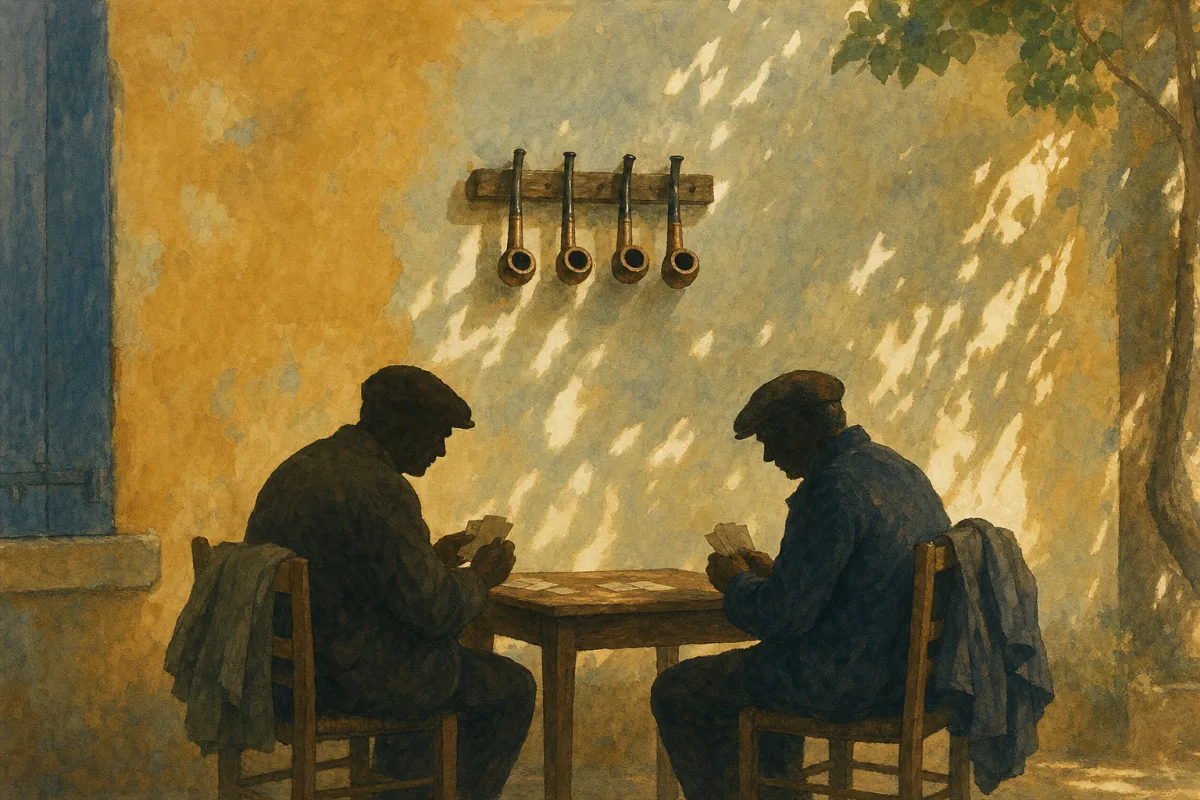
Paul Cézanne painted five versions of The Card Players in the 1890s - farmhands from his father's estate, faces lowered, no money on the table. The series became one of art history's most valuable poker-adjacent images and the template David Hockney riffed on in 2015.
This article is about painting, not chip orders - but the same quiet table is what hosts recreate with custom casino-grade chips when they want a serious room.
Why Cézanne returned to the card table
By the 1890s, Cézanne was in his fifties, painting Mont Sainte-Victoire, still lifes, and bathers - yet he spent years on men playing cards. The subject was not new. Caravaggio had painted cheats; Le Nain and Chardin had shown peasants at games. Cézanne's wager was different: strip away anecdote until only structure and patience remain.
He began with studies of individual models - workers from Jas de Bouffan, his family's estate near Aix-en-Provence. Technical examination by the Metropolitan Museum of Art shows he started with the smallest two-figure compositions and worked up to the multi-player scenes, repeatedly adjusting hands, hats, and table edges. Unresolved details - an absent hand here, a halo of repainted contour there - reveal an artist thinking through space, not illustrating a punchline.
For the material history of what later sat on such tables - once chips replaced coins - see our history of poker chips.
The five paintings: from crowd to duel
| Version (approx. date) | Location | Players | Character |
|---|---|---|---|
| Multi-figure | Metropolitan Museum of Art, New York | Four around a table | Compact, early struggle with grouping |
| Multi-figure | Barnes Foundation, Philadelphia | Five - largest canvas | Monumental, hieratic spacing |
| Two-figure | Musée d'Orsay, Paris | Pair | Pared back, strong verticals |
| Two-figure | Courtauld Gallery, London | Pair | Undefined room - pure ritual |
| Two-figure | Private collection | Pair | Reported ~$250m sale (2011) |
The Courtauld describes its canvas as "refined down to two men seated across a table in undefined surroundings" - faces turned to the cards, the game a shared trance. The Met notes Cézanne channelled the quiet authority of the multi-figure version into the Barnes masterpiece, where four pipes on the wall rhyme with the four seated players like a still-life grammar.
None of these rooms show denomination stacks or colour-coded racks. That omission is deliberate. Cézanne is not painting casino logistics - he is painting the moment before a decision.
Poker face before the phrase existed
Before televised hole cams, before sunglasses at the table, Cézanne gave card players emotional neutrality. Compare:
| Artist / work | Expression | Storytelling |
|---|---|---|
| Caravaggio, The Cardsharps | Drama, deception | Hidden cards, signals - our Caravaggio guide |
| Le Nain brothers | Anecdote, moralising | Genre-scene humour |
| Cézanne, Card Players | Stoic focus | Almost still life with humans |
| Coolidge, Dogs Playing Poker | Comedy, bluff | Calendar art and cigar ads |
| Hockney, A Bigger Card Players | Friendship, observation | Studio homage to Cézanne |
The Met's curators compare the multi-figure composition to an Egyptian relief - figures locked in place, yet brushwork keeps surfaces alive. That tension - frozen pose, shifting light - is exactly what a live player reads as unreadable.
Art writers sometimes ask whether the game is baccarat, gin rummy, or another French provincial pastime. For poker hosts the label matters less than the posture: shoulders still, eyes down, time stopped until the next card.
What is - and is not - on the table
Cézanne's tables hold cards and little else. No ivory counters, no clay discs, no stacked plaques - even though compression-moulded chips were emerging in saloons while he painted. He was not documenting equipment; he was studying people who wait.
That choice separates Card Players from manufacturing history (how custom chips are made today) and from structure guides about starting stacks. It also explains why Hockney's 2015 homage keeps stakes implicit - three friends, a folding table, attention as the subject.
When modern hosts do put value on the table, they use uniform chips so players can read stacks at a glance - the opposite of Cézanne's deliberate vagueness. Clay label inlays and ceramic direct print both serve that clarity; see clay vs ceramic if you are choosing a line.
Record prices and museum walls
The 2011 private sale - widely reported at roughly $250 million for one two-figure canvas - shocked even an art market used to eight-figure Impressionists. Public institutions hold the other landmark versions:
- 2011 exhibition Cézanne's Card Players united the series with studies and X-radiographs (Met + Courtauld collaboration)
- Barnes Foundation keeps the largest multi-figure painting in its Merion / Philadelphia collection
- Musée d'Orsay and the Courtauld anchor the two-player variants in Paris and London
You will not see these canvases in a poker room - but their influence is everywhere: album covers, film production design, and Hockney's photographic drawings at the Toledo Museum of Art.
Lessons for hosts - without pretending to be Cézanne
You are not curating a $250 million wall. You are curating attention:
| Cézanne principle | Home-game translation |
|---|---|
| Plain furniture | A stable table beats décor - felt, light, comfortable chairs |
| No visual noise | Keep drinks off the rail, phones away, one clear pot |
| Faces to the cards | Deal readable stacks - players should not squint at denominations |
| Time slows | Blind structure and breaks that let hands breathe |
The physical chip is Cézanne's opposite - colour-coded value you can count - but the mood is the same: respect the hand in front of you.
When your room is ready for casino-grade weight and artwork, get an instant quote - itemised, commitment-free.
What remains
Cézanne's Card Players will never teach you a blind structure or a colour-up schedule. They teach something rarer: dignity at a small table - the idea that cards among working men deserve the same seriousness as a mountain or an apple.
Hockney knew that when he set up a folding table with friends. Coolidge knew a different truth - that the same scene could be funny. All three belong to one culture: people who stay when the card is turned. For the American literary branch of that same obsession - steamboat draw, courtroom Science vs. Luck - see Mark Twain and poker.