
David Hockney and Poker: Remembering the Artist Behind "A Bigger Card Players"
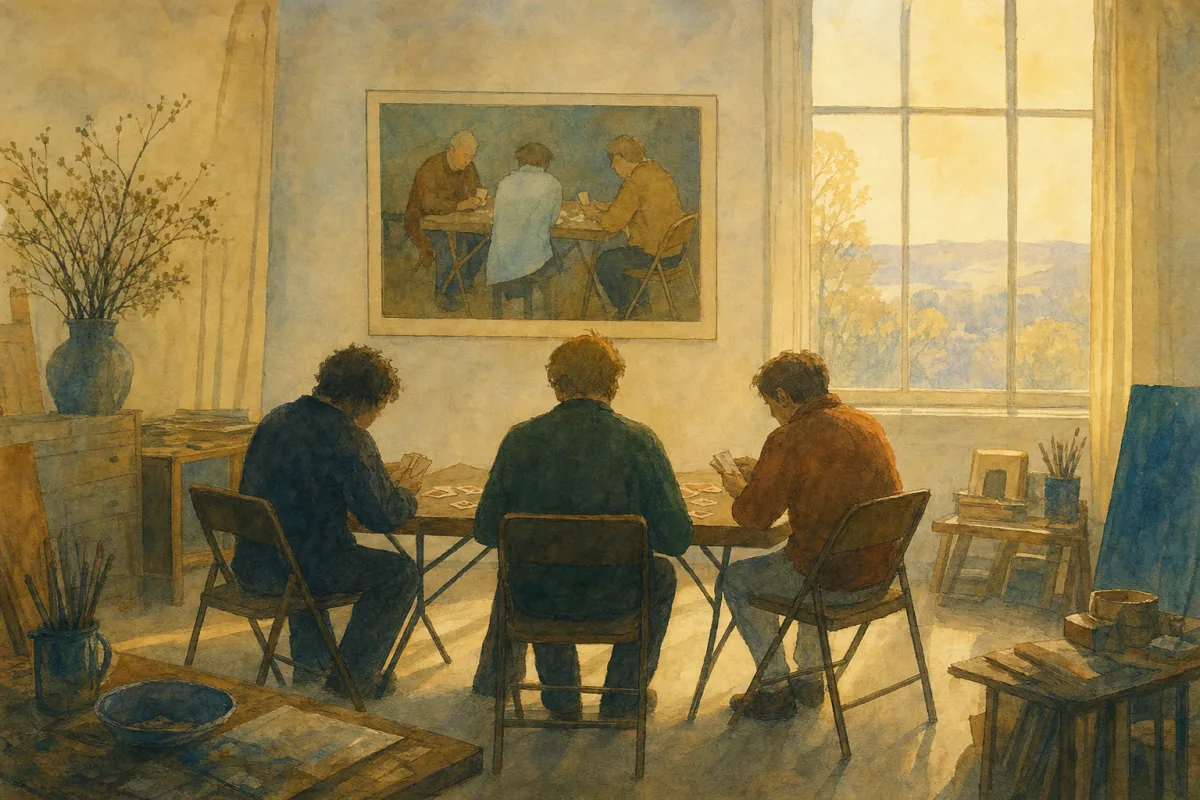
David Hockney died peacefully at home in London on 11 June 2026, aged 88. His link to the card table lives on in "A Bigger Card Players" - three friends, a folding table, and a conversation with Cézanne.
This is a brief appreciation, written with respect for his family, friends, and studio colleagues.
Remembering David Hockney
David Hockney was among the most influential British artists of the last century - a painter of California pools, Yorkshire lanes, double portraits, and, in his eighties, iPad landscapes drawn from a Normandy garden. His representatives said he passed peacefully at home on 11 June 2026, a month short of his 89th birthday.
He is survived by his partner Jean-Pierre Gonçalves de Lima, his brothers Philip and John, his great-nephew Richard (who assisted in the studio in recent years), and a wide family circle. Tributes from the BBC, The Independent, and galleries worldwide have remembered an artist of restless curiosity, warmth, and extraordinary visual intelligence.
In a 2023 interview, Hockney spoke about death without fear - calling life an adventure and insisting artists live in now. That urgency to see clearly - to stay present - runs through six decades of work.
Why card players appear in Hockney’s late work
Long before poker chips were standardised in casinos, painters treated the card table as a subject for concentration and companionship. Caravaggio's The Cardsharps (1594) fixed cheating and collusion as drama - see our Caravaggio Cardsharps guide. Paul Cézanne’s The Card Players (1890s) is the reference point - we unpack the full series in Cézanne’s Card Players: art history at the table. Provençal men in a plain interior, faces lowered toward their hands. Art historians identify the game as a French card game of the period - not modern hold’em - but the posture is universal. Three or four people, a simple table, the outside world paused.
In 2015, Hockney opened David Hockney: Painting and Photography at Annely Juda Fine Art in London and L.A. Louver in Venice, California. At its heart was A Bigger Card Players - “bigger” in the same spirit as A Bigger Splash and A Bigger Grand Canyon: not a copy, but a Hockney-scaled conversation with an old master.
He also made A Bigger Scrabble Players the same year - the same studio, the same friends, a different game. Cards were not a one-off prop. They were a way to study how people look when play demands their full attention.
For broader context on how the card table entered gambling culture, see our history of poker chips - a separate story about tokens and manufacture, not painting, but part of the same social world Hockney looked at sideways.
A Bigger Card Players: what Hockney made
| Element | What Hockney did |
|---|---|
| Subject | Three men at a folding card table in the studio |
| Medium | Oil paintings first, then photographic drawings (edition of 12) |
| Technique | Close-up photographs of heads, jackets, shirts, shoes - each with its own vanishing point, collaged into one image |
| Homage | Cézanne’s card players - and, in some compositions, Hockney’s own painting of the scene on the wall behind the sitters |
| Stated aim | An “almost 3D effect without the glasses” - putting the viewer inside the picture |
The Toledo Museum of Art, which acquired a photographic drawing in 2015, describes the utilitarian folding table as furniture for competitive play among friends - far from gilded salon tables, closer to an ordinary room where people gather.
In his own words, quoted in the Christie’s catalogue for an edition of the work:
“I made the paintings of the card players first. That helped me work out how to photograph them… Each photograph has a vanishing point, so instead of just one I get many vanishing points.”
The result is not documentary photography. It is looking - the same quality Cézanne brought to peasants who never hurried a hand.
Perspective and the card table
Hockney spent decades questioning single-point perspective - the “void” between viewer and photograph. At the card table he found a human-scale subject: bodies leaning in, trapezoidal table edges, hands below the frame.
The BBC covered the 2015 exhibition as a lesson in how painters bend space to match how we actually see. Anyone who has sat at a full table knows a version of that - the pot that looks larger from one chair, the player across the felt who never looks up from their cards.
Hockney was not illustrating a rule book. He was recording attention - the slight forward lean, the shared silence before the next card.
The card table as a social room
Hockney did not need a casino to make the scene credible. He needed friends, a folding table, and time.
| What the painting holds | Why it endures |
|---|---|
| Plain furniture | The game, not the décor, holds attention |
| Downward gaze | Faces turned to the cards, not the room |
| Small group | Three in the frame; intimacy over spectacle |
| Studio as living room | No velvet rope - cards as private ritual |
There is no widely reported record of Hockney as a poker player in the press or biographies we rely on. His gift is observation - the decision to treat an everyday card game with the same seriousness he gave a swimming pool or a Yorkshire wood. For the comic American opposite - anthropomorphic dogs bluffing on a calendar print - see Dogs Playing Poker painting history.
What remains
David Hockney showed generations how to look again - at light on water, at a lane in winter, at three friends who agreed to sit still while he studied them at play. A Bigger Card Players will outlive the folding table it depicts. That is what art does.
Our thoughts are with Jean-Pierre, his family, and everyone who worked beside him in the studio. If you gather friends around cards this week, there is no need to make it about anything except the people at the table.