

History of Poker Chips: Evolution from Ivory to Casino-Grade
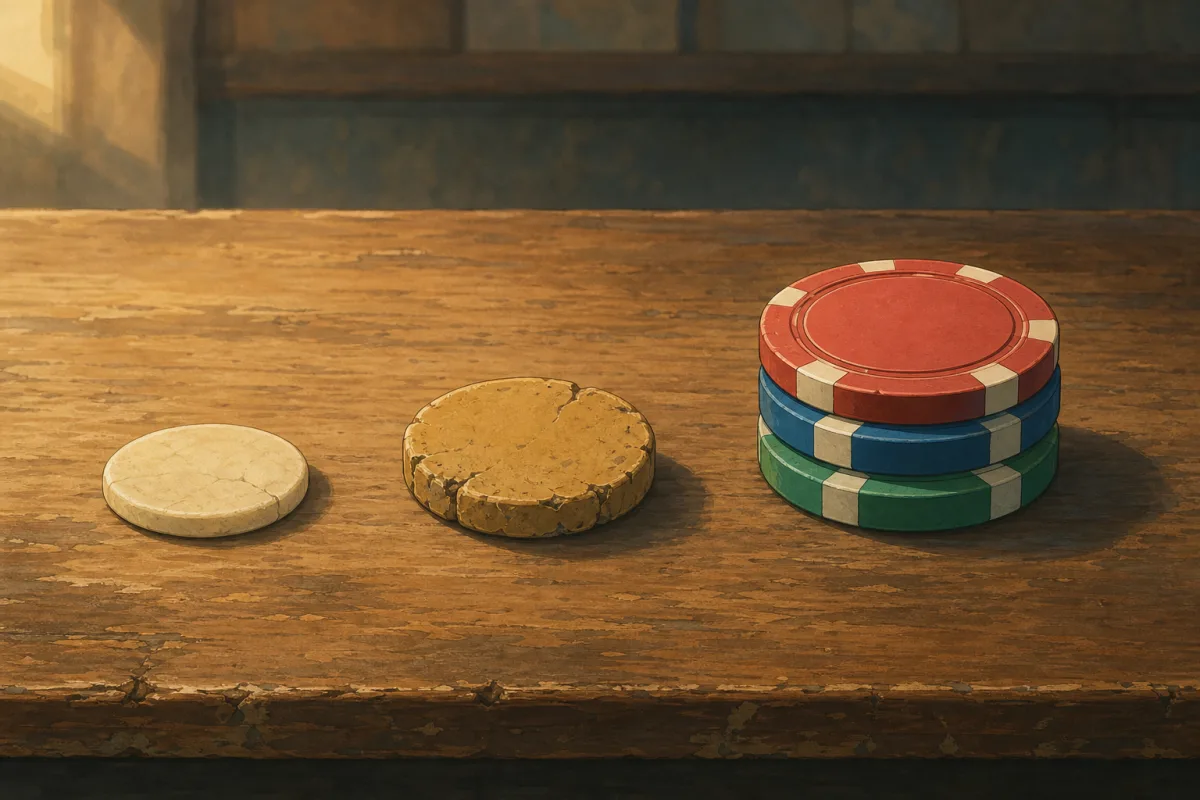
Poker chips did not start as colourful stacks on felt. From gold dust and carved ivory to compression-moulded clay and modern ceramic composite - here is how the token in your hand got here.
Poker is older than the chip in your hand. For decades on the American frontier and in early saloons, “buying in” meant whatever had value at the table. The modern stack - uniform weight, colour-coded values, a satisfying click when it hits felt - is the product of centuries of trial, fraud, and factory engineering. Painters caught that same table long before factories did - from Caravaggio’s The Cardsharps and Cézanne’s Card Players to Coolidge’s Dogs Playing Poker and David Hockney’s A Bigger Card Players; we marked Hockney’s 2026 passing in David Hockney and poker: a card-players tribute.
This guide walks through the history of poker chips era by era: what players used before casinos standardised tokens, how clay composite replaced brittle pure clay, why ceramic joined the lineup, and what that timeline means if you are upgrading a home game or club set today.
Before Standard Chips: Gold, Coins, and Carved Tokens
In the 1800s, poker spread alongside frontier gambling. Stakes were rarely neat:
- Gold dust and nuggets - common in mining camps; weighing and purity disputes were constant.
- Coins and paper money - convenient until players bent rules, palmed extra bills, or argued over change.
- Ivory, bone, and wood - carved or turned disks stood in for value; wealthier games used ivory as a prestige token.
- Generic counters - buttons, shells, and odd lot tokens filled gaps when nothing else was handy.
None of this scaled. A crowded table needs identical size, trusted colour coding, and tokens that survive shuffling without splintering. Saloons and early casinos pushed toward a factory-made answer.
The 1880s: Compression-Moulded Clay Arrives
By the late nineteenth century, manufacturers began compression-moulding clay into chips of uniform diameter and thickness - often with a centre inlay or stamp for the house name. These are the direct ancestors of today’s casino clay line.
Why clay won early casinos
| Advantage | Why it mattered |
|---|---|
| Uniform size | Faster dealing and stacking |
| Distinct colours | Denominations visible at a glance |
| House branding | Inlays and edge patterns reduced simple fakes |
| Better feel than bone or wood | Dense enough to stack, familiar to regular players |
The trade-off was durability. Near-pure clay chips cracked and chipped under rough handling - colours faded, edges crumbled, and operators replaced sets constantly. “Clay” on a modern product page almost never means 100% clay anymore; it means clay composite, and that shift is the next chapter.
The 1950s: Clay Composite Replaces Fragile Pure Clay
Through the early twentieth century, chip makers experimented with additives - sand, chalk, and synthetic binders - mixed into clay before moulding. By the 1950s, the industry settled on clay composite: still moulded and still marketed as “clay,” but engineered for strength, consistent weight, and colour stability.
That recipe is still what players mean by casino clay:
- Compression or injection moulding with proprietary blends (each major manufacturer guards its mix).
- Printed label inlays recessed in the face for artwork and denominations.
- Classic bevelled edge and textured surface - the feel associated with WSOP broadcasts and live poker rooms.
- 10g became the practical casino standard (some properties use 8.5–9.5g; premium custom lines target 10g).
If you have handled a quality live-room chip, you have handled this generation - not a nineteenth-century pure-clay disc.
Plastic and the Home-Game Explosion
Casino innovation ran in parallel with mass-market plastic. From the mid-twentieth century onward, injection-moulded ABS sets - often with stickers or shallow labels - filled department stores and, later, online marketplaces.
Plastic did not replace casino clay; it democratised poker:
- Low cost for casual hosts and families.
- Light weight (often under 10g) - portable, but prone to tipping stacks.
- Generic colour schemes not tied to your stakes.
For millions of players, “poker chips” means a $27–$68 tin case. That is a valid entry point - but it is a different product category from compression-moulded clay or ceramic composite. When weekly hosts outgrow peeling stickers and wobbly towers, they are really crossing a 150-year material timeline in one upgrade. Our upgrade from plastic guide covers that jump honestly.
The 1980s: Ceramic Composite Enters the Casino
In the mid-1980s, manufacturers introduced ceramic casino chips - not pottery, but a dense ceramic composite body moulded under pressure, with artwork applied directly to the chip face (no separate paper inlay label).
Casinos adopted ceramic for practical reasons:
- High impact tolerance - suited to constant shuffling and rack handling.
- Flat edge profile - distinct handling feel from bevelled clay.
- Bonded face print - no label layer to lift at the edges (the same printable face area as clay inlays on modern custom lines).
Ceramic did not “replace” clay worldwide - many rooms still run clay composite exclusively, and some use both for different games or denominations. The two materials coexist today the same way they do in the clay vs ceramic comparison for custom buyers.
The Modern Era: Security, RFID, and Custom Home Sets
From the 1990s onward, chip evolution split into casino security and custom branding:
On casino floors
- Edge spots and UV features - pattern recognition for pit and surveillance.
- RFID tags in some high-limit and tournament sets - tracking inventory and detecting counterfeits.
- Specialist manufacturers - a small number of factories supply most major properties; specs are tight and audited.
For a full breakdown of RFID, UV, and what custom buyers can request, see custom poker chips security: RFID and UV.
For home games, clubs, and events
- Direct-to-consumer custom orders - full artwork, printed denominations, club logos.
- Same material families as casinos - clay composite with inlay or ceramic composite with direct print, both at 10g on premium lines.
- Transparent quoting - quantity tiers, packaging, and lead times without opaque distributor markups.
Poker Foundry sits in that modern lane: casino-grade custom chips sourced from gaming-industry manufacturers, with honest material guidance rather than retail sticker sets. Browse the gallery for real customer examples, or read our sourcing story for how we selected suppliers.
Timeline at a Glance
| Era | Typical token | Milestone |
|---|---|---|
| 1800s (early) | Gold, coins, ivory, bone, wood | Improvised stakes; fraud and disputes common |
| ~1880s | Compression-moulded clay | First standardised casino chips |
| 1950s | Clay composite | Durable “clay” blend becomes industry norm |
| Mid-1900s | Plastic / ABS home sets | Mass-market poker for casual players |
| Mid-1980s | Ceramic composite | Alternative casino material; direct face print |
| 2000s–today | RFID, UV, custom MOQs | Security tech + branded home/club orders |
Common Myths About Chip History
| Myth | Reality |
|---|---|
| “Casino chips are 100% clay.” | They are clay composite - clay plus binders. Pure clay alone is too brittle for modern play. |
| “Ceramic chips are pottery.” | Ceramic composite is an engineered gaming material, moulded like clay composite, not fired earthenware. |
| “Ceramic was invented because clay cannot do detail.” | Clay printed inlays still deliver the sharpest fine detail; ceramic’s strengths are no separate label, higher rated durability, and often no separate label - not inherently “better” artwork. |
| “Heavier chips are always older or better.” | 10g is the casino convention; retail 14g ABS is often plastic-heavy, not historically “more authentic.” |
| “Plastic chips are the modern upgrade.” | Plastic is the mass-market branch of the tree; clay and ceramic composite are what serious rooms adopted for durability and feel. |
What This History Means for Your Next Set
Understanding the timeline helps you buy once at the right tier:
- Occasional casual play - retail plastic may still suffice.
- Weekly home games or clubs - move to 10g custom clay or ceramic, the same material families casinos refined after the 1950s.
- Artwork with small type, crests, or photos - lean clay and printed inlay (custom clay chips).
- Heavy play, no paper label, 500-chip minimum - lean ceramic (custom ceramic chips); add Full Chip Customisation in the quote if you need custom body and edge spots per denomination.
The history of poker chips is not museum curiosity - it explains why your guests notice when a plastic stack becomes a composite stack on the first deal. The same card-table obsession runs through painted cheats (Caravaggio, de La Tour, Cézanne), literature (Mark Twain and poker), and film (The Cincinnati Kid, Casino, Rounders, Casino Royale) - different media, same focus at the felt. For a full decision framework, see how to choose custom poker chips; for factory detail, how custom poker chips are made.
Next Steps
You do not need a history degree to order the right set - you need the right material for how often you play and artwork that survives shuffles. The evolution from ivory disks to casino-grade composite took more than a century; upgrading your table can take a few minutes in the quote tool.
Ready to configure a set with your denominations and design? Get an instant quote - itemised pricing, no sales call, commitment-free in under a minute.