

Poker Chip Size and Dimensions: 39mm Casino Specs
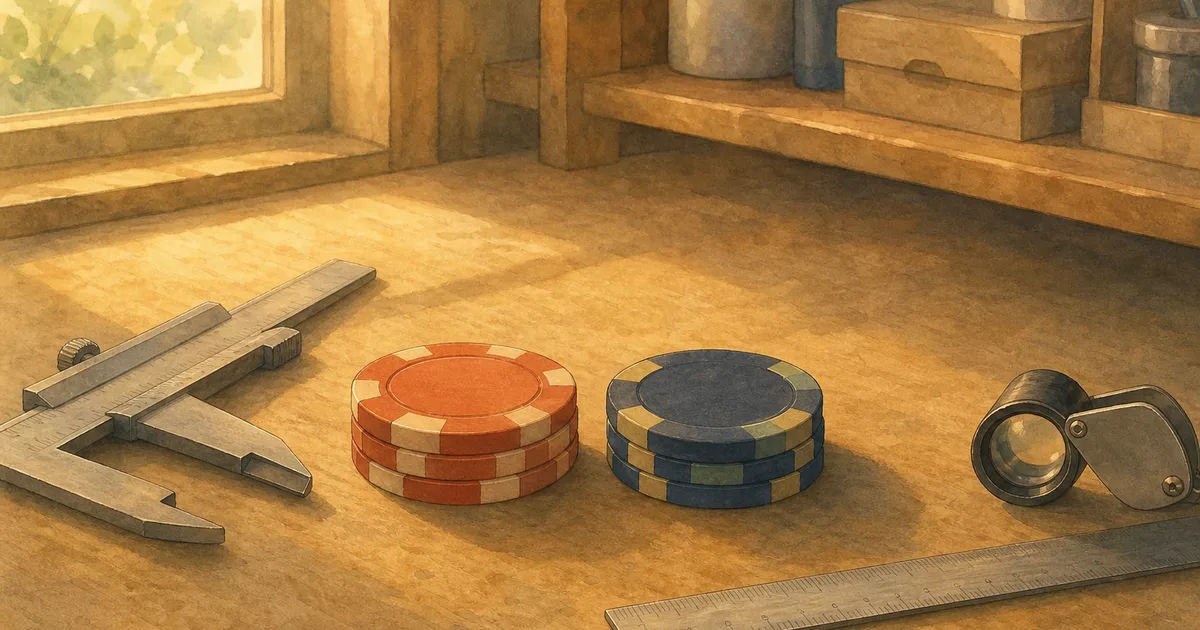
Poker chip size is 39 mm across with a thickness near 3.3 mm and a weight of 10g ± 0.2g. Here is what those specs change at the table and in a rack.
Suppliers throw "casino-grade" on everything from 4g plastic tokens to true 10g factory runs. This page is the dimensions and engineering reference - diameter, thickness, tolerances, construction, and print methods - so you can compare listings, brief a club committee, or verify what Poker Foundry ships. For the full learning path, see Poker Chip Academy. For what the label should mean in plain language, start with casino-grade custom poker chips guide; grams-only myths: poker chip weight comparison; the value ladder that goes on the face: poker chip values; factory testing: sourcing and quality standards.
Get an instant quote when you know material and quantity - ceramic from $1.10/chip (500 MOQ), clay from $1.28/chip (500 MOQ).
Poker chip size at a glance
| Dimension | Casino-grade target | Why it matters |
|---|---|---|
| Diameter (size across) | 39 mm (~1.5 in) | Fits standard racks, trays, and dealer muscle memory |
| Thickness | ~3.3 mm (3.2–3.4 mm typical) | Sets stack height and case fit |
| Weight | 10g ± 0.2g | Live-room feel without metal-slug bulk |
| Edge | Bevelled (clay) / flat (ceramic) | Stack behaviour and print construction |
Rule: quote diameter × thickness × weight together. A listing that only boasts 14g or casino look without publishing poker chip size / poker chips dimensions is incomplete for serious hosts.
Poker chips dimensions at a glance
Use the size table above as the master reference. The sections below unpack each dimension: diameter, weight tolerance, thickness, and construction.
Master spec table: casino-grade custom chips
| Spec | Clay composite (PF) | Ceramic composite (PF) | Typical retail "14g casino" |
|---|---|---|---|
| Weight | 10g ± 0.2g | 10g ± 0.2g | 11.5–14g (often metal slug) |
| Diameter | 39 mm (casino standard) | 39 mm | 39–40 mm |
| Thickness (nominal) | ~3.3 mm | ~3.3 mm | ~3.5–4 mm+ (thicker slug mould) |
| Edge profile | Bevelled | Flat | Moulded ridge / printed rim |
| Body construction | Compression-moulded composite | Compression-moulded composite | Injection-moulded + insert |
| Artwork method | Printed label inlay in face recess | Direct face print (no paper label) | Sticker, hot-stamp, or thin decal |
| Impact rating | 25,000+ cycles | 50,000+ cycles | Rarely published |
| Side / edge print | N/A (inlay on face) | Not offered - edge wear fails QC | Often marketed as "premium" |
| MOQ (Poker Foundry) | 500 chips | 500 chips | Set packs (100–500) |
Stack maths: twenty 10g chips ≈ 6–7 cm stack height - shorter than an adult hand span. If a product photo shows a "stack of ten" taller than a coffee mug, the chips are overscaled props, not 39 mm casino chips.
Diameter: why 39 mm is the live-room standard
| Diameter | Where you see it | Handling note |
|---|---|---|
| 39 mm | US and European poker rooms, WSOP-style sets, most custom clay/ceramic | Fits standard racks, shufflers, dealer muscle memory |
| 40 mm | Some Chinese moulds, a few retail composites | Slightly wider stack; usually still workable at home |
| 43 mm+ | Promotional / oversized novelty | Too large for standard racks and table layouts |
| ~30–32 mm “mini” | Party / kids sets, Amazon novelty packs | Will not seat cleanly in 39 mm racks; feel toy-like in adult hands |
Poker chip diameter is the first number rack and tray buyers should confirm - see racks and trays guide. Thickness and diameter together set stack height. A 14g chip in a 40 mm mould can tower over a 10g 39 mm casino chip - hosts notice when pot stacks wobble or do not fit travel cases designed for 39 mm.
Forum collectors often cite 39 mm × 3.3 mm as nominal for Paulson-style clay and many ceramic lines - the same dimensional family Poker Foundry targets at 10g.
Poker chip diameter vs Amazon “casino” blanks
| Product type | Typical diameter | Typical weight | Fit with 39 mm racks? |
|---|---|---|---|
| Casino-grade clay/ceramic (PF) | 39 mm | 10g ± 0.2g | Yes |
| Retail metal-insert “14g” | 39–40 mm | 11.5–14g | Usually yes, taller stacks |
| Mini / striped party chips | ~30–32 mm | Light plastic | No |
| Promo oversized | 43 mm+ | Varies | No - novelty mould |
Decision rule: if the listing photo shows a stack taller than a coffee mug for “ten chips,” or the package says mini, treat it as a different product than casino poker chips dimensions - even when the title says casino.
Weight tolerance: 10g ± 0.2g
Live poker rooms converged on ~10g because it balances dealer comfort, stack stability, and authentic feel - not because regulators mandate one global number.
| Weight band | What it usually means |
|---|---|
| 8.5–10.5g | Casino clay / ceramic compression bodies |
| 10g ± 0.2g | Poker Foundry factory tolerance on both lines |
| 11.5g | Classic home composite with metal insert |
| 13.5–14g | Heavy retail moulded plastic - density ≠ mould tier |
Ten chips at 10g ≈ 100 g (3.5 oz) in one hand. Fourteen-gram sets feel impressive for an hour; ten-gram casino spec is what dealers shuffle for eight-hour sessions.
Deep dive on grams and metal inserts: poker chip weight comparison.
Thickness and edge profile
How thick is a casino poker chip? On 39 mm casino-grade bodies, expect ~3.2–3.4 mm per chip - collectors often round to 3.3 mm nominal.
| Edge type | Material | Feel at the table | Print implication |
|---|---|---|---|
| Bevelled | Clay composite | Classic clack, sharp stack edges | Inlay sits in face recess |
| Flat | Ceramic composite | Smooth tap, precise columns | Face-only direct print |
Why we reject side-printed ceramic: the outer rim absorbs maximum impact during shuffling and splashing. Edge graphics chip, fade, and peel long before face artwork fails. Poker Foundry ceramic uses face-only direct print - documented in our sourcing story.
Artwork bonding and print resolution
| Method | Used on | Durability mechanism | Detail strength |
|---|---|---|---|
| Printed label inlay | Clay | Label embedded in recess, flush with face | Strongest fine lines and small text |
| Direct face print | Ceramic | Ink bonded to chip surface - no paper seam | Bold logos, clear denominations |
| Surface decal / sticker | Retail ABS | Adhesive on moulded blank | Peels under humidity and shuffle |
File prep standard: CMYK vector (AI, EPS, SVG) or 300 dpi+ raster at print size; critical text 3–4 mm from chip edge. Mock layouts in Label Studio before factory proof - artwork design guide.
Durability: impact cycles and abrasion
Casino-grade claims should be measurable, not adjectives.
| Line | Impact rating | What it implies |
|---|---|---|
| Poker Foundry clay | 25,000+ cycles | Years of weekly home games and club nights |
| Poker Foundry ceramic | 50,000+ cycles | Heavy multi-table use without separate label wear |
| Decal retail tier | Unrated | Replace when labels peel |
Our pre-launch testing included drop tests, shuffle stress, and long-term wear simulation - summarised in engineering quality standards. Warp resistance and edge alignment are checked at factory QC before dispatch; run your own delivery inspection checklist when the case arrives.
Factory manufacturing vs fast-decal turnaround
| Tier | Turnaround | Construction | Typical MOQ |
|---|---|---|---|
| Fast decal / print-on-blank | 1–4 days | Stock mould + sticker or heat transfer | Low (25–100+) |
| Casino-grade custom (PF) | ~10 weeks post sign-off standard; ~4 weeks rush (+$136) | Compression-moulded body + inlay or face print | 500 chips (ceramic and clay) |
Chips at gaming-industry factories that also supply casino floors follow the spec table above - not decal-on-blank workflows marketed as "custom." Process walkthrough: how custom poker chips are made.
Spec verification checklist (before you order)
Use this with our high-quality poker chip set criteria host checklist:
- Weight - 10g ± 0.2g, not "up to 14g" as quality proxy
- Diameter - 39 mm (or know why you accept 40 mm)
- Thickness - ~3.3 mm on compression bodies; suspicious if chips read as thick pucks
- Construction - compression-moulded composite, not hollow ABS
- Artwork - inlay or bonded face print; reject peelable decals on "casino" listings
- Impact rating - supplier publishes cycles or equivalent test protocol
- Proof workflow - digital (and physical where offered) before full production
- Total cost - per-chip plus shipping and setup in one quote - instant quote tool
Poker Foundry spec summary
| Clay | Ceramic | |
|---|---|---|
| Weight | 10g ± 0.2g | 10g ± 0.2g |
| Diameter | 39 mm | 39 mm |
| Thickness | ~3.3 mm nominal | ~3.3 mm nominal |
| Edge | Bevelled | Flat |
| Artwork | Printed label inlay | Face-only direct print |
| Impact | 25,000+ cycles | 50,000+ cycles |
| MOQ | 500 | 500 |
| From price | $1.28/chip | $1.10/chip |
Both lines are fully custom - your artwork and denominations - produced at gaming-industry factories to casino specifications. Order custom clay poker chips or custom ceramic poker chips, browse finished sets in the gallery, or get an instant quote.