

Custom Poker Chips for a Home Poker League: Seasons, Shared Sets, and Reorders
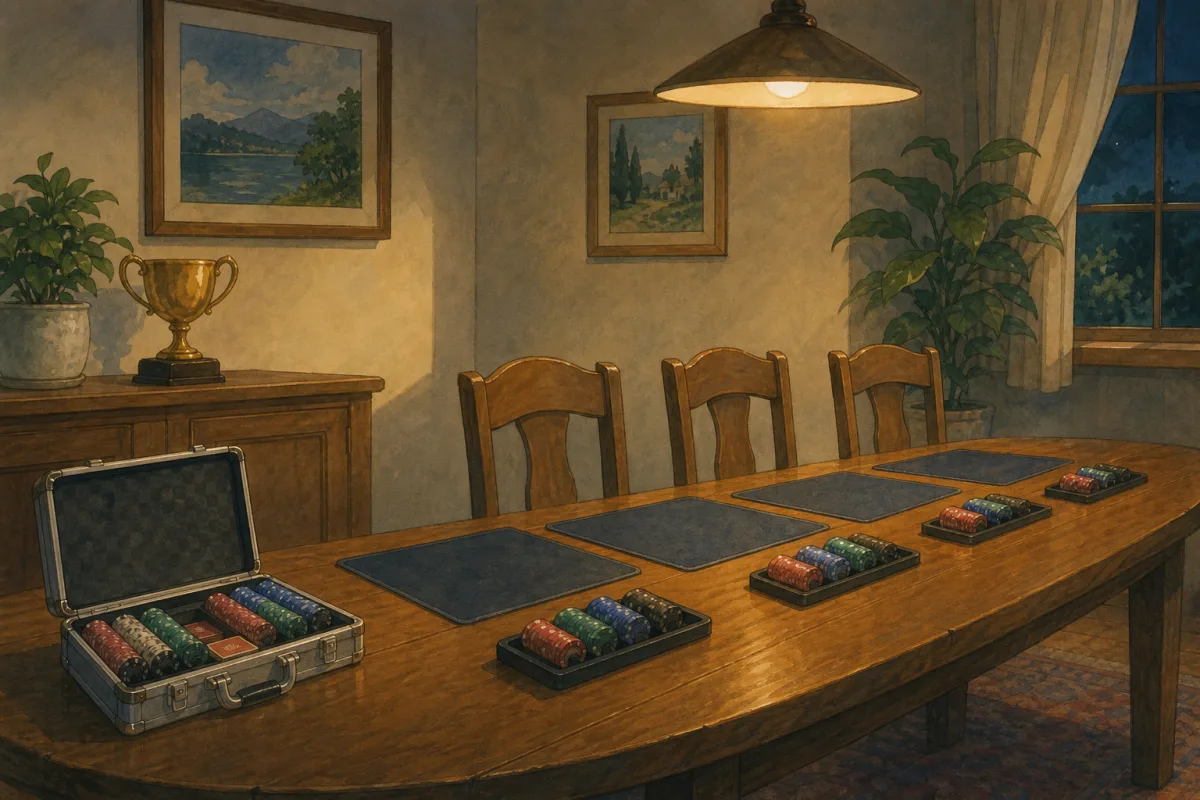
A home poker league is not one host’s weekly game - it is a shared inventory, rotating venues, and a season that deserves chips everyone trusts. Here is how to spec, custody, and reorder a league set.
A home league is not the same job as custom poker chips for home game hosts who own one table every Friday - or a university poker society with committee handover - see custom poker chips for university poker societies. Leagues rotate venues, track a season, split costs, and need chips that still feel fair when last month’s host deals this month. The how to choose custom poker chips guide covers material and artwork basics - this article covers league-specific sizing, custody, and reorders.
How a home poker league differs from a weekly home game
| Factor | Weekly home game | Home poker league |
|---|---|---|
| Ownership | One host buys and stores | Shared purchase - often split among founders |
| Venue | Same table most weeks | Rotates between members’ houses |
| Structure | Cash or ad-hoc tournament | Season, standings, scheduled stops |
| Chip custody | Host’s shelf | Commissioner’s case between nights |
| Growth | Add a seat at the table | Second table, new members mid-season |
That rotation is why consistent denominations and durable casino-grade chips matter more than in a single-host game. Mixed plastic from three members’ closets is how a league dies in month two.
What to put on league chips
League artwork should read as one organisation, not ten personal sets:
| Element | Typical placement |
|---|---|
| League name | Ring text - top and bottom arcs |
| Season or founding year | Ring text or small centre line - keep type large enough to proof at chip size |
| Tournament values | Centre or ring - 25 / 100 / 500 / 1,000 (unitless points, no $ or £) |
| Optional founder crest | One non-playing colour or the highest denomination |
Mock layouts free in Label Studio before you quote. File prep and safe zones: poker chip artwork design guide.
Do not print blind levels on chips - blinds change every level; print denominations and post a blind sheet at each host’s table. Structure help: home tournament blind structure.
How many chips a league should order
Use the same maths as any tournament night - then add league-specific headroom.
Single-table league (8–10 players)
| Component | Chips |
|---|---|
| Starting stacks | ~50–100 physical chips per player - mostly 25s and 100s in a full rack |
| Example T10,000 night | 40×25 + 45×100 + 8×500 + 2×1,000 ≈ 95 chips and ~11,500 tournament points per player (colour up excess at first break) |
| Bank reserve | 20–30% of total inventory - rebuys, add-ons, colour-ups |
| Typical order | ~700–1,000 chips total |
That inventory matches what a serious poker chip bank needs - the league bank is not optional when you allow rebuys through level four.
Two-table league (16–20 players)
| Scale | Chip inventory |
|---|---|
| Two full tables | ~1,600–1,900 in starting racks |
| With bank | ~2,000+ chips |
Volume pricing kicks in on larger league orders - model tiers in the instant quote before you ask ten members to contribute.
Compact minimum (tight budget only)
Some spreadsheets fit T10,000 into 46 physical chips per player. That is a minimum when chip supply is tight, not what players expect at a card room. Leagues that meet monthly should budget for full racks, not spreadsheet minimums.
Clay or ceramic for a shared league set?
Both lines are 10g casino-grade with the same printable face area. Pick on custody and handling, not myths about “sharper ceramic print”:
| Priority | Lean towards |
|---|---|
| League crest, small ring text, photo-style logo | Custom clay poker chips - printed label inlay |
| Heavy shuffling between hosts, 500-chip minimum, no label to peel | Custom ceramic poker chips - direct-to-chip, 50,000+ impact cycles |
| Lowest entry split among 6 founders | Ceramic - 500 MOQ vs 500 clay |
| Classic table sound in every host’s dining room | Clay - bevelled edge |
Commercial poker clubs often outgrow league quantities - but the material choice logic is similar at smaller scale.
Can I customise body colour and edge spots? On ceramic, add Full Chip Customisation in the quote. Clay customises the inlay only.
Custody, transport, and between-night storage
League chips fail when everyone takes “a few home” after a bad beat.
Rules that work:
- One custodian - commissioner or treasurer holds the metal case between events
- Count the bank after every night - match the inventory sheet before the case closes
- Transport in a case - not loose in a backpack; edge wear adds up across twelve hosts
- Dry storage - no garage damp or sunny window ledges; see how to store custom poker chips
Optional: a duplicate low-denomination sleeve in the case for colour-ups so the host is not raiding starting stacks mid-break. Colour-up timing: home tournament colour-up guide.
Season one timeline: when to order
Work backwards from opening night:
| Stage | Duration |
|---|---|
| League vote + member contributions | Your calendar |
| Instant quote + design brief | Same day |
| Digital proof + label sign-off | ~1 week typical |
| Standard production (after sign-off) | ~10 weeks post sign-off |
| Rush option | ~4 weeks (+$136) |
| Final delivery | ~2 days domestic · 7–10 days US and rest of world |
Start four months before game one. Rush saves weeks on freight - not on proof debates when twelve people Slack opinions on ring text.
Reorders: second table, new members, season two
Leagues grow. Plan before you need emergency plastic:
| Trigger | Action |
|---|---|
| Second table | Reorder ~800–1,000 chips matching existing colours and artwork |
| New denomination in structure | Same design system - new proof, not a new supplier |
| Worn lows after year three | Reorder one colour via reorder and colour matching |
| Rebrand / new sponsor | Treat as a new set - keep old chips as “legacy season” if budget allows |
Production still runs ~10 weeks post sign-off on reorders - book season two chips before you crown season one’s champion.
Splitting cost among league members
Transparent maths prevents resentment:
- Total quote from /quote - chips and shipping to custodian’s region
- Divide by founding members - or by expected seasons of use (amortise over three years)
- Document what the league owns vs what a departing member keeps (usually nothing - chips stay with the league)
From $1.10/chip (ceramic, 500 minimum) and $1.28/chip (clay, 500 minimum) at entry quantity - exact totals depend on quantity tier and shipping.
Common home league ordering mistakes
| Mistake | Why it hurts | Fix |
|---|---|---|
| Everyone buys 100 chips “their way” | Mixed sets, slow dealing | One league order, one design |
| Cash symbols on tournament chips | Confuses guests and rebuy rules | Unitless point values only |
| No bank in the budget | Rebuy night stalls at level three | 20–30% reserve in the quote |
| Chips live in rotating garages | Moisture, sun fade, lost lows | Single custodian + case |
| Reorder two weeks before playoffs | Plastic fill-ins for the finals | Reorder at mid-season headcount |
Poker Foundry for home poker leagues
Poker Foundry supplies casino-grade custom poker chips worldwide - transparent quoting, clay and ceramic under one roof, and real sets in the gallery. Leagues get the same proof discipline as clubs: mock in Label Studio, attach the layout on your quote, sign off once, manufacture once.
For a university-scale branded run, the RUPS Casino case study shows how a 1,000-chip ceramic inventory supports a recurring league-style room - useful when your group outgrows one table.
Bottom line
Custom poker chips for a home poker league turn a rotating group into something that feels like a real season - shared 700–1,000+ chip inventories, one design, one custodian, and a reorder plan before you add table two. Choose clay for crest detail or ceramic for shared handling and a 500-chip minimum, and order months before opening night.
Ready to price a league set? Get an instant quote - itemised, commitment-free, in under a minute.