

WSOP Poker Chips: What the 2026 Series Teaches Home Hosts
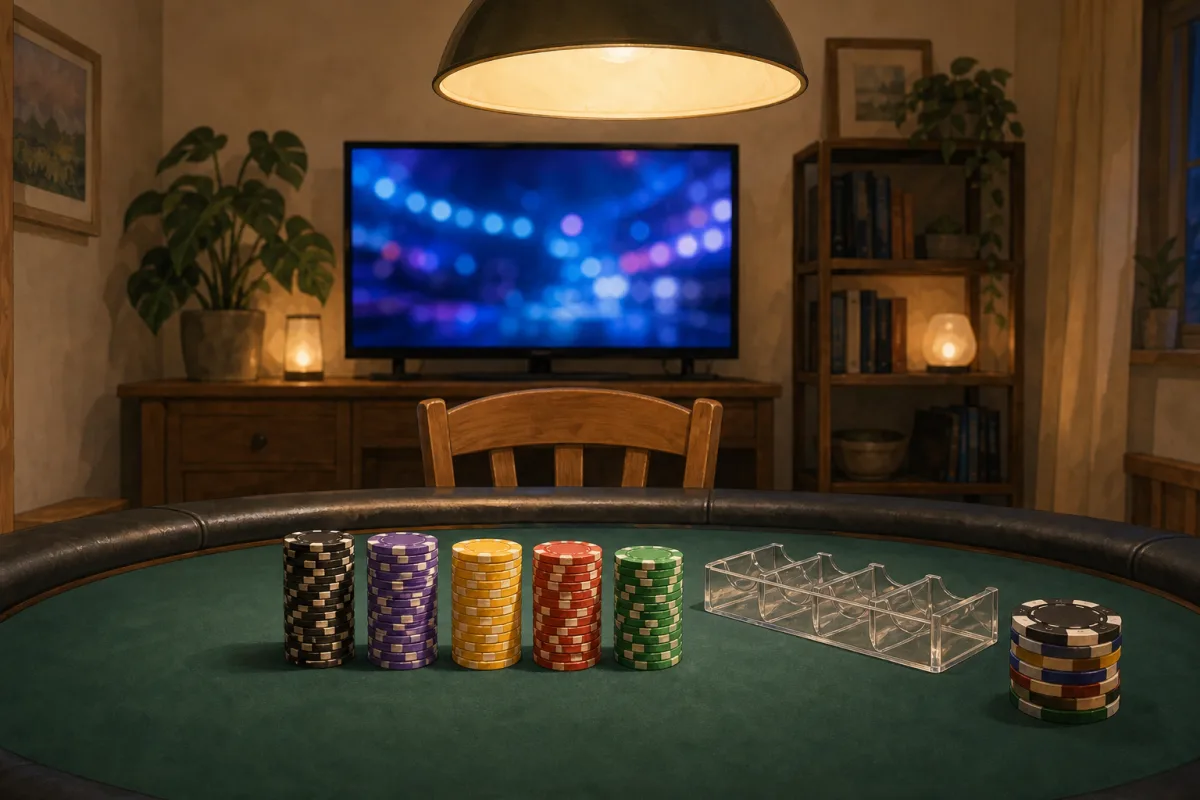
The 2026 World Series left a clear chip lesson for home hosts: copy the big-blind ratio and colour-up discipline, not the six-figure point graphics. Here is how to turn that into a Saturday night.
The 57th World Series of Poker ran at Horseshoe and Paris Las Vegas from 26 May through mid-July 2026, with the $10,000 Main Event Day 1 flights in early July. The livestreams and chip-leader graphics are still the best free masterclass for home tournament hosts - if you borrow the structure, not the calendar.
This guide decodes WSOP poker chips for a sharper Saturday-night event: what the series uses, how starting stacks map to blinds, which 2026 rules still matter for chip discipline, and how to translate it into one evening. For the Main Event path - 60,000-point Day 1 stacks, plaques, and a watch-party structure - see our WSOP Main Event chip structure guide. For Monster Stack depth and Millionaire Maker flights, see the Monster Stack home guide and Millionaire Maker home guide. Pair with the tournament chip denominations guide for full ladders.
What the 2026 WSOP showed home hosts
The series opened on 26 May with Event #1: $550 Mini Mystery Millions and ran through 100 bracelet events before the Main Event flights in early July. Mixed-game and high-roller weeks sat beside deep-stack flights like Monster Stack - different buy-ins, same chip logic on camera.
Headline numbers from 2026 still useful for hosts:
| Detail | What it means at home |
|---|---|
| 100 bracelet events | One structure lesson travels across buy-ins |
| Horseshoe + Paris Las Vegas | Same venue pairing since the post-Rio move |
| Main Event: early–mid July | 60,000-point Day 1 stacks; copy the BB ratio, not the schedule |
| Delayed final table | Deep events need plaque values only late - home nights rarely do |
| Daily livestreams | Free footage of colour-ups, rack discipline, and stack depth |
You do not need a $10,000 buy-in to learn from the structure. Most televised hands use the same chip logic as a $25 home tournament - just with more zeroes on the graphic.
What WSOP poker chips are made from
WSOP tournament chips are Paulson clay-composite - compression-moulded, bevelled-edge chips with printed inlays, the same broad construction as live poker rooms and custom clay poker chips. The Horseshoe/Paris primary sets have been largely consistent since 2022 when the series moved off the Rio floor.
Why players notice them: dense 10g weight, a deep stack clack, and colour coding that stays readable on camera. That tactile profile is exactly what home hosts chase when they upgrade from hollow plastic - see clay vs ceramic poker chips if you are choosing material for your own set.
What they are not: cash chips. Every tournament value is a point score tied to blinds and antes - and a 25,000-point starting stack is not 25,000 physical chips or $25,000 in cash. A single green 25,000 denomination chip in the Main Event is one betting unit worth 25,000 tournament points inside that event only.
WSOP starting stacks and the 200-big-blind rule
The WSOP publishes starting stacks as tournament points - the total value in play, not the number of physical chips in your rack. A 25,000-point stack is dealt as a full rack of Paulson chips across several denominations - often 80–120 physical pieces when you include all the 25s, 100s, and 500s - never 25,000 individual pieces.
The structure is built around big blinds, not physical chip count. The goal at every buy-in level: give players enough room to play poker before the structure forces shoves.
| Event type (2026) | Starting stack (points) | Opening blinds (example) | Big blinds at level 1 |
|---|---|---|---|
| $550 / $1,500 field events | 25,000 | 100 / 200 + ante | ~125 BB (varies by event) |
| $10,000 championships | 60,000 | 100 / 200 + ante | 300 BB (Main Event) |
| $25,000 High Roller | 150,000 | Faster structure | Deep by design |
The Main Event is the reference most fans know: 60,000 points, blinds 100/200, 200-point big blind ante - 300 BB to start (60,000 ÷ 200). Day 1 levels run 120 minutes each. That is why early footage looks patient: the structure is deliberately slow.
Home translation: If you want a WSOP-feel night, open at 10,000 points with blinds 25/50 (200 BB) or 5,000 points at 10/25 - then deal that as 50–100 physical chips per player so everyone has a proper rack (see below). The BB ratio matters more than copying six-figure point totals. Our tournament denominations guide has ready-made ladders for single-table and club events.
The WSOP denomination ladder (and when colour-ups happen)
On the current Main Event Paulson set, the ladder climbs through distinct colours - low values for early levels, oversized plaques when stacks balloon on the final table:
| Chip value | Typical colour (Main Event set) | Role in the structure |
|---|---|---|
| 100 | Black | Opening-level change |
| 500 | Purple | Early betting |
| 1,000 | Yellow | Mid-game workhorse |
| 5,000 | Red | Middle and late levels |
| 25,000 | Green | Deep-stack pots |
| 100,000 | Blue | Colour-up territory |
| 500,000+ | Plaques | Final-table consolidation |
Floor staff colour up - remove the lowest denomination and exchange it for the next step - once a value no longer matches the blind level. That is why WSOP tables look tidy on Day 3 even though everyone started with stacks of 100s and 500s.
Your home game should schedule the same removals at breaks. When blinds hit 500/1,000, nobody needs 25-value chips anymore. Announce the rule before hand one; assign one person to run exchanges. Skipping this is the fastest way to recreate the "messy plastic cup full of singles" problem - the opposite of what you are watching on stream.
2026 rule changes that matter for chip discipline
Two 2026 WSOP rule updates are worth knowing - one is a cautionary tale for any host who lets players wander.
Rule 35: chips in play from the first hand
If you pre-register before an event starts, your stack is live immediately - blinds and antes post whether you are seated or not. The loophole of registering early and strolling in two hours later is gone.
Lesson for home hosts: tournament chips represent time. If someone buys in, their stack should be in play at the posted start - or do not sell the seat. Consistency prevents arguments when the blinds have already jumped.
Rule 38: chips belong to the venue
Tournament chips are property of Horseshoe/Paris, not souvenirs. WSOP rules forbid removing chips from the playing area - including pocketing one as a memento. Penalties range from forfeiture to disqualification.
At home you make the rules, but the principle holds: clarify whether chips leave the table and whether you use venue-owned rentals. If you order a personal set, custom chips with printed denominations remove the guesswork - and you actually get to keep them.
Build a WSOP-style home tournament in one evening
You cannot run a 50-day series in your dining room. You can borrow the elements that make WSOP play feel professional:
- Set a 200-BB starting ratio - e.g. 10,000 points at 25/50, or 5,000 at 10/25 for a faster night.
- Use four denominations - 25 / 100 / 500 / 1,000 at home scale (add 5,000 plaques only for deep club fields).
- Issue 50–100 physical chips per player - tournament points and physical chips are different numbers; a 10,000-point stack should still fill a rack, not a handful of high-value pieces.
- Plan two colour-ups - one mid-way, one before the final table.
- Post the structure on paper or a phone timer - blinds, breaks, and colour-up levels in one place.
- Print values on every colour - guests should never ask "what is this worth?" mid-hand.
Why this matters: Walk into any card room or well-run home game and every player has a full rack in front of them - stacks of 25s and 100s they can actually bet with, not a neat handful of high-value plaques. Casino dealers make change and colour up constantly, so TV footage can look tidier than what you felt the first time you sat down. At home, under-dealing physical chips is the fastest way to kill the vibe: players feel short-stacked and spend the first hour making change.
For a 10-player WSOP-themed night with 10,000 starting points, deal a full rack - roughly 50–100 physical chips per player, weighted heavily to 25s and 100s:
| Denomination | Chips per player | Subtotal |
|---|---|---|
| 25 | 40 | 1,000 |
| 100 | 45 | 4,500 |
| 500 | 8 | 4,000 |
| 1,000 | 2 | 2,000 |
| Total | 95 chips | 11,500 |
Starting slightly above 10,000 points is normal - colour up the extras at the first break. The point total matters less than giving everyone enough low and mid chips to bet every street without borrowing from neighbours.
That is ~950 chips across ten starting stacks alone. Hold back a 20–30% bank for colour-ups and rebuys - so budget ~1,000–1,200 chips for a ten-player freezeout. See how many poker chips for a home game for full inventory sizing. A 1,000 chip poker set is the realistic target for a full-table WSOP-style tournament; a 500 chip poker set works for smaller fields (six to eight) or a compact structure with fewer physical pieces per player.
Common mistakes when copying WSOP structure
| Mistake | Why it hurts | Fix |
|---|---|---|
| Copying chip counts, not BB ratio | 60,000 points with 100/200 blinds feels nothing like TV | Target ~200 BB at level one |
| Too few physical chips per player | Constant change-making; stacks feel tiny | Issue 50–100 chips per player, mostly 25s and 100s |
| Too many denominations | Slows betting; looks amateur | Stick to 4 values at home scale |
| No colour-up schedule | Stacks become unreadable by hour three | Remove lows at planned breaks |
| Ambiguous chip ownership | Disputes when someone pockets a chip | State rules before the first deal |
| Plastic chips with stickers | Hard to stack and count on camera | Upgrade to 10g custom clay poker chips or custom ceramic poker chips |
Ordering chips that feel like the series
WSOP chips are not for sale - but the spec is: 10g, clear denominations, distinct colours, durable construction. Poker Foundry builds to that standard with your artwork:
- Custom clay poker chips - printed inlay, bevelled edge, closest feel to Paulson tournament chips (500-chip minimum).
- Custom ceramic poker chips - direct-to-chip print, no separate label, 500-chip minimum, higher durability rating for heavy weekly play. Optional Full Chip Customisation adds custom body and edge spots per denomination.
Mock up denomination placement in the free Label Studio before you quote. If you are hosting regularly, read custom poker chips for home game hosts for first-order sizing.
Watch the series, run the structure
The 2026 WSOP reminded hosts that great tournaments are engineered - starting stacks, denomination ladders, colour-ups, and chip discipline matter as much as the cards. You do not need Las Vegas tables or Paulson plaques to apply the same logic at home.
Pick your 200-BB ratio, map a 25 / 100 / 500 / 1,000 ladder (add 5,000 only for deeper club fields), schedule two colour-ups, and put values on the chips. Size the physical inventory with a 500 or 1,000 chip set guide before you quote. Your guests will feel the difference on the first orbit.
Ready to build a WSOP-inspired set with your branding? Browse custom poker chips, then get an instant quote - configure denominations, material, and quantity in under a minute.