

3D Printed Poker Chips: Why Layer Lines Fail at a Real Table
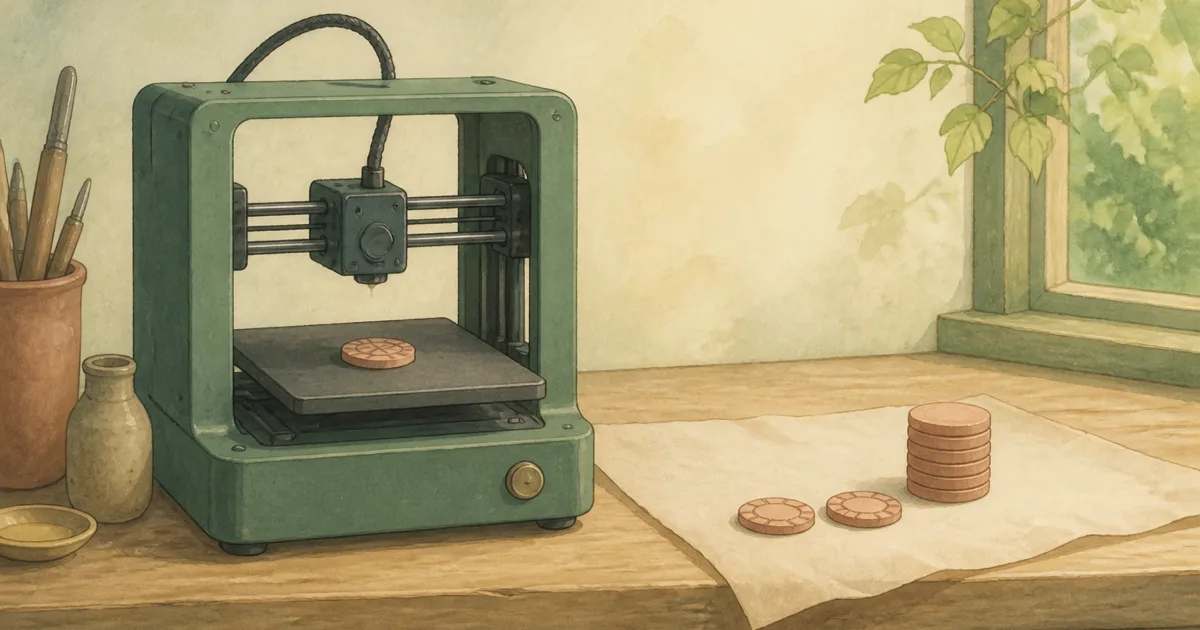
A printer can spit out a round disc in an evening. It cannot hold 10g tolerance, a casino edge, or artwork that survives a riffle. Here is when 3D printed poker chips are a prototype, not a bank.
Makers land here from two directions. One group already owns a printer and thinks a chip STL is a weekend project. The other group is trying to make their own poker chips and the algorithm offered 3D print as a shortcut. The second group should start with make your own poker chips: that page covers craft DIY versus designing a factory run. This page is the 3D-print-specific cut: layer lines, density, edges, and why a slicer will not replace a mould.
For the actual order path after you abandon the print farm, use how to choose custom poker chips.
What a 3D printed chip actually is
FDM (filament) builds a disc in horizontal layers. Even at fine settings you can see rings on the rim, and the edge is a stairstep, not a tooled bevel. Resin can look smoother, then chips or yellows under shuffle and sunlight.
Neither process is how custom poker chips are made at a gaming factory. Factory clay and ceramic are compression-moulded to a weight tolerance, then inlaid or direct-printed. A home printer is an additive model. Those are different industries.
A useful test: put a printed disc next to a real 39mm chip. The print is often too thick, too light, or both. Stacks of twenty should sit around 6–7cm, not a tower of pucks.
Why 3D printed poker chips fail in play
| Problem | What you notice | Why factory chips avoid it |
|---|---|---|
| Layer lines | Riffle catches; dirt lodges in grooves | Moulded smooth or tooled edge |
| Weight | Bets fly; stacks lean | 10g ± 0.2g on both PF lines |
| Infill | Some discs rattle or feel hollow | Solid composite body |
| Diameter drift | Will not rack with mixed prints | Tight 39mm-class tooling |
| Artwork | Stickers, paint, or UV print peels | Inlay or bonded direct print |
| Edge spots | You paint bands by hand; they wear off | Factory rim colour (stock or Full Chip Customisation on ceramic) |
Hosts who try to "just print 500" also discover time. A single high-quality disc can take an hour. A 500-chip ceramic minimum from the quote is a factory batch, not a week of babysitting a bed.
When a printed dummy is still useful
Keep 3D printed poker chips in the workshop if the job is not the bank:
- Scale check. Print one 39mm blank to see if a crest looks lost at chip size before you pay for art. Then mock the real face in Label Studio.
- Film or table dressing. A dummy that never takes a bet. For production props, film and TV chips still usually want real composites on camera.
- Teaching a CAD class. Fine. Do not deal them in a $1/$2.
If the dummy convinces you the logo works, the next step is a factory proof, not a print farm. Proof rules: proof approval guide.
3D print vs other DIY vs custom
This is the satellite under the make-your-own pillar. Do not treat all DIY as one bucket.
| Path | Good for | Bad for |
|---|---|---|
| 3D printed poker chips | One dummy, classroom, prop | Weekly play, clubs |
| Polymer clay / stickers | Party favours | Shuffle, humidity |
| Blank + decal | Tiny events | Durability |
| Custom clay (500 MOQ) | Feel, fine inlay, casino click | First orders under 500 |
| Custom ceramic (500 MOQ) | Durability, durable direct print | Ultra-fine 6pt crests vs clay inlay |
Blanks and stickers are covered in blank vs custom. Plastic retail tins belong in upgrade from plastic. 3D print is its own dead end: it looks "technical," so people assume it is closer to a factory than a sticker. It is not.
Common 3D-print chip mistakes
| Mistake | Why it hurts | Fix |
|---|---|---|
| Printing a full 500 "to save money" | Weeks of failures and mismatch | Quote 500 ceramic |
| Adding metal inserts for weight | Balance goes weird; edges still wrong | Buy 10g moulded chips |
| Painting edge spots with acrylic | Wears off in a session | Factory rim colour |
| Using a chip STL with denomination text in the mesh | Ugly, unreadable, not how print works | Inlay or direct print on a real face |
| Calling a print casino-grade | Spec does not exist for FDM | Read casino-grade |
How to get the set you actually wanted
- Stop the print job for anything that will be bet.
- Pick clay or ceramic in clay vs ceramic.
- Design the face in Label Studio or upload vector art.
- Quote quantity and split at /quote. Ceramic from $1.10/chip at 300; clay from $1.28/chip at 500. Full design service is $136 if you want the team to build files.
Door-to-door after sign-off is 11–12 weeks standard or 6 weeks rush. A printer is faster for a toy. It is slower than a factory if you count usable chips.
Poker Foundry tie-in
We do not sell STLs or filament. We sell 10g clay and ceramic from the same manufacturing class that supplies card rooms, with an itemised quote and a proof. If your search was 3D printed poker chips, the honest product is still a moulded custom set.
Next steps
Use the printer for a dummy, not a bank.
Get an instant quote for clay or ceramic. Want the wider DIY versus factory frame? Make your own poker chips.