

Bulk Poker Chips: How to Order a Large Set Without Waste
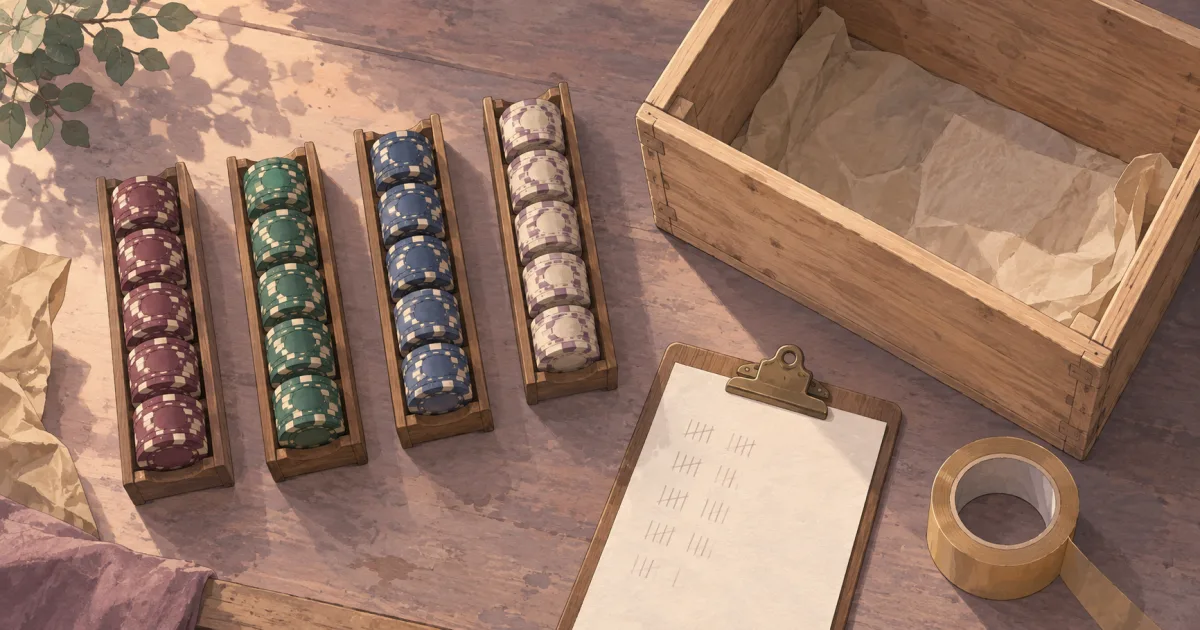
Ordering chips in bulk is mostly a counting problem. Here is how many you need, how to split the order across values, and why padding the low chips works better than a tidy even split.
Most people who order a big set get one thing wrong, and it is almost never the total. It is the mix. They buy a round number of chips, divide it neatly across five colours, and then discover three weeks later that the table is always hunting for small chips while the highest value sits untouched in the case.
This guide covers how many chips a big order should hold, how to split that order across denominations, the difference between retail bulk and custom bulk, and the shipping and reorder details that trip people up on large orders. If you are starting from the set-size question, begin with how many poker chips for a home game.
What counts as a bulk poker chip order
"Bulk" is a loose word. For a custom factory order it usually means 500 chips or more, because that is the minimum a run makes sense at. For home hosts it means a step up from a single starter set, and for clubs and events it means enough to run two or more tables from one matched set.
| Buyer | Typical order | What it covers |
|---|---|---|
| Single home table | 500 chips | One full table, cash or tournament |
| Bigger home game | 700 to 1,000 chips | Deeper stacks, a rebuy bank |
| Home league or club night | 1,000 to 1,200 chips | 10 players with a colour-up reserve |
| Club or event | 2,000+ chips | Several tables, one consistent set |
The number that matters is not the total on the invoice. It is chips per player and the bank behind them.
How many chips do you actually need
The rule that keeps you out of trouble is physical chips per player, not a single headline number.
- Cash games: plan 50 to 75 chips per player, plus a bank to cover a few rebuys.
- Tournaments: plan 50 to 100 physical chips per player, then add 20 to 30 percent as a bank for rebuys, add-ons, and colour-ups.
Here is what that looks like for a ten-player tournament.
| Item | Count |
|---|---|
| Players | 10 |
| Physical chips per player | 50 to 100 |
| Starting stacks | ~950 to 1,000 chips |
| Bank (20 to 30 percent) | ~200 to 300 chips |
| Total order | ~1,000 to 1,200 chips |
Two words cause most of the confusion here. Tournament points are the total value of a player's stack, like a 10,000-point start. Physical chips are the pieces in front of them, usually 50 to 100. A 10,000-point stack is not 10,000 chips, and a tournament that is described as "10,000" is talking about points, not pieces. The full structure is in tournament chip denominations.
Splitting a bulk order across denominations
This is where a large order is won or lost. The chips you deal most are the smallest values, so that is where the volume of your order should sit.
Weight the mix towards the low denominations, roughly 4:3:2:1 from the lowest value up. In plain terms, order the most 25s and 100s, fewer 500s, and only a thin layer of 1,000s and above.
| Colour | Typical cash value | Typical tournament value | Share of order |
|---|---|---|---|
| White | $1 | Low points | Heavy |
| Red | $5 | 100 | Heavy |
| Green | $25 | 25 | Moderate |
| Black | $100 | 100 | Lighter |
| Purple or above | $500 | 500 to 1,000 | Thin |
The mistake is ordering equal counts per colour because the set looks balanced in the case. At the table it is not. Players make change all night, the low chips run out, and the high chips barely move. Start from the value ladder, then split your total across it. If you are still setting values, use cash game poker chip denominations and then come back to the order size.
Retail bulk vs custom bulk
There are two ways to buy a big set, and they are not the same product.
| Factor | Retail bulk | Custom bulk |
|---|---|---|
| Design | Fixed house artwork | Your artwork |
| Values | Standard retail ladder | Your denominations |
| Entry price | Lower per chip | Higher at low volume, better at scale |
| Minimum | None to low | 500 chips |
| Reorder | While the shop stocks it | Same artwork, any time |
| Best for | A casual single table | A club, league, or keeper set |
If you are buying 2,000 chips to run a permanent league, the reorder point matters more than the first invoice. A retail line can be discontinued; a custom run with saved artwork is yours to repeat. That single difference is why clubs tend to order custom and casual hosts often start retail.
Why per-chip cost falls as quantity rises
Custom pricing is not one flat rate. Setup and mould work are fixed costs, so they spread across more chips as the order grows. Order 500 and you carry a bigger slice of that setup per chip. Order 2,000 and the same work is divided across four times as many pieces.
On the current lines, ceramic starts around $1.10 per chip at 500 and clay around $1.28 per chip at 500, with lower all-in rates at higher tiers. The exact breakpoints differ between the two materials, so compare them at your real quantity rather than a headline price. The tier-by-tier picture, including illustrative rates at 2,000 chips, is in custom poker chip volume pricing.
Shipping, insurance and reorders on large orders
A few hundred chips is a small parcel. A few thousand is a crate, and that changes the practical details.
- Weight adds up. A 1,000-chip order is a genuine box. Check the shipping tier before you finalise, not after.
- Insure the parcel. Large orders are worth insuring for the full replacement value, so a lost crate is a claim rather than a loss.
- Check on arrival. Count and inspect before your first game; the delivery checklist in inspecting custom poker chips on delivery covers what to look for.
- Keep the artwork. For a custom set, store the print files so a future reorder matches exactly. The reorder process is in custom poker chip reorder and colour matching.
Storage matters once the order lands. Split it into racks and trays so one table's worth is easy to carry, and keep the spare bank boxed separately from the chips in play.
Poker Foundry tie-in
We supply custom clay and ceramic chips at a 10g casino-grade spec, from a 500-chip minimum up to club and event quantities, with your artwork and your denomination split. If you are ordering a large set and want the per-chip rate to reflect the real volume, get an instant quote for an itemised total in under a minute.
Common mistakes with bulk orders
| Mistake | Why it hurts | Fix |
|---|---|---|
| Even split across colours | Short of small chips every night | Weight the order 4:3:2:1 towards lows |
| Confusing points with physical chips | You under-order the rack | Plan 50 to 100 pieces per player |
| Forgetting the bank | No chips for rebuys or colour-ups | Add 20 to 30 percent |
| Buying high-value chips you never use | Money parked in the case | Keep the top colour thin |
| Skipping the shipping tier | Surprise cost on a heavy crate | Check weight and region early |
| No saved artwork on a custom order | A later reorder will not match | Store the print files |
Next steps
A bulk chip order is a counting job: set chips per player, add a bank, and weight the mix towards the low denominations. Sort the set size first with how many poker chips for a home game, check the per-chip curve in volume pricing, then price your actual split.
Ready to see the itemised total for your order? Get an instant quote and change the quantity until the per-chip rate looks right.