

Colour-Blind-Friendly Custom Poker Chips: Design for Every Player
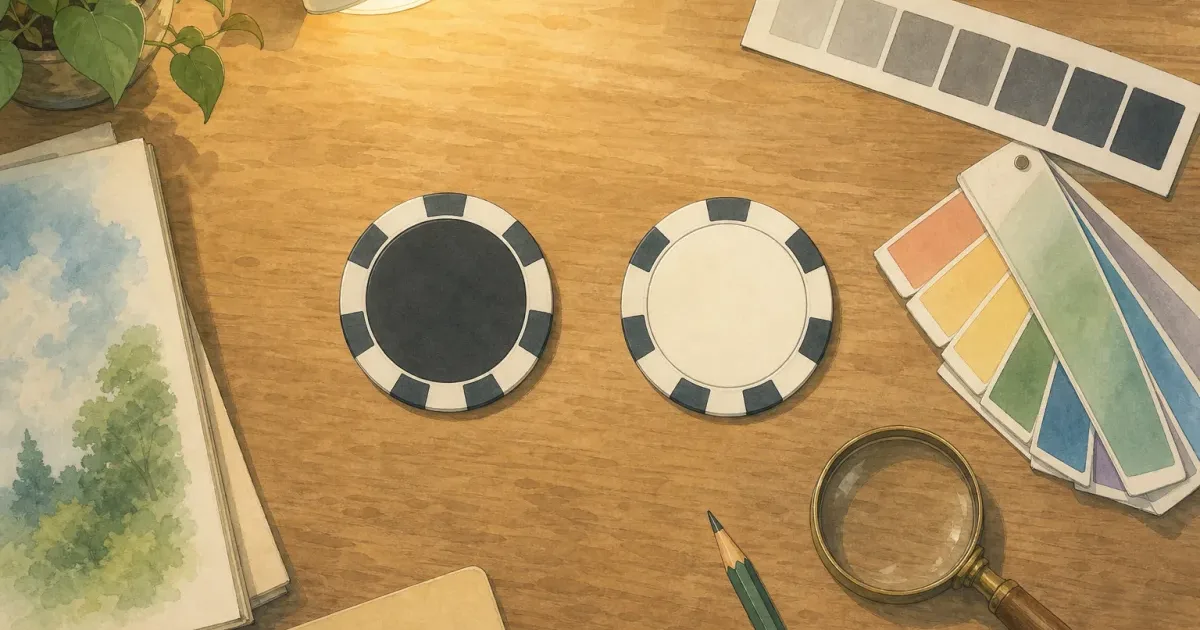
Red-green confusion is common at the table - colour alone is not enough. Here is how to design custom poker chips with readable denominations, contrast, and rim cues that work for every guest.
A host who spent weeks on a beautiful pastel ladder still has a problem if seat seven cannot tell $5 from $25 after sunset. Accessibility at the poker table is not an ADA checklist - it is fewer misreads, faster pots, and guests who come back. Start from the conventional poker chip colors ladder, then redesign for contrast. This guide sits inside our custom poker chips artwork guide cluster: what to put on the face, how big, and what clay vs ceramic actually let you control.
Why colour fails before denominations do
Colour blindness is not one condition. Deuteranopia (red-green), protanopia (red weak), and tritanopia (blue-yellow) each break different pairs - and no single palette works for every player.
| Problem pair | Why it hurts at the table |
|---|---|
| Red / green | Classic $5 / $25 confusion when shades match |
| Blue / purple | $10 / $500 home sets under warm bulbs |
| Dark grey / black | $100 vs $500 when stacks overlap |
| Yellow / green | Tournament 25 / 100 solids in bad light |
Experienced players learn edge spot patterns and stack height - but guests and tired regulars still bet wrong. Printed values fix the root cause; colour is a bonus cue.
Design rules that work for every player
Centre denomination first
Put the value as large as the safe zone allows - numerals, not spelled-out words. $5, 25, 500 read from across the table; "FIVE DOLLARS" in script does not.
Full sizing guidance: custom poker chip denomination text size.
High contrast beats brand pastels
| Centre field | Value text | Result |
|---|---|---|
| Dark navy | White or gold | Strong at distance |
| Cream / white | Black or deep red | Works in dim rooms |
| Mid grey | Any colour | Avoid - muddies in greyscale |
Run your proof through a simulator and a greyscale export. If two denominations look identical in greyscale, change centre field, not just rim hue.
Alternate light and dark across the ladder
A light → dark → light centre pattern helps players who distinguish brightness when hue fails:
| Value (cash example) | Centre field |
|---|---|
| $1 | Light |
| $5 | Dark |
| $25 | Light |
| $100 | Dark |
Tournament values stay unitless (25 / 100 / 500) - same alternation rule.
Rim cues: what you can actually order
| Order type | Rim customisation | Accessibility tactic |
|---|---|---|
| Clay (500 MOQ) | Factory-standard mould body and edge spots | Inlay artwork - bold values, contrast, optional ring icons (stars, bars) per value |
| Ceramic <1,000 | Stock body colours | Pick stock colours that alternate light/dark; face print carries the value |
| ceramic Full Chip Customisation | Custom body + edge spots per denomination | Wildly different spot patterns - not a subtle progression |
See custom poker chip edge spots for stock and custom body options.
Clay vs ceramic for accessible artwork
Printable face area is the same on both lines - the difference is construction and what you customise.
| Priority | Lean toward |
|---|---|
| Smallest readable ring text | Clay printed inlay |
| Bold centre numerals only | Either line |
| No paper inlay, heavy shuffle | Ceramic - from $1.10/chip, 500 MOQ |
| Custom rim colours per value | ceramic Full Chip Customisation only |
Clay does not offer custom mould body or edge spot colours - your accessibility levers are inlay layout, type size, and contrast. Ceramic direct print favours thick centre values over hairline serif copy.
Compare materials: clay vs ceramic custom poker chips.
Mock and proof workflow
- Draft in Label Studio - centre value, ring branding, chip-body preview (free online).
- Simulator pass - deuteranopia, protanopia, tritanopia filters on the export.
- Greyscale check - every denomination must separate by contrast or pattern.
- Factory proof - approve at real chip size, not zoomed screen pixels (proof approval guide).
- Table test - one hand under your actual room light before the full order ships.
Three design paths in the quote tool: Label Studio (free), own artwork upload (free), or full design service ($136) - optional; Studio is standalone, not a required step before paid design.
Common accessibility mistakes
| Mistake | Why it hurts | Fix |
|---|---|---|
| Colour-only ladder | Fails for ~8% of men | Print every value on the face |
| Tiny ring text | Unreadable at seat eight | Centre numerals - largest that fits |
| Pastel-on-pastel | Brand-cute, table-blind | High contrast centre fields |
| Identical spot patterns | Stacks look the same edge-on | Distinct patterns (ceramic Full Chip Customisation) or icons on inlay |
| Assuming casino lighting | Dining rooms are dim | Test under your bulb, not a monitor |
Poker Foundry next steps
Accessible custom chips are readable chips - large values, honest contrast, and proofs you actually squint at. When your club outgrows stock rim colours, plan a Full Chip Customisation ceramic run with per-denomination edge spots; until then, inlay artwork does the heavy lifting on clay.
Mock denomination layout free in Label Studio, then get an instant quote with your breakdown.
Conclusion
Colour blind poker chips are not a separate product line - they are well-designed custom chips: printed denominations, contrast, and rim differentiation where your order tier allows. Colour helps players who see it; numbers help everyone.
Ready to spec an accessible set? Get an instant quote - worldwide delivery, itemised in under a minute.