

What Are Poker Chips Made Of? Custom Chip Manufacturing
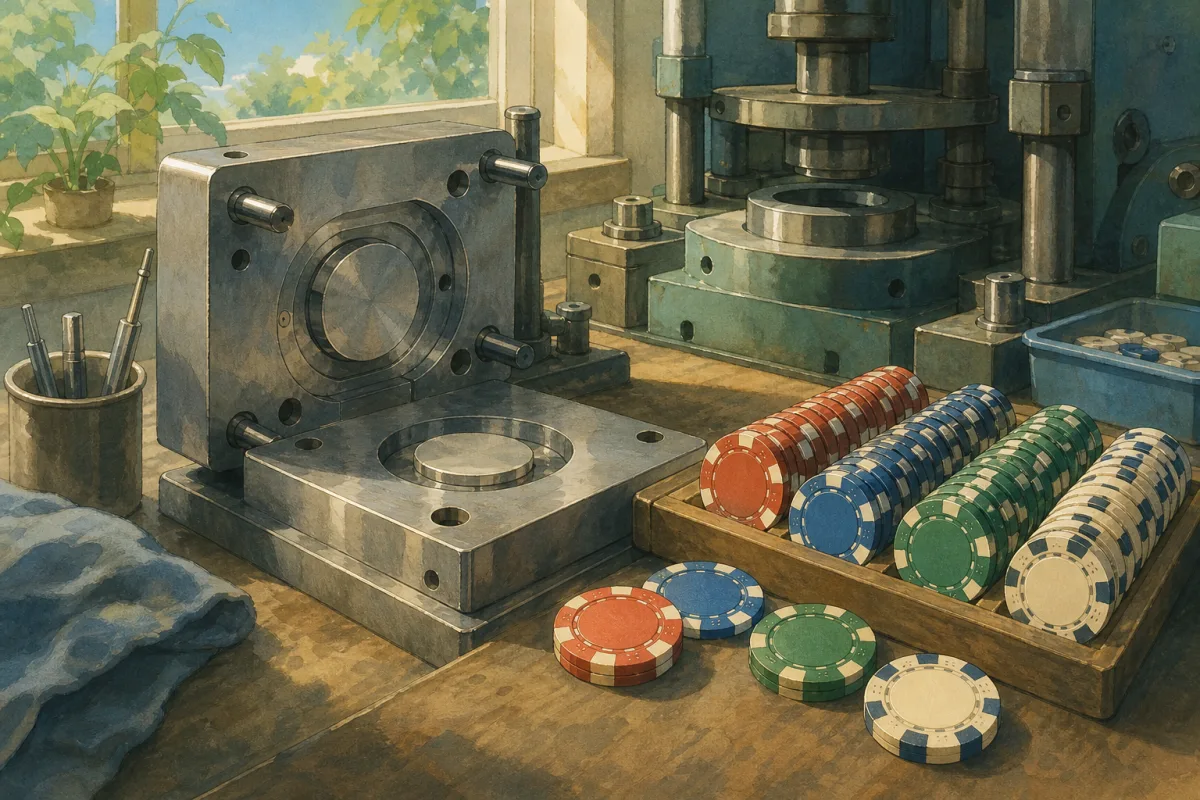
Custom poker chips are not printed stickers on plastic blanks. Here is how casino-grade clay and ceramic chips are actually engineered - from material selection to artwork application and quality control.
Most retail chip sets are injection-moulded plastic with a sticker label pressed into a recess. Custom casino-grade chips follow a different path - compression moulding, embedded inlays, or ceramic composite bodies with bonded face print. Understanding material helps you order once at the right tier instead of upgrading twice. For quotable dimensions and tolerances, see poker chip specifications.
Factory custom vs DIY: two different questions
Search "how to make custom poker chips" and you will see DIY sticker tutorials, print-on-blank suppliers, and factory compression moulding mixed together. They are not interchangeable.
| Path | What you get | Typical turnaround | MOQ | Best for |
|---|---|---|---|---|
| DIY / craft | Blank discs + printed paper or vinyl | Same day | 1+ | Props, one-off crafts, board-game tokens |
| Fast decal supplier | Stock mould + heat transfer or sticker | 1–4 days | 25–100+ | Swag, corporate giveaways, casual home games |
| Casino-grade factory custom (PF) | Compression-moulded clay or ceramic, 10g ± 0.2g, bonded artwork | ~10 weeks post sign-off standard; ~4 weeks rush (+$136) | 500 chips (ceramic and clay) | Weekly home games, clubs, leagues, events |
Poker Foundry sits in the factory custom row - ceramic from $1.10/chip (500 MOQ), clay from $1.28/chip (500 MOQ), instant itemised quote at /quote. The steps below describe how casino-grade chips are actually manufactured, not how to glue labels in a kitchen.
What are poker chips made of? The four common families
Search "what are poker chips made of" and you will see clay, ceramic, plastic, and metal mentioned in the same breath - often without explaining that marketing names ≠ pure materials. Here is the honest breakdown hosts and club buyers use when comparing sets.
| Family | What it actually is | Typical weight | How artwork is applied | Best for |
|---|---|---|---|---|
| Clay composite | Clay plus binders and fillers, compression-moulded | 10g casino standard | Printed label inlay in face recess | Casino feel, fine detail, bevelled-edge sound |
| Ceramic composite | Engineered ceramic composite body (not porcelain) | 10g casino standard | Direct-to-chip full-colour print on face | No separate label; 50,000+ rated impact cycles |
| ABS plastic | Injection-moulded acrylic/nitrile blend | 8–11g (hollow feel common) | Sticker, hot-stamp, or thin inlay | Budget home sets, fast retail turnover |
| Metal-insert moulded | Plastic body with brass or steel slug | 11–14g marketed as "heavy" | Same as ABS tier - surface label | Weight theatre without casino mould quality |
Pure clay chips existed in the 1880s - they chipped and cracked under shuffle wear. Modern "clay" in a poker room or custom order means composite. "Ceramic" in gaming supply means impact-rated composite, not a coffee mug. "14g" often signals metal filler in moulded plastic, not higher manufacturing tier.
Still choosing between the two casino-grade lines? Compare feel and MOQ in clay vs ceramic custom poker chips. Ready to price a composite order? Get an instant quote - ceramic from $1.10/chip (500 MOQ), clay from $1.28/chip (500 MOQ).
How to tell materials apart without a lab
| Test | Clay composite | Ceramic composite | Cheap ABS |
|---|---|---|---|
| Edge | Bevelled | Flat | Often sharp mould seam |
| Sound | Classic clack when stacked | Softer tap | Hollow click |
| Label | Inlay flush in recess | No paper border - print on face | Peelable sticker or hot-stamp |
| Stack | Stable column | Stable column | Often wobbly or uneven |
Forum threads on poker chip materials repeat the same field tests - edge profile and label construction beat guessing from colour alone.
Two Manufacturing Families: Clay Composite vs Ceramic Composite
Before you configure a design, you need the foundational material. Premium custom chips fall into two engineered lines:
| Feature | Custom clay chips | Custom ceramic chips |
|---|---|---|
| Edge | Classic bevelled edge | Flat edge |
| Artwork | Printed label inlay recessed in face | Direct-to-chip full-colour print |
| Surface | Textured, slightly porous | Smooth matte |
| Weight | 10g ± 0.2g | 10g ± 0.2g |
| Durability | 25,000+ impact cycles | 50,000+ impact cycles |
| Best for | Casino feel, fine inlay detail | No label; durability; 500 MOQ |
Our custom clay poker chips use a specialised composite blend - pure clay shatters easily, so binders and polymers provide grip and strength without the hollow feel of cheap plastic. Our custom ceramic chips deliver a smooth glide across felt, popular for tournaments and clubs that want no separate inlay label.
Still choosing? Read clay vs ceramic or watch both lines in our comparison video on the product pages.
Step 1: Moulding (Clay)
Clay composite chips start with compression moulding - material is pressed under heat and pressure into a factory standard mould (body, bevel, and rim edge spots). You customise the printed label inlay - not the mould body or edge-spot colours per order.
- Mould setup: included in your quoted clay chip price (not a separate line item)
- Minimum order: 500 chips
- Result: Consistent 40mm diameter, bevelled edge, textured face ready for inlay
Custom body colour and edge spots per denomination are a ceramic Full Chip Customisation option - see custom poker chip edge spots guide.
Ceramic lines use a 500-chip minimum (no separate clay mould setup).
Step 2: Applying Artwork
Clay - printed label inlay
Artwork is printed as a high-resolution label and set into a recess on the chip face, flush with the composite surface. The inlay is protected from direct shuffle wear better than a surface sticker, and reproduces fine lines and small text more sharply than ceramic direct print.
Design rules:
- Bold, legible denominations - players must read values in dim light
- Keep critical elements 3–4mm from the edge
- CMYK vector files preferred
Ceramic - direct-to-chip printing
Artwork is printed directly onto the chip face - no separate label border. Colour is bonded to the surface for even wear under heavy play. Default ceramic uses factory-standard stock body and rim colours; optional Full Chip Customisation briefs body colour and edge spot bands per denomination. See custom poker chip edge spots guide for how each tier works.
Important manufacturing decision: many suppliers offer edge or side printing on ceramic chips. Rigorous testing shows the outer rim takes maximum impact during shuffling - side print chips, fades, and peels unacceptably fast. Poker Foundry uses face-only direct print for longevity. Read why in our sourcing and testing story.
Step 3: Artwork and File Preparation
Manufacturing quality starts with file quality:
| Requirement | Standard |
|---|---|
| Preferred format | Vector - AI, EPS, SVG |
| Raster minimum | 300dpi at intended print size |
| Colour mode | CMYK (not RGB) |
| Safe zone | Critical text 3–4mm from chip edge |
Low-resolution artwork produces muddy, pixelated chips regardless of factory quality. Mock up layout and contrast in the Label Studio first - full detail: poker chip artwork design guide.
Step 4: Quality Control and Delivery
Before full production runs:
- Digital proof - client approves layout, colours, denominations - see custom poker chip proof approval guide for the sign-off checklist
- Physical sample (where applicable) - weight, print accuracy, edge profile verified
- Full batch production - standard ~10 weeks post label sign-off; ~4 weeks rush (+$136)
- QC and dispatch - impact-rated composites checked before shipping; run your own delivery inspection checklist when the case arrives
Common Manufacturing Misconceptions
| Misconception | Reality |
|---|---|
| "Custom chips are stickers on blanks" | Tier 1 decal chips yes; casino-grade clay/ceramic are moulded and printed in factory runs |
| "14g means better quality" | Professional rooms use 10g; extra weight often means metal inserts in moulded plastic |
| "Ceramic chips are porcelain" | Gaming ceramic is an engineered composite rated for impact cycles |
| "Side print looks premium" | Edge wear destroys side graphics - face print lasts |
What Happens When You Order From Poker Foundry
- Get an instant quote - quantity, clay or ceramic, delivery region
- Submit artwork or brief - mock up in the Label Studio or select full design service ($136) in the instant quote
- Approve digital proof - production locked after sign-off
- Manufacturing - ~10 weeks post sign-off standard or ~4 weeks rush
- Delivery - worldwide from our London base
Browse real customer sets to see finished clay and ceramic lines in play.
Next Steps
Whether you need the commanding weight of custom clay sets or the direct-print durability of custom ceramic poker chips, the manufacturing path is the same: define material → approve artwork → factory production.
Get an instant quote - itemised, commitment-free, under a minute.