

Poker Chip Collecting: How to Start and What to Look For
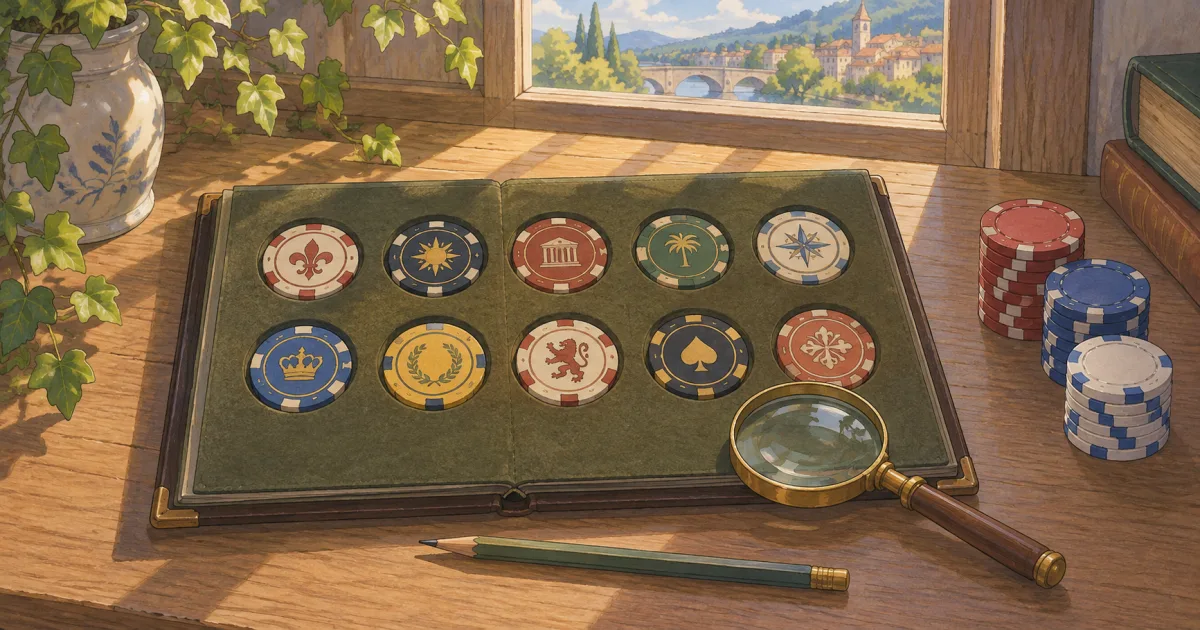
Poker chip collecting starts with a single $1 chip from a real casino. Here is how the hobby works, what makes a chip worth keeping, and how to store what you find.
There is a particular pleasure in the hobby that separates it from buying gear. A home set is about your game tonight; a collection is about every table that came before it. A worn $1 chip from a casino that closed in the eighties is a small, physical piece of poker history, and it usually costs less than a coffee.
This guide explains how the hobby works, where to start, what actually drives value, and how to store what you find without wrecking it. If you end up wanting a set of your own rather than a tray of souvenirs, that is a different job, and the design and buying guide covers it. For the longer story of how chips evolved from clay tokens to today's casino-grade builds, see the history of poker chips.
What casino chip collecting actually is
The hobby most people call poker chip collecting is more precisely casino chip collecting. The objects are chips issued by a venue: a $1 from a downtown card room, a $5 from a riverboat, a commemorative from a tournament that ran once.
| What collectors chase | What they usually ignore |
|---|---|
| Single chips from real venues | Matched 500-chip retail sets |
| Closed or renamed casinos | Chips still easily available today |
| Obsolete values no longer in use | Whatever is cheapest per chip |
| Designs and edge spots unique to a room | Plain, common, widely issued chips |
That focus is why the hobby overlaps so little with home-game gear. Collectors are not trying to deal a tournament; they are trying to hold a piece of a specific place and time.
Why the $1 chip is where most collectors start
The $1 chip is the collector's entry point for practical reasons. It is the lowest value in play, it exists in almost every room, and it carries the casino's full design: logo, edge spots, and often a house motif.
That makes it the perfect starter for three reasons.
- Affordable. You can build a real collection for the price of a night out.
- Accessible. You collect where you play, one room per trip.
- Documented. References such as ChipGuide catalogue millions of issued chips, so you can usually identify what you have.
Over time, many collectors specialise: one city, one era, one manufacturer, or one chip shape. A tight focus is what turns a jar of chips into a collection with a story.
What makes a poker chip valuable
Value in this hobby is mostly scarcity plus story, with condition close behind. The table below is the order most collectors weigh things.
| Factor | Why it moves the price |
|---|---|
| Closed venue | Supply is fixed forever; no more chips can be issued |
| Obsolete value | Early or retired denominations are harder to find than current ones |
| Low mintage | Small runs, commemoratives, and short-lived designs are scarce |
| Condition | Uncirculated chips outrank worn ones of the same design |
| Errors | Misprints, off-centre inlays, and wrong edge spots attract specialists |
| Manufacturer | Names like Paulson or Bud Jones add a following, not a guarantee |
Notice what is not on the list: material. A clay chip is not automatically worth more than a ceramic one. What matters is how many exist and who wants one.
Can you cash in old poker chips?
This is the question that trips up new collectors, so it is worth being precise.
| Situation | What usually happens |
|---|---|
| Open casino, current chip | Normally redeemable at face value |
| Open casino, obsolete chip | Often bought back and destroyed, sometimes refused |
| Closed casino | Memorabilia only; worth what a collector will pay |
| Cancelled or drilled chip | A chip, not money; collected for its story |
The rule of thumb: a chip is money while its room still honours it, and a collectible after that. Some venues actively buy back and destroy retired chips to keep them out of circulation, which is exactly why surviving examples become interesting.
Do casinos clean their chips, and why it matters
Yes. Casino chips pick up grime from hands and felt, so venues wash or tumble them on a schedule to keep the racks presentable.
For a collector, that has two consequences.
- Never clean your own chips. A wash can strip the surface character and print that prove a chip's age and use, and cleaning a collectible usually reduces what it is worth.
- Read condition carefully. A suspiciously bright "vintage" chip may have been washed by the venue, which is fine for a home-game chip and a mark against a premium collectible.
If you buy from a dealer, ask whether a chip has been cleaned. If you find one in the wild, leave it as it is.
How to start collecting in a weekend
- Visit a room and buy a $1 chip. Take it from the cage, not the table, so it stays clean.
- Record it straight away. Note the casino name, city, and date, then look the chip up in a reference such as ChipGuide.
- Set a focus before you buy more. One city, one manufacturer, or one era keeps a small collection coherent.
- Buy your first holders. Hard plastic capsules or a felt album stop edges chipping in a drawer.
- Join a community. Collector forums and chip shows are where singles, errors, and closed-room chips actually change hands.
You do not need a big budget to start. You need a focus and a way to document what you find.
Storing and handling a collection
Storage is where beginners lose value without noticing. A few habits protect a collection for decades.
- Hold chips by the edges. Finger oils and friction dull print on the face.
- Keep them out of sunlight and heat. UV and warmth fade colours and warp bodies.
- Do not let them rattle. Loose chips knock against each other; store them in individual pockets or holders.
- Skip the harsh cleaners. A dry microfibre wipe is the most a collectible should ever get.
- Log as you go. A simple note of venue, date, and condition makes the collection worth more to a buyer later.
For chips you actually play with, the care rules are different and more forgiving; see how to clean and care for poker chips.
Collecting versus building a home set
These are two different hobbies and it helps to be honest about which you want.
| Collecting | Home set | |
|---|---|---|
| Goal | History and resale | Your game tonight |
| Unit | Single chips | Matched racks |
| Design | The venue's | Yours |
| Values | Whatever the room issued | Your ladder |
| Source | Casinos, forums, shows | A factory order |
If you want the second column, you do not have to wait years to assemble it from singles. A custom order gives you every colour, every value, and your own artwork in one run, at 10g ± 0.2g and 39 mm, from $1.10/chip ceramic or $1.28/chip clay at a 500-chip minimum. Mock your faces in Label Studio and get an instant quote.
Many collectors do both: a serious tray of casino singles, and a proper custom set for their own table. That is the healthy version of the hobby.
Common mistakes new collectors make
| Mistake | Why it hurts | Fix |
|---|---|---|
| Cleaning chips to make them shine | Strips print and surface history | Leave them as found |
| Storing chips loose in a jar | Edges chip, print rubs | Holders or a felt album |
| Buying without a focus | A random pile, not a collection | Pick a city, maker, or era |
| Paying top price for a common chip | Easy to overpay early | Check a reference before you buy |
| Assuming "clay" means valuable | Material is not scarcity | Value the story, not the material |
| Cashing an obsolete chip by mistake | You may lose it for face value | Research before you spend it |
A single mistake here, cleaning a rare chip, is permanent. The rest are just money you can learn from.
Poker Foundry tie-in
We do not sell casino collectibles; we make custom clay and ceramic chips for hosts. If your interest in chips is really about your own table, with your own colours and values printed on a casino-grade build, that is what we do. Get an instant quote to see an itemised price in under a minute.
Next steps
Start with one $1 chip from a room you have played. Keep the focus tight, keep the chips clean of cleaners, and let the collection tell a story. If the pull is really toward your own set instead, that path starts with a brief. Get an instant quote, or begin with how to choose custom poker chips and the history of poker chips.