

Poker Chip Tricks: How to Roll, Spin and Shuffle a Chip
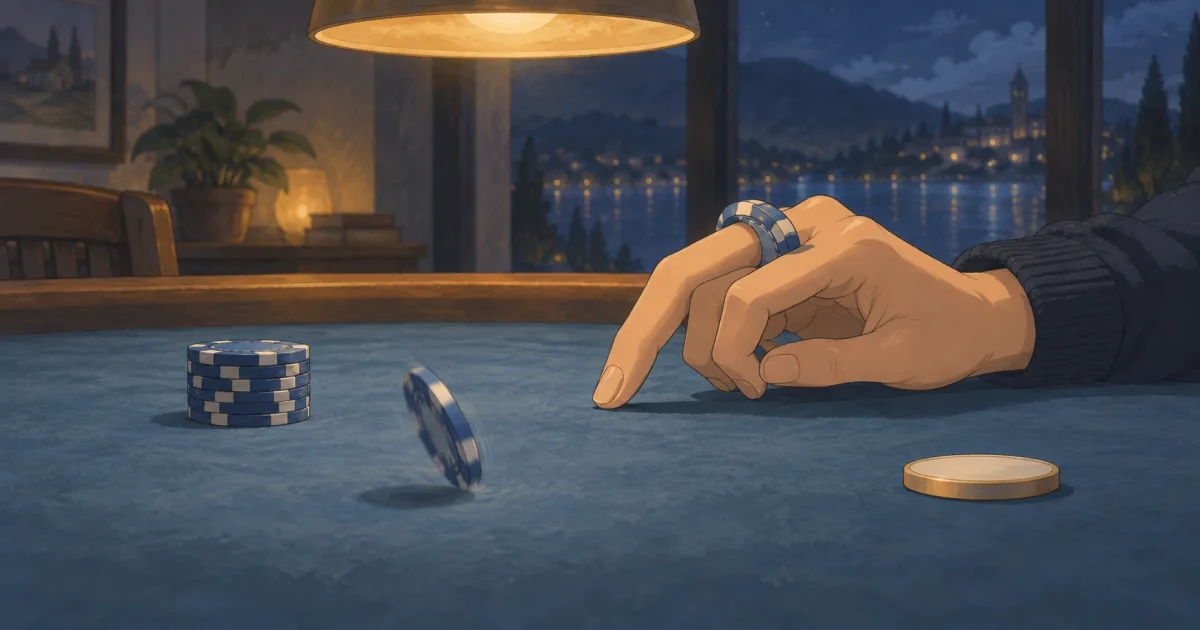
A good chip trick is rhythm more than sleight of hand. Here is how the chip shuffle, roll, twirl and thumb flip actually work, and how to learn them without slowing the game.
Card rooms are full of small, quiet skills that have nothing to do with reading a board. A player rolls a chip across their knuckles while they think, or riffles two short stacks without looking down. It reads as calm, and it is genuinely calming. The tricks are also a fast way to get comfortable handling chips, which helps when you are counting a pot or splitting a stack.
This guide covers the moves worth learning, the grip that makes them work, and how to practise without becoming the person everyone at the table is waiting on. If you want the proper shuffle rather than the flourish, start with how to shuffle poker chips, and if you are still choosing a set, the custom poker chip buying guide is the right first stop.
What counts as a poker chip trick
A poker chip trick is any controlled flourish you do with one or more chips, usually while waiting for a hand. It is not part of the game. Nobody is required to learn one, and a player who never touches a chip outside a bet is not missing anything.
The useful split is between one-chip tricks and stack tricks.
| Type | Examples | Chips needed | Difficulty |
|---|---|---|---|
| One-chip | Thumb flip, single-chip twirl, chip roll | 1 | Easy |
| Two-chip | Two-chip riffle, simple pinch flip | 2 | Easy to medium |
| Stack | Chip shuffle, knuckle roll, multi-chip fan | 4 or more | Medium |
Start with the right-hand column of one chip. A single chip teaches you the finger control that every bigger trick depends on, and it is the least likely to spray chips across the felt if it goes wrong.
The four moves worth learning first
You do not need a long list. Four moves cover almost every chip trick you will see at a real table, and each one builds on the last.
The thumb flip
Hold one chip flat on the middle and index fingertips, thumb resting on the near edge. Snap the thumb down and slightly forward so the chip spins off your fingers and lands face up on the felt. The mistake is flicking with the whole hand. The thumb does the work; the hand stays still.
The single-chip roll
Balance the chip on the second knuckle of your index finger, then walk it across the middle, ring, and little finger with small, even pushes. The chip should stay flat and move slowly. Fast is what causes drops. Slow is what looks effortless.
The twirl or spin
Rest the chip on its edge on one finger and spin it like a coin. The trick here is patience: give it a gentle push and let it settle rather than chasing it. On a felt table a spinning chip slows quickly, so this one is better over a mat or a hard, flat surface.
The chip shuffle
The chip shuffle is the eye-catching one: two short stacks, riffled together and squared. Hold both stacks lightly between thumb and fingers, break the top of each, and push the two halves together so the chips interleave. Full stacking technique and how it differs from a real table shuffle is in how to shuffle poker chips.
The grip and rhythm behind every trick
Every trick that fails, fails in the hands before it fails in the air. Three habits carry all four moves.
- Loose fingers, light pressure. Beginners grip like they are holding a rope. A chip that is squeezed cannot slide, and a chip that cannot slide cannot roll. Let it sit on the fingers.
- Flat hands. Tilt your palm and gravity takes the chip. Keep the hand level and the chip stays where you put it.
- One movement at a time. Learn the push, then the catch, then the release. Combining them too early is what turns a roll into a scatter.
Rhythm matters more than speed. A slow, even chip shuffle looks deliberate. A fast, jerky one looks like a nervous habit. If you watch a dealer handle chips, notice how little effort is visible. That is the whole target.
How to practise without slowing the table
Chip tricks are a solo skill, and the table is a bad classroom.
- Practise away from the game. Roll and riffle at home, on the sofa, or at your desk. Ten minutes of short reps works better than one long session.
- Use felt or a mat. A drop onto felt is harmless. A drop onto a hard table edge is how chips chip.
- Stop when a hand is live. The moment cards are dealt or a bet is in front of you, the flourish goes away. No one wants to wait on your knuckle roll.
- Keep it quiet. A soft shuffle is fine. Loud, rattling chip tricks are the part players actually dislike.
- Read the room. In a casual home game, a trick or two is fun. In a serious game, keep the hands still and let the chips talk.
Which chips make tricks easier
You can learn on almost anything, but the chip you practise with changes how fast you improve. Light, hollow plastic chips feel slippery and turn over unpredictably. A 10g casino-grade chip with a flat face and a bit of grip behaves the way a dealer's chip behaves, so the timing you learn at home transfers to a real table.
Shape and weight matter more than colour here.
| Chip trait | Why it helps |
|---|---|
| 10g body | Enough weight to roll and riffle cleanly, not so heavy it fights your fingers |
| 39mm diameter | The standard casino size, so your grip matches a real table |
| Flat face, smooth edge | Rolls further and squares faster than a chunky novelty token |
| Consistent mould | Every chip in your set behaves the same, which is what makes a stack riffle |
Whether you go clay or ceramic is a feel decision. Clay has a classic casino click and a bevelled edge; ceramic is smoother and rates for heavier play. The full comparison, including how each handles and how each sounds, is in ceramic vs clay poker chips. If your main goal is a set that doubles as a practice chip, handle both before you order and pick by feel.
Common mistakes when learning chip tricks
| Mistake | Why it hurts | Fix |
|---|---|---|
| Starting with the knuckle roll | Hardest move, most drops | Learn the thumb flip first |
| Squeezing the chip | Binds the roll and kills the riffle | Lighter fingers |
| Practising over hard floors | Chips chip and print dulls | Use felt or a mat |
| Doing tricks mid-hand | Looks like a slow-roll | Hands still when cards are live |
| Practising to the ceiling | Looking down at your hands reads as disinterest | Watch the table, not your fingers |
| Chasing speed | Fast plus jerky looks worse than slow and smooth | Slow, even, then slowly faster |
Poker Foundry tie-in
We make custom clay and ceramic chips at a casino-grade 10g spec, which is exactly the weight and size these tricks are built around. If you want a set that handles like the chips you practise with, brief your artwork and values and get an instant quote for an itemised total in under a minute.
Next steps
Pick one move and give it five minutes a day: the thumb flip if you are brand new, the chip shuffle if you want the one everyone notices. Keep the hands quiet when a hand is live, and practise on felt rather than stone. Still sorting out the set itself? Read how to shuffle poker chips for the proper shuffle, then how to choose custom poker chips for everything that goes into the order.
Ready to price a set that handles like a card-room chip? Get an instant quote and see the itemised total before you commit to anything.