

Custom Poker Chips for 6-Max Home Cash Games
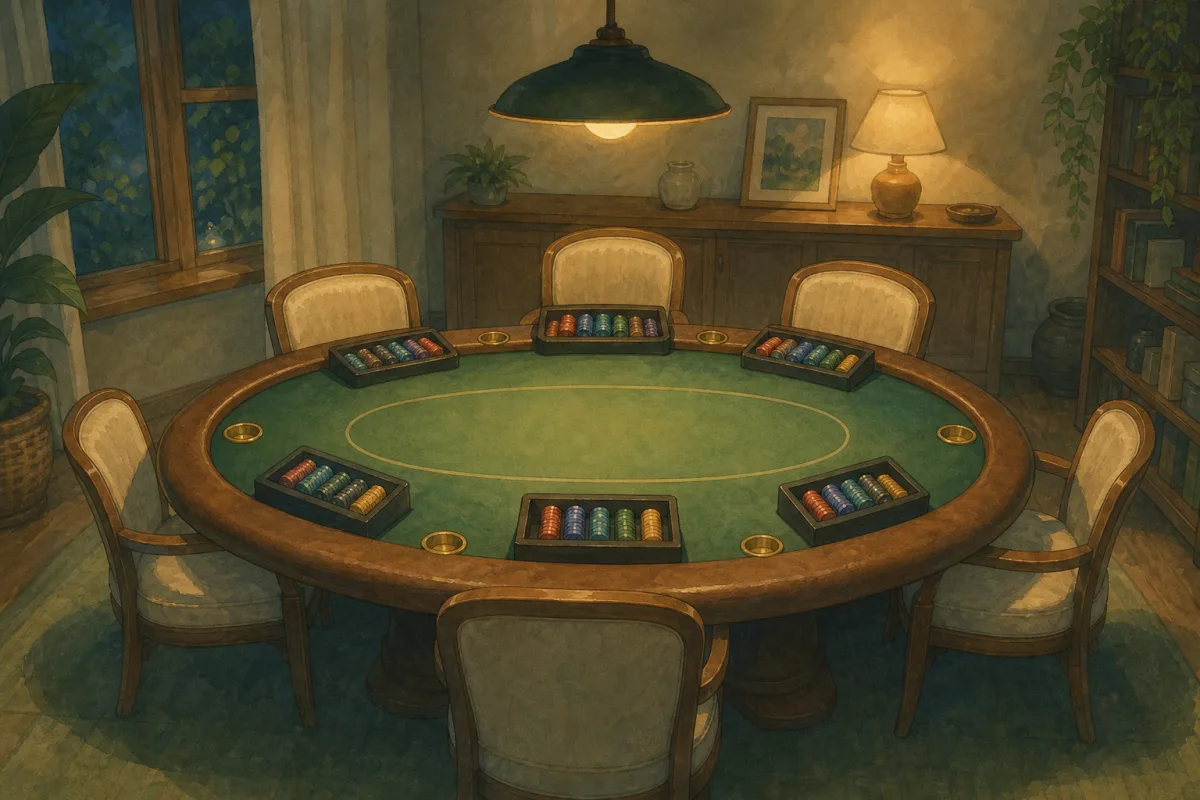
Six-handed cash plays deeper and faster than a full ring - your chip order should reflect that. Here is how to spec custom chips for 6-max home games without overbuying highs.
Six-max plays more hands per hour and deeper stacks relative to blinds than nine-handed - but hosts still over-order $25 and $100 because retail sets skew high. This guide sizes custom chip inventory for six-handed cash without repeating full-ring tournament maths.
For denomination spacing and the 4×–5× rule, start with our cash game poker chip denominations guide. For total-set comparisons across player counts, see how many custom poker chips for a home game.
Why 6-max changes quantity - not values
Six-max means fewer players, not different chip colours. The US home ladder $1 (white) → $5 (red) → $25 (green) → $100 (black) still applies at $1/$2 and $2/$5.
What changes:
| Factor | Nine-handed | Six-max |
|---|---|---|
| Seats | 8–9 | 6 |
| Chips in play (typical) | 540–675 | 360–450 |
| Bank (25%) | 135–170 | 90–115 |
| Total inventory | ~700–850 | ~450–550 |
| Hands per hour | Lower | Higher - more shuffle wear |
Deeper effective stacks: with only six players, average big blinds per stack runs higher than a loose nine-handed table - you need enough $1 and $5 chips in play, not more $100 plaques gathering dust.
Buy-in depth and chips per player
Size in-play stacks from typical buy-in, not blind labels alone:
| Stakes | Typical buy-in | Target chips in play | Denominations |
|---|---|---|---|
| $0.50 / $1 | $40–$80 | 50–60 | $0.50 / $1 / $5 (optional $0.25) |
| $1 / $2 | $100–$200 | 55–70 | $1 / $5 / $25 |
| $2 / $5 | $200–$500 | 60–75 | $1 / $5 / $25 / $100 |
| $5 / $10 | $500–$1,000 | 65–80 | $5 / $25 / $100 |
Add 20–30% bank for rebuys and change-making - see poker chip bank guide.
Worked splits for a 6-max $1/$2 night
Assumptions: six players, $150 average buy-in, 60 chips in play each, 25% bank.
Per-player starting stack (example)
| Denomination | Qty | Value |
|---|---|---|
| $1 | 25 | $25 |
| $5 | 20 | $100 |
| $25 | 4 | $100 |
| Total | 49 chips | $225 |
Hosts often issue slightly more than minimum buy-in so players are not constantly topping up - adjust $1 count upward before adding $25 plaques.
Full set inventory (6 players + bank)
| Denomination | In play (6×) | Bank (~25%) | Order qty |
|---|---|---|---|
| $1 | 150 | 38 | ~190 |
| $5 | 120 | 30 | ~150 |
| $25 | 24 | 6 | ~30 |
| Total chips | 294 | 74 | ~370 |
A 500-chip ceramic order is tight for this profile - workable if rebuys are rare; 500-chip clay adds headroom for deep stacks and new players.
Weighting rule: roughly 4:3:2:1 across the ladder - most pieces at the lowest value.
Table setup for six-handed cash
Six-max rewards organisation:
- One two-tier rack per seat - stacks stay readable at speed.
- One dealer tray for the bank - sorted $1 / $5 / $25 rows.
- Printed values on chip faces - guests who only play monthly should not guess colours.
Rack and tray buying guide: poker chip racks and trays.
Common 6-max ordering mistakes
| Mistake | Why it hurts | Fix |
|---|---|---|
| Ordering for nine seats “just in case” | $200+ wasted on unused inventory | Size to six + bank; reorder top-ups later |
| Too many $25 chips | Change-making at small pots | Weight $1 and $5 at ~70% of count |
| No printed values | Fast six-max → costly errors | $1 / $5 / $25 on faces - Label Studio |
| 300 chips with heavy rebuys | Bank empties by hour three | 500+ or cap rebuys |
| Same colours as tournament set | Friday cash vs Sunday points confusion | Separate art or dual-format rules |
Material choice for weekly 6-max
| Priority | Lean toward |
|---|---|
| Lowest entry order | Ceramic - 500 MOQ, from $1.10/chip |
| Sharpest denomination text | Clay inlay - 500 MOQ, from $1.28/chip |
| Heavy weekly shuffle | Ceramic - 50,000+ impact cycles, no label |
| Casino click and feel | Clay - bevelled edge, 25,000+ cycles |
Both lines share the same printable face area - clay wins fine ring text; ceramic wins durability and durable direct prints. Product pages: clay · ceramic.
Can I customise body colour and edge spots? On ceramic, add Full Chip Customisation in the quote. Clay customises the inlay only.
Poker Foundry next steps
Spec six-handed cash like a small card room: low-heavy splits, printed values, and racks at every seat. When your group also runs single-table tournaments, read custom poker chips for sit-and-go tournaments before you lock counts.
Browse finished sets in the gallery, then get an instant quote with your denomination breakdown.
Conclusion
6-max cash needs fewer chips than full ring, not fewer denominations. Nail $1 / $5 / $25 spacing, ~450–550 total for a typical $1/$2 night, and MOQ headroom if rebuys run hot. Seat eight or nine regularly? Size up with custom poker chips for 9-max cash games.
Ready to price a six-handed set? Get an instant quote - worldwide delivery, itemised in under a minute.