

How to Set Up Poker Chips: Cash Games, Tournaments and Host Checklist
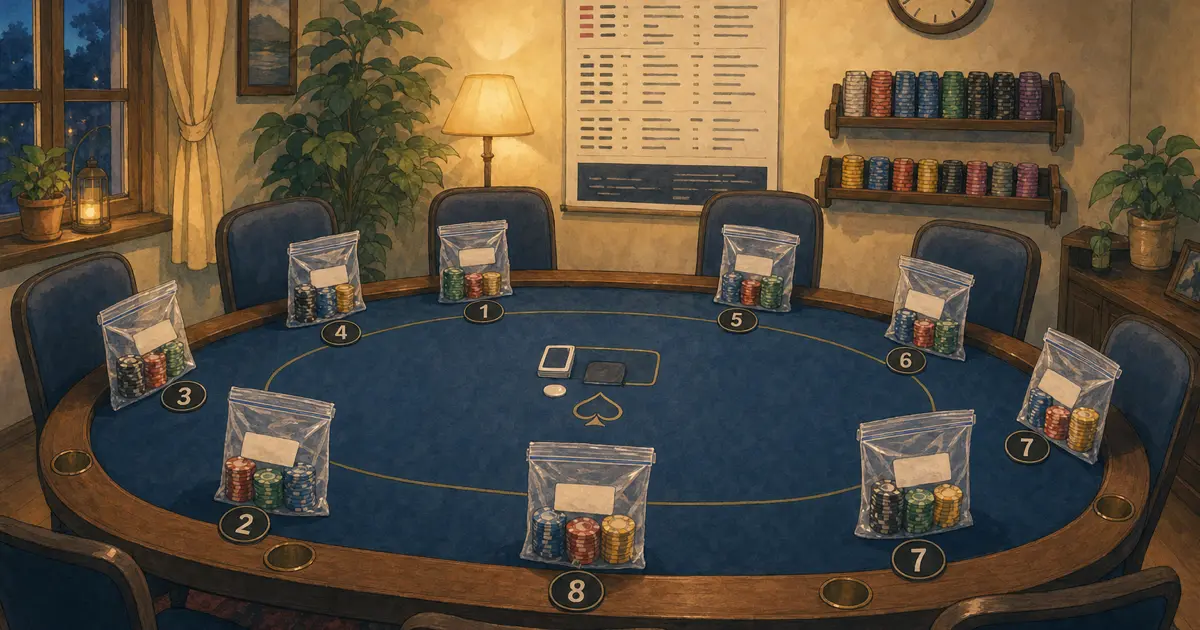
A good blind structure still fails if stacks arrive as a pile of plaques. Here is how to set up tournament chips at home - full racks, seat bags, colour-ups, and bank reserves.
Getting chip setup wrong is the fastest way to lose forty minutes before hand one - and to spend the rest of the night making change. This guide covers cash and tournament setup: what to prepare before guests arrive, how many chips each player gets, and how card rooms run colour-ups without chaos.
For how many chips each player starts with, see how many chips do you start with in poker. Build the full inventory as a tournament poker chip set. For which values to print on each colour, start with our tournament chip denominations guide. Count stacks fast with how to count poker chips. Cash nights use dollar ladders and $20 / $50 buy-in splits - see poker chip values and cash denominations. For level lengths and BB depth, see home tournament blind structure. For eight-player inventory maths, see how many poker chips for 8 players. Rebuy and add-on nights need a larger bank - home tournament rebuy chip bank.
How to Set Up Poker Chips Before Guests Arrive
Run this checklist once when you first buy a set, then repeat the deal-down steps every session.
| Step | Cash game | Tournament |
|---|---|---|
| 1. Denominations | $1 / $5 / $25 (add $100 if needed) | 25 / 100 / 500 / 1,000 (unitless - no $) |
| 2. Starting stack | 50–75 chips per buy-in | 50–100 chips per player (~95 for T10,000) |
| 3. Bank | 20–30% off table for rebuys/change | 20–30% for colour-ups and rebuys |
| 4. Post rules | Stakes + buy-in cap on paper or whiteboard | Blind poster + break schedule |
| 5. Seat setup | One rack per player at buy-in | Labelled seat bags with full rack inside |
Never dump the whole case on the felt and sort by colour mid-game - that is when hosts lose the room.
Cash game setup (same night)
- Sort denominations into trays - lows heaviest.
- Deal buy-in stacks when each player pays (~60 chips typical at $1/$2).
- Keep bank in a host tray - not in anyone's stack.
- Announce rebuy rules before the first hand.
Tournament setup (same night)
- Pre-bag one full rack per registered seat the night before.
- Post blind structure and colour-up trade table on the wall.
- Open seat bags - players build one front stack, no mid-deal trades.
- Run colour-ups at breaks only - never mid-hand.
Chip counts per format: how many chips do you start with in poker.
Tournament points vs physical chips (setup rule #1)
| Term | Meaning | Example |
|---|---|---|
| Tournament points | Total stack value | 10,000-point starting stack |
| Physical chips | Pieces in the rack | ~95 chips per player |
| Denomination face value | Value on one chip | One 500 chip = 500 points |
Never deal a 10,000-point structure as ten × 1,000 chips - players cannot bet naturally. Deal 25s and 100s they can shove, call, and raise with; colour up later.
Standard T10,000 starting rack (per player)
Use this full-rack split for most home freezeouts (25/50 opening blinds):
| Denomination | Qty | Points | Role |
|---|---|---|---|
| 25 | 40 | 1,000 | Opening-level betting |
| 100 | 45 | 4,500 | Main early workhorse |
| 500 | 8 | 4,000 | Mid-game bridges |
| 1,000 | 2 | 2,000 | Colour-up targets |
| Total | 95 | 11,500 | Slightly over 10,000 - normal |
Colour up excess 25s at the first break if you want stacks closer to 10,000 on paper. Dealing slightly over the published starting value is standard - extra lows keep play smooth.
Compact minimum (tight supply only - ~50 physical chips):
| Denomination | Qty | Points |
|---|---|---|
| 25 | 20 | 500 |
| 100 | 20 | 2,000 |
| 500 | 5 | 2,500 |
| Total | 45 | 5,000 |
Label compact racks explicitly - they are for limited chip inventory, not card-room norm.
Pre-event setup workflow
1. Inventory check (night before)
| Step | Action |
|---|---|
| Count denominations | Match order sheet - lows should be heaviest |
| Set bank aside | 20–30% of total chips not in seat bags |
| Print blind poster | Levels, breaks, colour-up notes |
| Prep seat bags | One full rack per registered player |
| Racks/trays | One rack per seat - racks and trays guide |
2. Seat bags
Label zip bags or small trays with seat numbers. Each bag holds one complete starting rack - players open their bag, build one stack, and play. No dealing from a central mound.
Ten-player inventory example (T10,000 racks above):
- Starting stacks: 10 × 95 = 950 chips in play
- Bank reserve (25%): ~240 chips (mostly 25 / 100 for colour-ups)
- Total: ~1,000 chips
3. Table layout before hand one
- Dealer button and cut card ready
- Blind poster visible from every seat
- Break schedule announced verbally
- Colour-up trade sheet on the host clipboard
- Unused bank off the table - host-controlled
Dealing the first hand
- Players take seat bags and build one front stack (optional: two stacks of 20 + remainder - house style).
- Confirm posted blinds match level one (25/50 for T10,000 above).
- Antes (if used): big-blind ante model saves time - see big blind ante home tournament guide.
- No mid-deal denomination changes until the first scheduled break.
Host tip: If a player arrives late, deal their full rack from a pre-made bag - do not skim other stacks.
Colour-up tables (run at breaks only)
Remove a denomination once blinds no longer need it. Announce trades before the break ends.
Example colour-up schedule (T10,000, 25/50 start)
| Break | Remove | Trade rate | When blinds reach |
|---|---|---|---|
| Break 1 | 25 | 1 × 100 for 4 × 25 (or house rate) | 100/200+ |
| Break 2 | 100 | 1 × 500 for 5 × 100 | 500/1,000+ |
| Break 3 | 500 | 1 × 1,000 for 2 × 500 | 2,000/4,000+ |
Post exact rates on your blind sheet - consistency beats optimising every trade.
| Colour-up mistake | Fix |
|---|---|
| Trading mid-hand | Breaks only |
| Removing 25s too early | Wait until 25 is dead money at current blinds |
| No bank for odd lots | Host makes change from bank, not player stacks |
| Skipping announcement | Post trade table with blind poster |
Scaling setup by player count
| Players | T10,000 full rack | Total inventory (with bank) |
|---|---|---|
| 6 | 6 × ~95 = ~570 | ~700–750 |
| 8 | 8 × ~95 = ~760 | ~950–1,000 |
| 10 | 10 × ~95 = ~950 | ~1,000–1,200 |
Sit-and-go (6–9 players, one table): faster blind levels, same rack philosophy - sit-and-go tournament chips.
Multi-table: duplicate bank + seat bags per table; do not shuttle loose denominations between rooms mid-level.
Custom chips for tournament setup
Print unitless denomination values (25 / 100 / 500 / 1,000) on each colour - not dollar signs, not blind levels. Guests should read chip face value, not remember a host's colour code from last month.
| Material | Setup advantage |
|---|---|
| Ceramic | No paper inlay - survives repeated colour-up handling; 500 MOQ |
| Clay | Sharpest small denomination text on inlay; classic stack sound; 500 MOQ |
Mock layouts in Label Studio before you quote. Plaques for mega-stacks: home tournament plaques guide.
Common setup mistakes
| Mistake | Why it hurts | Fix |
|---|---|---|
| Token stacks of 500/1,000 only | Players cannot bet naturally | Full rack of lows and mids |
| No seat bags | 30+ minutes dealing | Pre-sort one rack per player |
| Zero bank | Colour-ups stall | Hold 20–30% off table |
| Blinds on chips | Values obsolete every level | Print denominations, post blinds separately |
| 500-chip set for 10 players | Impossible full racks | ~1,000 inventory - 8-player sizing |
Tie setup to your blind structure
Chip setup and blind structure are one system:
- Pick starting tournament points (T5,000 or T10,000)
- Build full rack split (tables above)
- Set opening BB to 0.5–1% of points (25/50 or 50/100)
- Schedule colour-ups at breaks that match blind growth
- Order custom chips with denominations from step 2
Full blind pacing: home tournament blind structure guide. WSOP watch-party structures: WSOP home tournament guide.
Next steps
Great tournaments feel professional in the first orbit - because racks were right before the shuffle. Bag seats, bank reserves, post blinds, colour up on schedule.
Ready to order chips built for your structure? Get an instant quote - specify denominations, quantity, and material; itemised pricing in under a minute.