

Poker Chip Colors & Colours: Standard US Cash and Tournament Ladder
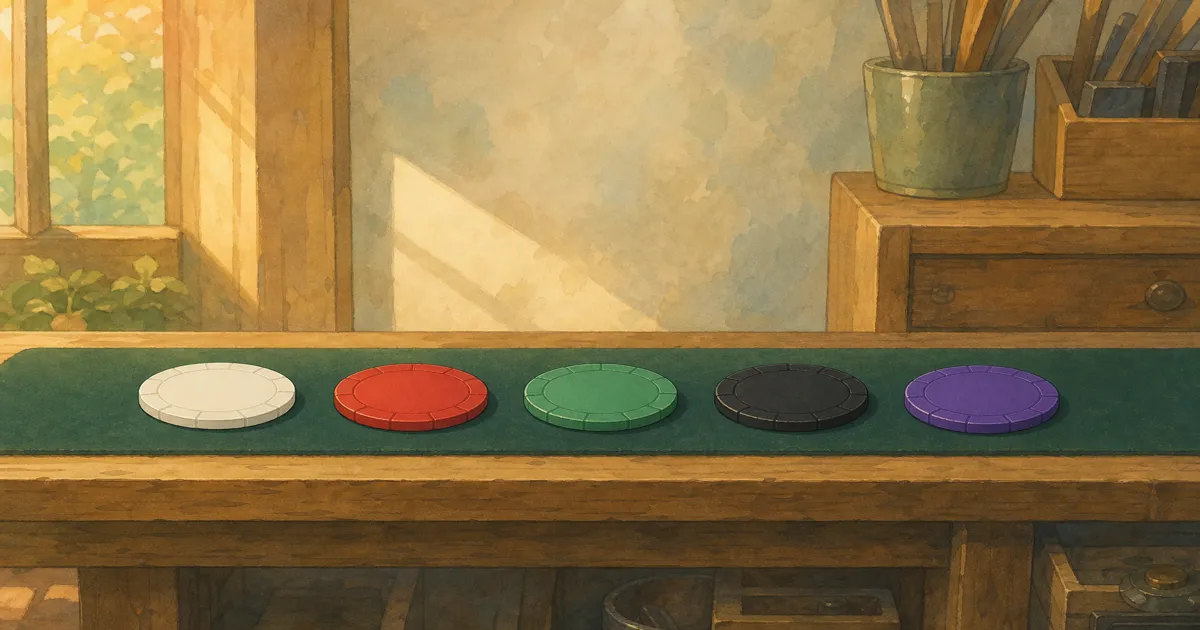
White is not always $1 until your house says so. Use the familiar cash-game colour ladder, then print values clearly so no guest has to guess.
Retail sets train you to think equal stacks of five colours - pretty on a shelf, wrong for dealing. Standard poker chip colours are a shorthand for value, not a guarantee. This guide maps the US ladder for cash and tournaments, explains where rooms diverge, and shows how to translate colours into a factory order without guest confusion.
Poker chip colors at a glance
| Colour | Typical US cash value | Typical tournament points | Quick mnemonic |
|---|---|---|---|
| White | $1 | - (cash change) | Smallest cash chip |
| Red | $5 | Sometimes 100 | Workhorse pots |
| Green | $25 | 25 | Rebuys / mid stack |
| Black | $100 | 100 | Deep cash / T100 |
| Purple | $500 | 500 | High limits only |
| Yellow / gold | Rare at home | 1,000 | Late tournament |
Memorise the cash ladder first - then override with printed faces if your house rules differ. Full buy-in splits: cash game poker chip denominations. Guests who struggle to tell red from green under warm lamps should read colour-blind-friendly custom poker chips before you lock body hues.
What color is each cash chip?
| Face value | Conventional US poker chip color | Home-game tip |
|---|---|---|
| $1 | White | Keep the heaviest count on white |
| $5 | Red | Most pots - do not under-order |
| $25 | Green | Fewer chips; higher value |
| $100 | Black | Only when buy-ins justify it |
| $500 | Purple | Rare below serious high-stakes home |
Tournament hosts: the same hues often mean points, not dollars - green 25, black 100, purple 500. Never cash out tournament colours at dollar face without a published conversion table.
Why Standard Poker Chip Colours Exist
Casinos need dealers and surveillance to read stacks from a distance. A consistent colour → value map speeds payouts and reduces theft. Home games inherited the same conventions from televised cash games - even when stakes are 25c/50c instead of $2/$5.
Three facts every host should know:
| Fact | Implication |
|---|---|
| Colour is conventional, not universal | A green chip might be $25 cash or 25 points in a tournament |
| Values beat hues | Printed $5 on the face beats arguing whether red "looks like five" |
| More colours ≠ better set | Three or four cash values cover most home nights |
If guests rotate or stakes change, skip memory games - read poker chips with denominations and print values on each colour.
Set the colour rule before players sit down
The safest home-game system is simple: announce the value ladder, put it on the chip face, and keep the same colours each time the group plays. This matters most when you host new players, change stakes, or use chips for a charity event.
If you reuse a familiar colour for a different value, make the printed denomination large and high contrast. A quick one-page table sign by the dealer also prevents the small pauses that turn into arguments later in the night.
Standard US Cash Game Colours
This is the ladder most US players expect on TV and in card rooms:
| Colour | Standard cash value | Typical role |
|---|---|---|
| White | $1 | Blinds, small bets, change |
| Red | $5 | Workhorse - most pots |
| Green | $25 | Rebuys, deeper stacks |
| Black | $100 | High buy-ins, thick stacks |
| Purple | $500 | Rare at home; high-stakes only |
Extended colours you may see on TV or in regional rooms:
| Colour | Sometimes used for | Home-game note |
|---|---|---|
| Blue | $10 cash or 50 tournament points | Often skipped in home cash - jump $5 → $25 |
| Yellow / gold | 1,000 tournament points | Late tournament levels |
| Orange / grey | 5,000+ tournament points | Plaque territory - not typical home cash |
Full buy-in splits, $1/$2 host charts, and order quantities: cash game poker chip denominations.
Tournament Colours vs Cash Colours
Tournament chips are scoring tokens - not dollars until payout. Hosts reuse familiar hues but assign points:
| Colour | Typical tournament value | Cash equivalent? |
|---|---|---|
| Green | 25 | No - points only |
| Black | 100 | No |
| Purple / blue | 500 | No |
| Yellow / gold | 1,000 | No |
Never cash out tournament point chips at dollar face value without a published conversion table. Dual-format inventory rules: one set for tournament and cash. Stack math and colour-ups: tournament chip denominations.
When Colours Differ by Room or Region
| Situation | What changes | What hosts should do |
|---|---|---|
| UK / Europe cash | Same ladder, £ values (£1 / £5 / £25 / £100) | Post currency on chart - see UK buying guide for delivery only |
| Micro stakes | 25c / $1 / $5 instead of dollar ladder | Use white or blue for 25c - print face value |
| High-stakes home | Purple $500 enters play | Add colour only when buy-ins justify it |
| TV prop sets | Fictional colours | Not a buying guide - order your ladder |
Practical rule: if your group changes stakes seasonally, print values on custom chips rather than retraining everyone on a new colour map.
Picking Colours for a Custom Order
Factories offer dozens of body colours and edge spots. Choose for contrast at the table, not shelf aesthetics:
| Decision | Guidance |
|---|---|
| Contrast | Adjacent denominations should look distinct under your room lighting |
| Readability | Dark body + light centre numeral (or vice versa) beats same-tone stacks |
| Edge spots | Help players tell denominations by feel in low light - see edge spots guide |
| Quantity per colour | Weight low values heaviest - not equal counts per hue |
Clay vs ceramic colour control:
| Line | What you customise |
|---|---|
| Custom clay | Printed inlay artwork; body/edge from factory mould options |
| Custom ceramic | Full-face print including bold centre numerals; optional per-denomination body colour |
Mock layouts free in Label Studio. When you are ready to price 200 × $5 red and 80 × $25 green, use the instant quote tool - itemised totals in under a minute.
Common Colour Mistakes
| Mistake | Why it hurts | Fix |
|---|---|---|
| Equal counts per colour | Short on $1 and 25c every night | Follow distribution tables |
| Too many close values | $5 and $10 both red-adjacent hues | Skip $10 - use 4×–5× jumps |
| Tournament colours in a cash pot | Expensive cash-out errors | Separate sets or print $ vs points on faces |
| Low-contrast greens | Two greens look identical on felt | Pick distinct body colours + printed values |
| Choosing colour before stakes | Wrong inventory for your blinds | Map denominations to blinds first |
Next Steps
- Values and buy-in splits → Cash game poker chip denominations
- Printing values on each chip → Poker chips with denominations
- Choosing material → How to choose custom poker chips
- Ready to order → Get an instant quote
When your colour ladder is set, get an instant quote with exact counts per denomination - from $1.10/chip ceramic (300 MOQ) or $1.14/chip clay (500 MOQ).