

Custom Poker Chips: One Set for Tournament and Cash Games?
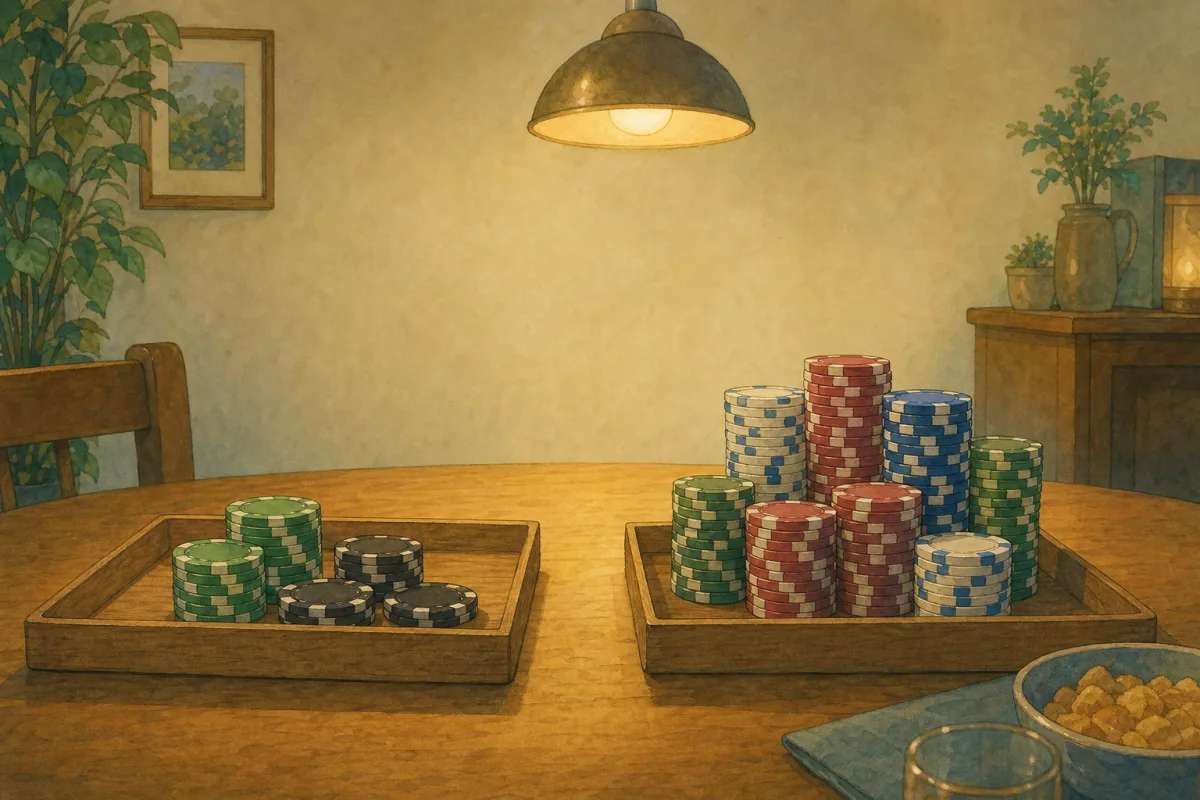
You host Friday cash and monthly tournaments on the same table. Here is how to spec one custom chip set for both - without mixing up payouts at midnight.
Most home groups do not live in a single format. Friday is $1/$2 with real money on the table; once a month someone runs a 10,000-point freezeout for pride and a trophy. Buying two complete custom sets is ideal for a busy club - but many hosts want one investment that serves both. That is workable with clear labelling and inventory planning, not with “we will remember which is which.”
This guide sits in the planning-sizing cluster: it assumes you already know how many chips you need in total - see how many custom poker chips for a home game - and focuses on making one set honest for two game types. For cash-only ladders, use the cash game poker chip denominations guide; for tournament ladders, the tournament denominations guide.
Why one set fails without a labelling plan
Dual-format pain usually shows up at cash-out, not during play:
- A guest stacks tournament 500s beside cash $25s because the green body colour matches
- Someone assumes 100 on the chip face means $100, not 100 tournament points
- The bank runs out of $1s on cash night because half the whites are locked in a tournament colour-up bag from last month
Custom chips fix the feel problem retail sets leave behind - but they do not fix ambiguous values. Printing denominations on every face is the point of ordering custom; use that surface to separate formats, not to decorate.
Cash vs tournament values on the same inventory
| Format | What the number means | Symbol on chip | Typical ladder |
|---|---|---|---|
| Cash | Real money in play | $ (or local currency) | $1 / $5 / $25 / $100 |
| Tournament | Points with no cash value | None - unitless | 25 / 100 / 500 / 1,000 |
Never run a tournament where chips could be mistaken for cash unless everyone signed up for that explicit structure (rare in home games). Never reuse the same printed value on the same body colour for both formats - e.g. a green $25 cash chip and a green 500 tournament chip is a lawsuit waiting for dim lighting.
Practical split strategies
| Strategy | Best for | Trade-off |
|---|---|---|
| Separate colour families | Weekly hosts who switch monthly | Needs 4+ colours per format in a large set |
| Shared lows, split highs | Small 700-chip sets | Only works if cash and tournament never share a session |
| Two labelled bank trays | Same table, same chips | Host discipline - trays go away in the closet between modes |
| Second 300–500 chip order | Busy club | Extra cost, zero ambiguity |
Sizing one set for both formats
Work from peak demand, not average Friday.
Cash night (9 players, $1/$2, $200 buy-in)
- 50–75 chips per player in play
- Bank weighted to $1 and $5 - roughly 4:3:2:1 across the ladder
- Total with bank: ~650–750 chips for this table size
Full splits and the 4× rule live in the cash game denominations guide.
Tournament night (10 players, 10,000-point start)
- ~95 physical chips per player in a full rack - mostly 25s and 100s
- Starting stack slightly over 10,000 points is normal (e.g. 11,500), then colour up at the first break
- Total with 20–30% bank: ~1,000–1,200 chips
Tournament breakdown tables and blind alignment: poker tournament chip denominations guide.
One order that covers both
| Players | Dual-use target | Notes |
|---|---|---|
| 6–8 | 700–800 chips | Cash-heavy group; compact tournament stacks labelled minimum if supply is tight only |
| 9–10 | 900–1,100 chips | Sweet spot for full-rack tournaments plus cash bank |
| Club with rebuys | 1,200+ | Plan bank using rebuy chip bank guide |
If the quote tool shows ceramic from $1.10/chip at 500 minimum or clay from $1.28/chip at 500, price your dual-use count in the instant quote before you shrink the order to fit one format only.
Design choices that prevent expensive mistakes
Custom artwork should make format obvious at a glance:
- Cash chips - centre $ value + host logo; ring text optional
- Tournament chips - unitless centre value; consider “TOURNAMENT” or season name on the ring so cash guests do not assume currency
- Different layout per format - cash uses logo centre / value ring; tournament uses value centre / league name ring (or the reverse - just stay consistent within each format)
- Mock before you commit - Label Studio is free for layout; production proofs still refine CMYK spacing
Clay printed inlays carry the sharpest small type if you pack ring denominations; ceramic direct print suits bold centre values. Same printable face area on both lines - detail fidelity differs. See clay vs ceramic custom poker chips.
For edge spot contrast on Full Chip Customisation ceramic orders, rim colour planning is separate from face text - custom poker chip edge spots guide.
Session checklist: switching formats on one set
Before cash night
- Pull only cash-labelled colours into the bank tray
- Bag or shelf tournament colours in another room - not the dealer tray
- Post stakes on a card: $1/$2, $200 max buy-in (example)
- Confirm no tournament chips on the felt from last month
Before tournament night
- Issue unitless stacks per the published structure - 50–100 physical chips per player for a full-rack feel
- Announce no cash value before hand one
- Schedule colour-ups at breaks - home tournament colour-up guide
- Keep cash $ chips off the table entirely
After either session
- Reconcile the bank back to labelled trays
- Note low denominations for reorder before the next season - reorder and colour matching
Common mistakes (dual-format hosts)
| Mistake | Why it hurts | Fix |
|---|---|---|
| Same body colour, different meanings | Cash-out disputes | Distinct art per format; never rely on colour memory |
| Tournament 25 on a chip that looks like $25 | Guests confuse points and dollars | Unitless tournament faces; $ on all cash faces |
| Ordering for cash only (500 chips) | Tournament night feels chip-starved | Size to ~1,000 or accept compact minimum stacks - label them |
| Skipping printed denominations | “We always play the same” until a new guest arrives | Print values - custom chips exist to remove ambiguity |
| Mixing formats same night without house rules | Side-game chaos | One format per session unless you are a card room with staff |
When to buy two sets instead of one
Split into two custom orders when:
- Cash and tournaments run in the same week with overlapping guests
- Inventory fights - not enough 25s for tournaments after you weighted $1s for cash
- Two hosts store chips in different houses (home poker league model)
- Branding differs - corporate cash game vs league trophy event
A second order matching your proof is often faster than redesigning one confused set. Poker Foundry retains production files for colour-matched reorders.
Poker Foundry angle
Dual-format hosts benefit most from printed denominations, consistent proofs, and honest quantity quoting. Whether you land on 900 or 1,100 chips, the instant quote itemises clay and ceramic with worldwide shipping - no sales call required. Browse the gallery for centre-value vs ring-value layouts that keep cash and tournament sets readable under the same pendant lamp.
Next steps
- Pick your busier format and size total inventory to that peak
- Separate cash ($) and tournament (unitless) artwork on different colours
- Mock layouts in Label Studio or upload print-ready art
- Get an instant quote at your dual-use chip count
One custom set for tournament and cash is a labelling and storage problem before it is a manufacturing problem. Get those right and a single 10g inventory can serve your group for years.