

Custom Poker Chips Security: RFID, UV and What Your Game Needs
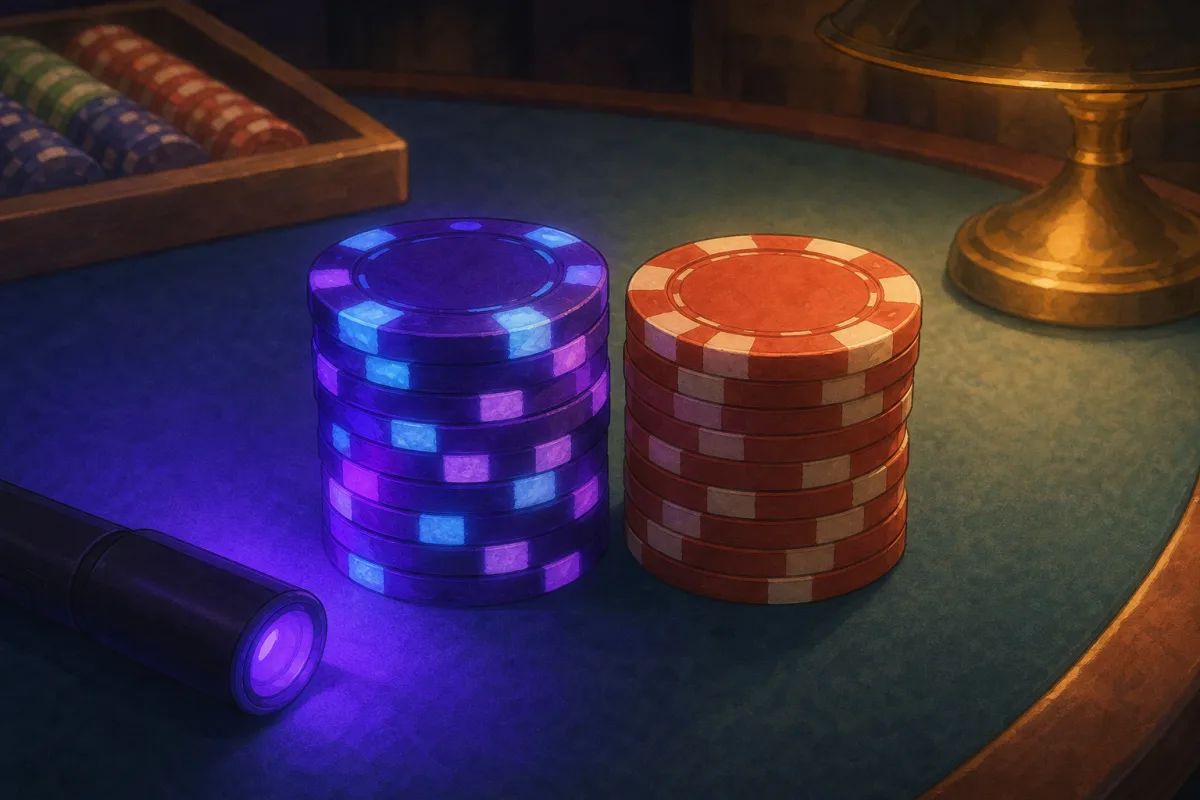
Casino chips use RFID tags, UV ink, and locked moulds - standard custom orders cover most clubs, but RFID and covert UV are available on request. Here is what each layer does and when to talk to us.
Search “RFID poker chips” or “UV poker chips” and you will find factory listings, patent diagrams, and forum threads about Ellis Island craps tables - not much that explains what your weekly game actually needs. This guide separates casino-floor technology from custom orders, so you do not over-buy gimmicks or under-spec a club set. For how chips are moulded and printed in the first place, start with how custom poker chips are made; for a short historical arc including RFID and UV, see the history of poker chips.
Why Poker Chips Need Security at All
A chip is an IOU for cash. Casinos must know:
- How many chips left the cage
- Which table they are on
- Whether a stack presented for cash-out is genuine property issue
Home games rarely run cage liability at that scale - but trust still matters. A player who slips in lookalike plastic from a discount set can steal value if denominations are vague and colours generic. Security is not only RFID; it is anything that makes foreign chips obvious and house chips hard to fake. Live stream hosts lean on the same principle - distinct custom artwork reads on camera and signals integrity to viewers; see custom poker chips for live stream home games.
Casino Chip Security: The Full Stack
Major venues combine physical, optical, and electronic layers. None of them alone is enough.
| Layer | What it does | Typical use |
|---|---|---|
| Proprietary mould & edge spots | Unique shape, bevel, and colour bands staff recognise by eye | Every table |
| UV / covert ink | Hidden marks visible under blacklight | Pit checks, surveillance |
| Microtext & fine patterns | Details hard to photocopy onto counterfeits | High-value denominations |
| Serialisation / inventory | Cage tracks issue and redemption | Cage and count rooms |
| RFID tags | Unique ID read without line-of-sight | Inventory, some table games, high-limit |
| Procedure | Who can bring chips in, colour-up rules, out-of-play racks | Floor + cage |
Regulated jurisdictions also audit manufacturers - artwork, moulds, samples, and scrap - so chips are not something a random print shop can replicate overnight. That is why “casino chip” and “casino-grade custom chip” are related but not identical products.
RFID Poker Chips: How They Work
RFID (radio-frequency identification) embeds a small transponder inside the chip body during manufacturing. A reader sends a radio signal; the tag returns a unique identifier (and sometimes encrypted data).
What casinos use it for:
- Inventory - how many $25 chips are on the floor vs in the vault
- Authentication - does this chip belong to this property?
- Table automation - some layouts (notably certain craps and experimental poker setups) read bets in real time
- Loss prevention - flagged chips leaving permitted areas
What RFID is not:
- A magic “anti-cheat” button for home poker - you need readers, software, and tagged chips designed for that system
- Standard on every $1 chip - properties often RFID higher denominations or specific games first
- Something you add with a hobby kit - tags sit inside the composite during moulding
For a home host, RFID is usually engineering and cost overkill unless you are building a commercial card room with vendor support. The interesting lesson is simpler: casinos secure chips by making each one identifiable in a system, not only by making them heavy.
If you do need RFID chips: tags must be ordered with the chip run, matched to your reader frequency, and planned alongside table or cage hardware. That is outside our standard quote flow - email contact@pokerfoundry.net (or WhatsApp) with quantity, denominations, and any table vendor details so we can confirm what is buildable.
UV Poker Chips and Covert Markings
UV security means features visible under ultraviolet light - often edge spots, logos, or patterns invisible under normal room lighting.
Why venues like UV:
- Fast pit checks - tilt a stack under a wand without slowing the game
- Surveillance support - confirms a rack matches house issue
- Layered defence - counterfeiter must copy visible art and covert marks
Home-game reality:
- Retail sets sometimes advertise “UV chips” as a novelty - glow under a party blacklight, not the same as property-controlled covert design
- DIY UV ink on existing chips is unreliable (wear, inconsistency, safety) and does not integrate with cage records
- Custom factory artwork - edge spots, logos, denominations - gives you visible identity; covert UV is a manufacturer spec, not a DIY add-on
If you want players to recognise house chips instantly, invest in a distinct colour scheme and printed denominations first. Covert UV markings for club or commercial use can often be arranged at source when you brief us - same as RFID, it is a conversation, not a dropdown on the quote page.
Other Physical Security You Will Hear About
| Feature | Plain-English role |
|---|---|
| Edge spots | Coloured bands on the rim - quick denomination ID and brand signature |
| Inlay vs direct print | Clay inlays recess a printed label; ceramic bonds art to the face - both can be highly distinctive, neither is “RFID” by itself |
| Holograms / laser etch | Extra anti-copy layers on some casino issues |
| Weight & feel | 10g casino-standard chips handle differently from lightweight plastic - staff notice wrong “hand feel” |
| Controlled mould | Only one factory run uses your club mould geometry |
These are why a custom 10g set feels “secure” in a club even without electronics: copying your exact art + mould + weight at casual quality is not trivial.
Practical Security Without a Smart Table
What most home games and clubs do first:
- Custom design - logo, colours, and printed values unique to your game (personalised custom poker chips).
- Consistent denominations - no arguing whether the blue chip is $10 or $25.
- Controlled issue - one person stores the set; no foreign chips in play (state the rule clearly).
- Separate buy-in tray - players trade cash for house chips once; no mid-game “I brought extras”.
- Photograph the set - insurance and identification if chips travel to pubs or events.
- Storage discipline - dry case, limited access (how to store custom poker chips).
Clubs running weekly games or leagues add:
- Member-only colours or seasonal edge-spot variants for tournaments
- Two-set rotation if volume wears one set faster
- Dealer training - spot wrong weight or missing edge pattern before a pot is pushed
That is the same philosophy as RFID - identify house issue quickly - without six-figure table infrastructure until you actually need it.
Bespoke Security: RFID, UV, and Beyond the Standard Quote
Our instant quote covers standard custom clay and ceramic - the line most home games, clubs, and events order. It is the fastest way to price 10g chips, artwork, quantity, and delivery timeline.
Advanced or casino-style security sits outside that configurator but is still in scope for Poker Foundry:
| Requirement | Typical approach |
|---|---|
| RFID-tagged chips | Factory-embedded transponders matched to your reader spec |
| Covert UV / security ink | Manufacturer-applied markings for pit or surveillance checks |
| Unusual moulds, edge treatments, or materials | Sourced through the same specialist factories we use for standard runs |
| Very large or multi-property programmes | Custom production planning, phased delivery |
We do not sell RFID chips off the shelf like a catalogue SKU. We resolve the requirement - feasibility, factory capability, MOQ, lead time, and price - then produce if it stacks up. If you are not sure whether your idea is realistic, that is exactly what the conversation is for.
How to brief us: email contact@pokerfoundry.net (WhatsApp available) with:
- Chip quantity and denominations
- Clay, ceramic, or “not sure yet”
- What you are solving (RFID inventory, UV pit checks, anti-counterfeit, etc.)
- Any table vendor, reader frequency, or compliance notes you already have
We will come back with what is possible - or an honest no if the spec does not fit factory capability.
Standard Custom vs Property Casino Chips
Casino-grade custom on a standard order means:
- 10g professional composite bodies
- Factory moulding and permanent artwork (inlay or direct print)
- Your brand, denominations, and colours
- Durability rated for 25,000+ (clay) or 50,000+ (ceramic) impact cycles
Not included unless you ask:
- RFID transponders or cage integration
- Another casino’s proprietary UV package or mould
- Legal tender status - chips redeem only where your rules say they do
We match the material and manufacturing families serious rooms use. We do not copy another venue’s regulated cage chip. Your advanced security features - when buildable - are specified with us, not lifted from a rival property’s mould.
For material choice when security means durability and legibility, compare clay vs ceramic custom poker chips. Customisation: default ceramic is label artwork on stock bodies; Full Chip Customisation adds custom body and edge spots per denomination - clay is label inlay only.
Common Security Mistakes (Home Games and Clubs)
| Mistake | Why it hurts | Fix |
|---|---|---|
| Buying “RFID chips” with no readers | Paying for tags you cannot use | Confirm reader spec first, then email contact@pokerfoundry.net for a bespoke RFID run |
| Generic Amazon colours | Easy to match from any discount set | Custom denominations and distinctive art |
| Letting players supply chips | Opens door to smuggled stacks | House issue only |
| Assuming heavy = secure | 14g plastic feels dense but copies easily | 10g composite with custom print |
| Believing UV pens fix security | Wears off; inconsistent | Factory custom design |
| No storage control | Sets walk out; mix with other games | Locked case, inventory before/after |
When to Upgrade Security Further
| Your situation | Sensible next step |
|---|---|
| Weekly home game, trust issues with generic plastic | Standard custom - art, weight, denominations (instant quote) |
| Club with cash games and repeat players | Standard custom + procedural issue rules; add UV or RFID only if compliance or scale justifies it |
| Commercial card room, RFID tables on order | Contact us before you lock chip spec - tags and readers must align |
For most readers, the right path is:
- Stop using ambiguous plastic
- Order custom casino-grade chips sized for your game (how many chips for a home game)
- Document and store the set (storage guide)
- Email us if you later need RFID, covert UV, or a non-standard security brief
Next Steps
Standard custom clay or ceramic: Get an instant quote - itemised pricing in under a minute.
RFID, UV, or anything not in the quote tool: email contact@pokerfoundry.net (WhatsApp available - see about Poker Foundry) with your brief. We will tell you what our factories can build - and what lead time to expect.
Browse the gallery for real club and home-game sets while you plan your spec.