

Dogs Playing Poker: Artist, Meaning and What They Are Worth
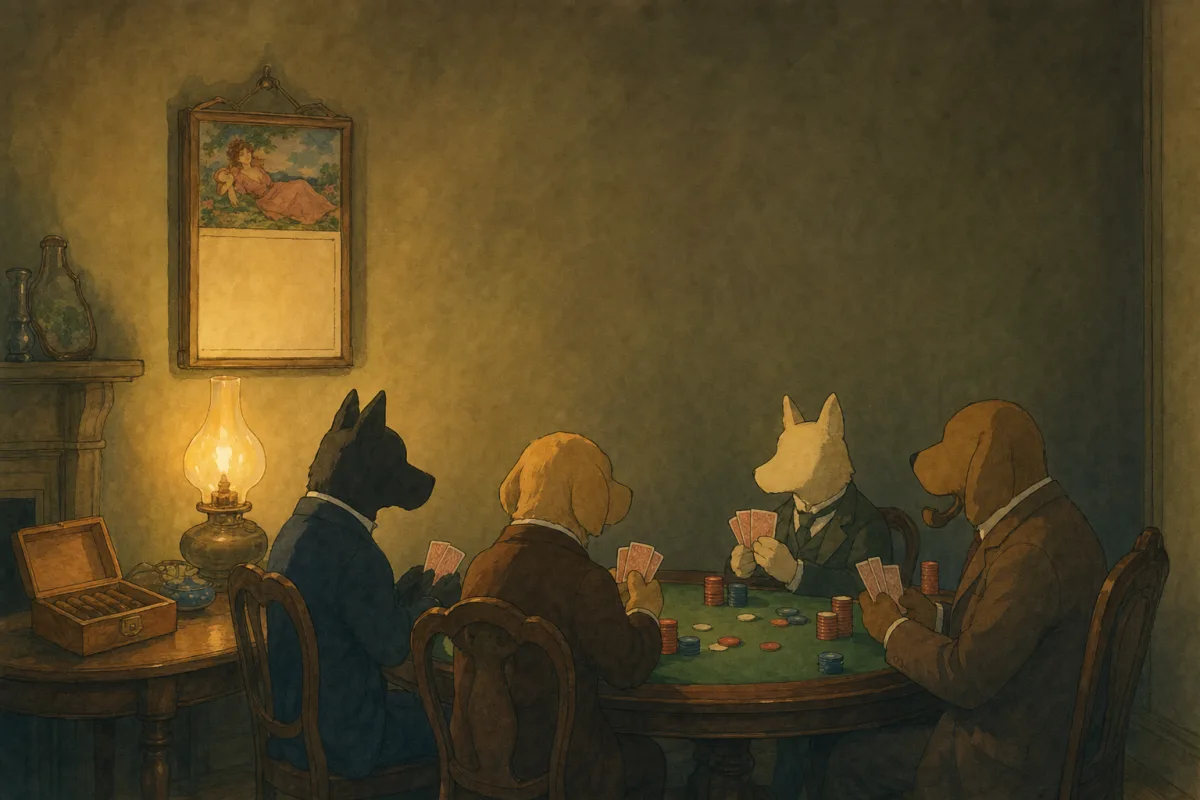
Dogs Playing Poker means the Coolidge calendar paintings, not one canvas. Here is who painted them, what they mean, and what originals sell for.
Authenticated originals sell for roughly $74,000–$658,000 at auction. Posters and puzzles cost $10–$40. Jump to which canvas is on your wall or what Dogs Playing Poker is worth.
This is cultural history, not a chip-buying guide. The same card table Coolidge lampooned is still the one hosts set with casino-grade custom chips tonight.
Dogs Playing Poker: quick answers
Most people arrive with one of three questions: who painted it, which canvas is the famous cheat, or whether a dorm-room poster is worth anything. This section answers those directly before the deeper art history below.
| Question | Short answer |
|---|---|
| Who painted Dogs Playing Poker? | Cassius Marcellus Coolidge (1844–1934), signing some work "Kash Koolidge" |
| How many paintings are there? | Sixteen dog oils for Brown & Bigelow; nine are poker scenes |
| Which painting is on every poster? | Usually A Friend in Need - ace under the paw |
| Is it one painting or a series? | A series - bluff pairs, train games, police raids, post-hand arguments |
| Are they "real" art? | Commercial illustration that became folk icon - auction prices disagree with old critics |
Dogs playing poker as a topic is almost never about live WSOP chip specs or home-game denominations. If you landed here for table gear, start at how to choose custom poker chips. If you want game-room décor that nods to the same saloon culture Coolidge painted, browse the gallery or read poker chip artwork design.
What does Dogs Playing Poker mean?
The meaning of Dogs Playing Poker is the joke Coolidge was paid to make: poker as human comedy, played by hounds who bluff, cheat, and sulk exactly like the men watching from the barbershop chair. The dogs are stand-ins for human foibles, and the table is a portrait of male social ritual at a moment when poker was a saloon and cigar-lounge game, not a televised sport.
Three readings cover almost every "meaning" search:
| Reading | What it points to |
|---|---|
| Satire of vice | Bluffing, collusion, and post-hand arguments at A Friend in Need and Post Mortem |
| Comfort and camaraderie | The warm, low-lit table in A Bold Bluff and Waterloo |
| Advertising art | Brown & Bigelow calendar imagery built to sell cigars, not philosophy |
So the honest answer is that the series does not carry one hidden symbol. It is commercial illustration that became folk icon because the behaviour it mocked is the behaviour every home game still produces. That is why the images hang in card rooms today, next to the modern chips hosts order for their own tables.
Dogs playing poker artist: Cassius Marcellus Coolidge
When people ask for the dogs playing poker artist, they almost always mean Cassius Marcellus Coolidge - not a contemporary painter and not a single canvas signed Dogs Playing Poker.
| Fact | Detail |
|---|---|
| Full name | Cassius Marcellus Coolidge (1844–1934) |
| Also searched as | C.M. Coolidge, CM Coolidge, Cash Coolidge |
| Nickname / signature | "Cash" Coolidge; signed some work "Kash Koolidge" |
| Birthplace | Antwerp, New York - upstate, not the Belgian city |
| Day jobs | Banking, newspapers, sign painting, comic illustration; also pioneered carnival "comic foregrounds" (face-in-hole photo boards) |
| Famous commission | Brown & Bigelow calendar art from 1903 |
| Earlier poker prototype | Poker Game (1894) - predates the ad series |
Coolidge was a jobbing American illustrator, not a salon painter like Cézanne or Caravaggio. He invented the anthropomorphic dogs at cards motif for mass print, which is why Wikipedia, Artsy, Artsper, and dogsplayingpoker.org all cite him - and why auction houses still attach six-figure estimates to authenticated original oils.
C.M. Coolidge dogs playing poker: why the initials stick
Searches for cm coolidge dogs playing poker and c.m. coolidge dogs playing poker are the same person as Cassius Marcellus Coolidge. Calendar captions and auction lots often compress the name to C.M. Coolidge - the form most collectors typed on print backs for a century. If a listing says C.M. Coolidge without a title, ask which scene: most wall prints still reproduce A Friend in Need, not the full sixteen-painting run.
For the European cheat tradition Coolidge parodied - marked cards, signals, hidden aces - see Caravaggio's The Cardsharps. For what eventually sat on saloon tables after calendar art went mass-market, see history of poker chips.
Complete Dogs Playing Poker series: all sixteen titles
Collectors and poster shops blur the nine poker scenes with seven non-poker dog oils. This table is the full Brown & Bigelow run - use it when a search says "dogs poker painting" or "how many Dogs Playing Poker paintings":
| # | Title (common) | Year | Poker? | Scene |
|---|---|---|---|---|
| 1 | Poker Game | 1894 | Yes | Prototype - tighter table, fewer dogs |
| 2 | A Bold Bluff | 1903 | Yes | St Bernard pushes chips forward |
| 3 | Waterloo | 1903 | Yes | Pair to A Bold Bluff - pot collected |
| 4 | A Friend in Need | 1903 | Yes | Ace under the paw - default poster image |
| 5 | His Station and Four Aces | 1903 | Yes | Dogs deal on a train |
| 6 | Pinched with Four Aces | 1903 | Yes | Police raid mid-hand |
| 7 | Poker Sympathy | 1903 | Yes | Loser consoled or mocked |
| 8 | Post Mortem | 1903 | Yes | After the hand - cigars, argument |
| 9 | Stranger in Camp | 1903 | Yes | Campfire poker |
| 10 | Sitting up with a Sick Friend | 1903 | Yes | Cover story for cards |
| 11 | New Year's Eve in Dogville | 1903 | No | Dogs dancing |
| 12 | One to Tie Two to Win | 1903 | No | Dogs at baseball |
| 13 | Kelly Pool | 1903 | No | Dogs at billiards |
| 14 | Riding the Goat | 1903 | No | Masonic initiation joke |
| 15 | Breaching the Monocle | 1903 | No | Dogs in court |
| 16 | Looks Like Four of a Kind | 1910 | No | Dogs testifying |
Only rows 1–10 are poker-table scenes. Retail collage posters often mash #4 with fragments of #2–#9 - which is why "painting of dogs playing poker" feels like one image when it is really a print franchise.
Dogs playing poker painting: which canvas is on your wall?
When someone says dogs playing poker painting, they usually want one painting identified, not the full sixteen-painting catalogue. Use this flow before you price anything:
| You see… | Likely Coolidge title | Year | Notes |
|---|---|---|---|
| Bulldog passing a card under the table | A Friend in Need | 1903 | Default poster and meme image |
| St Bernard pushing chips, then collecting | A Bold Bluff + Waterloo | 1903 | Two-panel story - pairs sell together at auction |
| Dogs on a train dealing cards | His Station and Four Aces | 1903 | Travel setting |
| Police bursting in mid-hand | Pinched with Four Aces | 1903 | Raid comedy |
| Argument after the pot | Post Mortem | 1903 | Cigars and post-hand debate |
| Collage of nine scenes | Series mash-up | - | Licensed print - not one original composition |
| Signed oil, heavy canvas, provenance papers | Varies | 1894–1910 | Auction house territory - see worth table |
Poster sizes on mass-market prints are usually 18×24 in, 24×36 in, or panoramic collage formats - none of those dimensions authenticate an original. Brown & Bigelow built the franchise for barbershop walls, not museum vitrines.
Painting of dogs playing poker: prints, posters, and auction originals
Painting of dogs playing poker usually means A Friend in Need or a licensed reproduction - not a single museum title on the wall. Know which market you are in before you compare prices:
| What you are buying | Typical price | What you get |
|---|---|---|
| Unframed poster / puzzle | $10–$40 | Unlimited print - what most walls show |
| Tapestry / giclée | $50–$300 | Licensed decor (Amazon, art retailers) |
| Authenticated original oil | $74,000–$658,000+ | Coolidge's hand - rare at auction |
The painting of dogs playing poker on a thrift-store frame is virtually always a reproduction. Brown & Bigelow designed the series for mass distribution - millions of cheap colour prints in barbershops and saloons - so scarcity applies to canvases, not cultural reach. Full auction table: how much are Dogs Playing Poker worth?
Dogs gambling painting: what the phrase means
Dogs gambling painting is informal shorthand for Cassius Marcellus Coolidge's Dogs Playing Poker oils - the 1903–1910s calendar commission where anthropomorphic hounds bluff, cheat, and argue over pots. The phrase does not name one official museum title; it usually means either A Friend in Need (the ace-under-the-paw cheat) or the whole nine-painting poker subset Brown & Bigelow printed by the million.
| Common phrase | What people usually mean | Coolidge answer |
|---|---|---|
| Dogs gambling painting | The famous card-table dogs image | A Friend in Need or the full poker series |
| Dogs playing cards painting | Same art - slightly different wording | Same nine poker scenes |
| Painting poker dogs | Biography + which canvas is which | This guide |
| Dogs playing poker worth | Print vs auction original prices | See auction table below |
Coolidge was not painting modern casino chips or WSOP stacks - his counters read as generic gambling tokens. The joke still lands because the table behaviour (bluffing, collusion, post-hand arguments) is what hosts recreate today with casino-grade custom chips.
Painting poker dogs: what the phrase refers to
Painting poker dogs and Dogs Playing Poker point at the same Coolidge calendar commission - not a single canvas in a museum labelled with one official title. The confusion is understandable: sixteen dog oils exist, only nine are poker scenes, and reproductions rarely name the individual painting.
| If you mean… | Coolidge title (1903 unless noted) | What you will recognise |
|---|---|---|
| The cheating image | A Friend in Need | Bulldog passes an ace under the table |
| The bluff pair | A Bold Bluff + Waterloo | St Bernard pushes chips, then collects |
| The earlier prototype | Poker Game (1894) | Tighter composition, same premise |
| Police raid comedy | Pinched with Four Aces | Dogs caught mid-deal |
| After the hand | Post Mortem | Cigars and argument over the pot |
Non-poker Coolidge dogs - baseball, New Year's dance, court testimony - share the Brown & Bigelow print run but are not what poker players mean by "the painting." For chip history on those same saloon tables, see history of poker chips.
Before the meme: Coolidge and Brown & Bigelow
Cassius Marcellus Coolidge - "Cash" to friends, "Kash" on some canvases - was a jobbing American illustrator long before poker went on television. Born in 1844 in Antwerp, New York, he worked in banking, newspapers, and sign painting while producing comic scenes of dogs behaving like people.
In 1903, the St Paul firm Brown & Bigelow hired him for a run of calendar art. Their business model was simple: give barbershops, tobacconists, and saloons a free decorative print that kept a brand name in view all year. Coolidge's dogs were instantly readable - funny, slightly louche, and perfect for rooms where men already gathered to smoke and talk.
The commission was not a single painting. Coolidge delivered sixteen oils over roughly a decade. Only nine are poker scenes; the rest show dogs testifying in court, playing baseball, dancing on New Year's Eve, and getting pinched by police mid-hand. Poker was one human habit among many - but it was the one that stuck.
For the longer arc of what sat on those tables before modern chips, see our history of poker chips - tokens, fraud, and factory clay in parallel with Coolidge's saloon world.
The poker paintings: bluff, cheat, and sympathy
Coolidge treated poker as storytelling - sequential narratives you could read across a calendar year.
| Painting (1903 unless noted) | What happens at the table |
|---|---|
| A Bold Bluff | A St Bernard pushes chips forward; the other dogs study his face |
| Waterloo | The same hand resolves - the bluff worked, the pot is pushed |
| A Friend in Need | A bulldog passes an ace beneath the table to an ally |
| His Station and Four Aces | Dogs play on a train - travel and cards as twin pastimes |
| Pinched with Four Aces | Police raid an illegal game mid-deal |
| Poker Sympathy | One dog loses; the others react with mockery or consolation |
| Post Mortem | After the hand - cigars, post-mortem analysis, camaraderie |
| Stranger in Camp | Poker in a camping setting - frontier leisure |
| Sitting up with a Sick Friend | A cover story for cards - social excuse as old as the game |
| Poker Game (1894) | The earlier prototype - tighter composition, same premise |
Notice what is absent: televised hole cards, WSOP branding, standardised casino chips. Coolidge's dogs bet with generic counters and piles of chips that read as "gambling" rather than a specific denomination ladder. That vagueness helped - viewers filled in their own local game.
The A Bold Bluff / Waterloo pair is the clearest two-panel comic. In 2006, Doyle New York auctioned what may be the originals of the Brown & Bigelow versions for $590,400 - then a record for Coolidge, demolishing the previous $74,000 high mark.
Why Dogs Playing Poker became iconic
Several forces turned calendar filler into folklore:
| Factor | Effect |
|---|---|
| Mass reproduction | Cheap prints in barbershops, bars, and basements - seen by millions who never visited a museum |
| Anthropomorphic humour | Dogs bluff badly, cheat openly, and mope - human foibles without human sitters |
| Poker as male social space | The paintings mirror real home games and saloon tables - exclusive, comic, slightly illicit |
| Kitsch embrace | Ironically hung in dorm rooms and TV sets (Cheers, Roseanne, countless films) - familiarity outlasted the snobbery |
| Auction shock | Six-figure prices forced art pages to take Coolidge seriously again |
A Friend in Need - the ace-up-the-paw cheat - is the default mental image when someone says "Dogs Playing Poker." It is also the painting most poker players quietly recognise: the collusion joke, the soft light, the low furniture. Coolidge drew the social texture of a home game even while painting spaniels.
Kitsch, class, and the "real" card-table tradition
Art historians have long separated Coolidge from the European card-player tradition - Caravaggio's cheats, Cézanne's silent peasants, Hockney's studio friends. Fair enough: Coolidge was selling cigars, not pursuing perspective theory.
But the line is not as clean as snobbery suggests. All of these artists ask: what do people look like when cards matter?
| Tradition | Tone | Stakes on canvas |
|---|---|---|
| Caravaggio (The Cardsharps) | Deception, lost innocence | Hidden cards, signals - see our Caravaggio cardsharps guide |
| Cézanne (Card Players) | Gravity, timeless labour | No money, no chips - pure concentration |
| Coolidge (Dogs Playing Poker) | Comedy, bluff and cheat | Generic counters, narrative punchlines |
| Hockney (A Bigger Card Players) | Homage, perspective experiment | Folding table, photographic collage |
Coolidge sits closest to popular print culture - the same world that eventually bought plastic chip sets by the million before upgrading to custom clay. He did not paint how chips were made (that is a different story); he painted why people stayed up late playing.
How much are Dogs Playing Poker worth?
Searches for "how much are Dogs Playing Poker worth" usually mix up mass-market prints with auction originals. They are different markets:
| Item | Typical price | Notes |
|---|---|---|
| Poster / puzzle / dorm print | $10–$40 | Unlimited reproduction - what most walls show |
| Framed giclée or tapestry | $50–$300 | Licensed decor, not Coolidge's hand |
| Original oil at auction | $74,000–$658,000+ | Poker subjects command premiums when authenticated |
Recorded auction highs for poker scenes:
- Poker Game (1894) - $658,000 at Sotheby's New York (2015)
- A Bold Bluff + Waterloo - $590,400 at Doyle (2006)
- A Bold Bluff alone - $74,000 at Sotheby's (1999), the previous record
Reproduction prints are everywhere - and that was always the point. Brown & Bigelow wanted distribution, not museum prestige.
What is a poker dog?
"Poker dog" is informal shorthand for Coolidge's anthropomorphic players - bulldogs, St Bernards, and mixed breeds seated at a felt table in waistcoats and collars. It is not modern table slang for a player type or a breed nickname.
Coolidge's dogs perform human poker habits: the St Bernard bluffs in A Bold Bluff, the bulldog passes an ace in A Friend in Need, the table argues in Post Mortem. That is why the meme still lands - the species is a costume for familiar host behaviour, not canine expertise.
Collecting Coolidge today
Original Coolidge oils appear rarely at auction. When they do, poker subjects command the premiums in the table above.
If you hang a reproduction in a game room, you are continuing a 120-year tradition of treating poker as room décor as much as sport - the same instinct that leads hosts to order personalised chip faces instead of anonymous plastic.
What Coolidge gets right about the table
Strip away the bulldogs and the joke is accurate:
- Bluffing is performance - the St Bernard's face is the whole plot in A Bold Bluff
- Collusion happens - A Friend in Need is funny because it is familiar
- The hand does not end at the river - Post Mortem is the post-hand argument, still the best part of many nights
- Poker needs a room - low lamp, close chairs, the outside world shut out
Modern hosts chase that feeling with weight, sound, and artwork on real chips - not calendar dogs. When your set is ready for the table, get an instant quote for casino-grade clay or ceramic. For how chips evolved from clay composites to today's 10g custom lines, read history of poker chips.
Why "dogs playing cards" still connects to poker culture
Dogs playing cards is overwhelmingly Coolidge art history - Wikipedia, auction houses, poster shops. Some readers also care about the card table in the paintings: the same social object hosts still recreate with felt, low light, stacked chips, and bluffing faces.
| If you are here for… | Start here |
|---|---|
| Art, posters, or auction prices | This guide - Coolidge biography and famous canvases |
| Poker room décor | Gallery, design guide |
| What a real table costs to set up | Value sweet spot, choose custom chips |
The table culture Coolidge mocked is why hosts still order custom chips today: denominations, weight, and artwork that survive weekly shuffles. Serious hosts comparing suppliers start at best custom poker chips for serious home games.
Collectibility parallel: Coolidge originals appreciate at auction; custom chip sets appreciate in nights played - not resale markets. Both are identity objects for the same room.
What remains
Dogs Playing Poker will never be Cézanne. It was never trying to be. Coolidge captured something else: the American card table as comedy, fraternity, and minor vice - reproduced on a million walls before anyone streamed a final table.
If you host a game this week, you owe him a small debt. Someone at your table will bluff too wide, complain too long, and pass a win across the felt like an ace under a paw. Coolidge saw it first - and painted it with spaniels.