

Mark Twain and Poker: Literary Culture at the Card Table
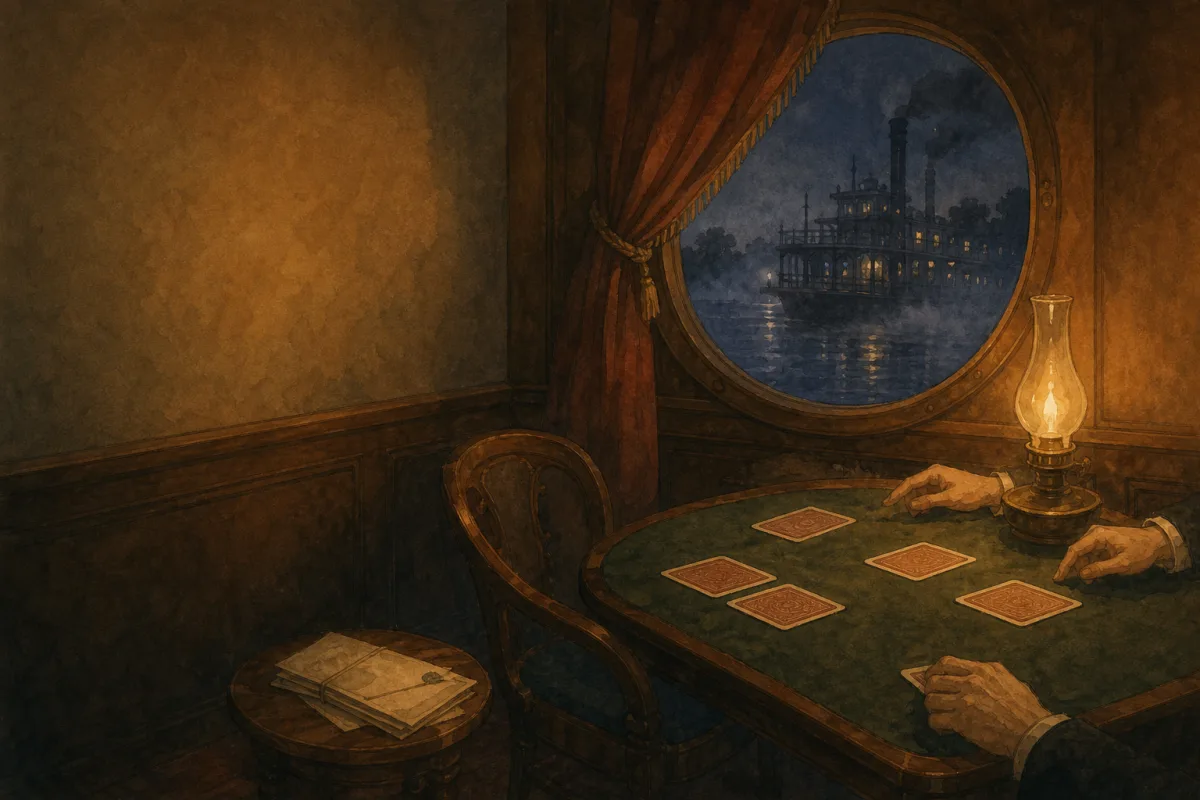
Before tournament points and custom inlays, Mark Twain was already arguing that poker belonged in polite conversation - and writing the funniest courtroom defence of the game America ever published.
Twain did not paint card players like Cézanne or film underground hold'em like Rounders. He wrote the American card table into literature - steamboat salons, frontier saloons, and the respectable argument that poker belongs in the conversation. For how tokens evolved into the 10g stacks hosts order today, see our history of poker chips; this piece is about words, law, and Mississippi river mist.
Twain on the Mississippi: draw poker before hold'em
Twain trained as a riverboat pilot on the Mississippi in the 1850s - the era that would feed Life on the Mississippi (1883). Steamboat culture ran on long evenings, strangers, and draw poker - five cards, betting rounds, no community board. Hustlers worked the passenger decks; Twain's own accounts suggest he played, but avoided the gun-belt professionals when he could.
That setting matters for modern readers:
| Then (Twain's era) | Now (home games) |
|---|---|
| Draw poker dominant | Hold'em and Omaha standard |
| Coins and improvised counters | Printed denomination chips |
| Saloon law patchy by state | Licensed rooms and private home games |
| Bluff as character test | Same - only the stakes changed |
The psychology Twain cared about - who folds, who chases, who cannot read a flush - survived every rule change.
"Science vs. Luck": poker on trial
Around 1867–1870, Twain published Science vs. Luck - a tall-tale legal sketch, not a transcript. The setup: twelve Kentucky schoolboys arrested for playing cards for money. Anti-gambling statutes targeted games of chance; the defence argues poker is science.
The judge, stuck, adopts the lawyer's proposal: impanel six deacons as the "chance" jury and six experienced players as the "science" jury. Give them candles, two decks, and the jury room.
The result is pure Twain:
| Side | Outcome in the sketch |
|---|---|
| "Chance" jurymen | Never win a pot; end busted |
| "Science" jurymen | Win consistently; leave with the money |
| Court's lesson | The game rewards judgment, not lottery tickets |
Twain's narrator notes the verdict entered the statute books - a fiction, but a pointed one. Kentucky and other states really did debate whether cards were chance or skill; Harvard students really were fined for playing, not merely for drinking. The sketch is available in full at American Literature.
Note for careful readers: the published jury verdict in some editions names "old sledge" or seven-up - another card game - as the tested skill. Twain's framing still targets the same legal question hosts and lawmakers argue today: is this gambling, or is this a game you can learn?
The neglected national pastime: Twain's poker quote
Twain's comic complaint about American poker illiteracy is widely quoted:
There are few things that are so unpardonably neglected in our country as poker. The upper class knows very little about it… I have known clergymen, good men, kind-hearted, liberal, sincere, and all that, who did not know the meaning of a "flush." It is enough to make one ashamed of one's species.
The line circulates on poker forums and in quotation indexes. Whether every word is verbatim Twain or later anthology glue matters less than the intent: poker as civic education - a game the educated classes should understand, not leave to saloon mythology.
That attitude rhymes with how serious home hosts treat equipment today: not as toy-store plastic, but as gear that signals respect for the game - the jump our upgrade from plastic guide describes in material terms Twain never needed.
Poker in the novels and sketches
Twain did not write a poker novel the way he wrote Huckleberry Finn - but cards and betting surface across his work:
- Life on the Mississippi - river culture, risk, and the professional gambler as a type
- Roughing It (1872) - Frontier gambling and boom-town absurdity
- Journalism and sketches - courtroom, church, and saloon in the same breath
He returned to luck as theme in Luck (1886) - a story about a foolish officer promoted by accident. That tale is not about poker, but it completes the picture: Twain spent a career asking whether outcomes reward merit or accident. Science vs. Luck answers with stacked decks and jurymen; Luck answers with Crimean War confusion.
Card-table culture then and now
Twain's table had no custom inlay, no Label Studio mockup, no 11–12 week factory lead time. It had lamplight, strangers, and draw cards. Yet the social contract he described still runs through every hub on this site:
| Twain's concern | Modern host equivalent |
|---|---|
| Skill vs. chance in public opinion | Clear house rules and printed denominations |
| Character at the table | Inspecting chips on delivery - trust the equipment |
| Neglected education | Guides on tournament structure and cash ladders |
| Cheats and hustlers | Caravaggio's cardsharps - older visual warning |
Painters showed the face; filmmakers showed the stack; Twain showed the argument - that poker is worth taking seriously.
Further reading in the card-players cluster
If Twain's Mississippi table interests you, these pieces trace the same obsession in other media:
- Cézanne's Card Players - companionship without chips
- Georges de La Tour - the hidden ace
- David Hockney's A Bigger Card Players - twentieth-century homage
- Rounders - 1990s hold'em myth
For manufacturing and sourcing today - the chips that sit on your table - start with how custom poker chips are made.
Soft CTA
Twain wanted America to understand poker, not apologise for it. If you are past the plastic phase and ready for casino-grade custom chips with denominations printed clearly, get an instant quote - worldwide delivery, no sales call required.