

Rounders (1998): Poker Film Culture and the Home-Game Table
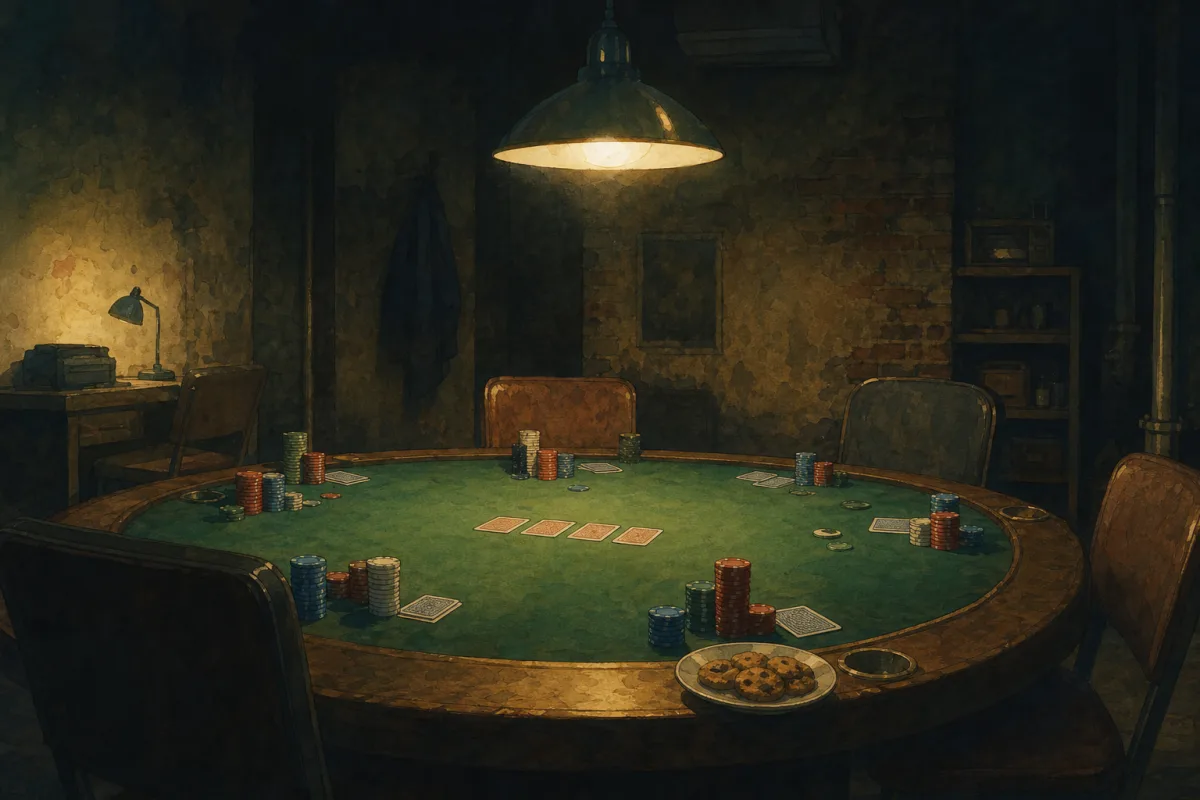
Rounders turned underground New York hold'em into a generation's reference point - Oreos, Russian vodka, and Teddy KGB paying a debt he did not want to owe. A look at the 1998 film and the tables it inspired.
For the material side of what sits on those tables today - 10g clay and ceramic instead of plastic movie props - see our history of poker chips.
Why Rounders still plays at the home-game table
By 1998, televised poker was niche and online play barely existed. Rounders gave audiences a vocabulary: grinders, rounders, credit, the nut straight, splashing the pot. Law-school dropout fantasies aside, the film nailed one truth hosts still repeat: poker is a people game wearing a maths costume.
Director John Dahl and writers Brian Koppelman and David Levien framed Mike as a player trying to leave the life - pulled back in by Worm (Edward Norton), a hustler whose debts drag both men through city-wide cash games toward a final heads-up confrontation with Teddy KGB.
That arc - debt → grind → showdown - is closer to pub league season planning than to a WSOP highlight reel. The film is about rooms, not bracelets.
The Teddy KGB final hand: culture in one scene
The climax is no-limit hold'em in KGB's basement club - check-raise traps, Oreos as a tell, Russian dialogue when things go wrong. When Mike reveals he flopped the nut straight, KGB throws cards and chips, then stops his muscle from violence:
He beat me. Straight up. Pay him. Pay that man his money.
The line matters because KGB is not gracious - he is cornered by his own code. Underground games ran on reputation; without "straight up" payment, the room dies. Home hosts borrow the quote when a bad beat lands and the winner still needs to be paid before the next hand.
Compare the candlelit cheats in Georges de La Tour - different century, same problem: someone at the table knows something someone else does not.
Rounders vs real hosting: what transfers
| Film beat | Real home / pub game |
|---|---|
| Credit between regulars | Track buy-ins - do not run IOU chaos |
| Reading Oreos / tells | Fun table talk - enforce visible cards and clear pots |
| Splashing the pot | Neat stacks - easier counts, fewer arguments |
| KGB's club chips | Custom 10g sets with denominations matched to blinds |
| All-night grind | Blind structure with a hard stop - blind structure guide |
The film glamorises underground stakes; your league probably needs insurance, venue permission, and chips that survive weekly transport - pub poker ordering guide.
Chips on screen vs chips you order
Prop departments choose chips for camera contrast - bold edges, readable stacks, satisfying splash sound. That is not the same spec as casino-grade custom:
| On-screen (props) | Custom hosting (Poker Foundry) |
|---|---|
| Generic mould | Your artwork - pub, club, or home logo |
| Unknown weight | 10g clay or ceramic |
| Rental inventory | 500+ ceramic or 500+ clay MOQ |
| No long-term care | Cases, cleaning, storage guides |
Film/TV productions that need script-accurate branded stacks order custom - see custom poker chips for film and TV props. Casino Royale (2006) pushed high-stakes hold'em glamour to a wider audience - Casino Royale poker scene and chips. Home hosts usually want fewer plaques, more workable racks - tournament denomination guide.
The Rounders family tree in card-table art
Rounders sits on a branch that starts in painted card rooms:
- Caravaggio - street Cardsharps and marked decks (art history)
- Georges de La Tour - candlelit ace hidden at the belt (de La Tour guide)
- Cézanne - silent Card Players without stakes on canvas (Cézanne)
- Coolidge - dogs bluffing and cheating on calendar art (Dogs Playing Poker)
- Hockney - friends at a folding table in 2015 (Hockney tribute)
- Rounders - neon, debt, and hold'em as American folklore
None of these teach you blind levels - they teach you why the table feels charged. Manufacturing detail lives in how custom poker chips are made.
Quotes hosts still steal (and what they mean)
| Line | Speaker | Hosting translation |
|---|---|---|
| "Pay that man his money" | Teddy KGB | Settle pots before the next deal |
| "The key to the game is playing the man" | Mike | Table dynamics matter - but clear rules matter more |
| "If you can't spot the sucker in your first half hour at the table, then you are the sucker" | Mike | Seat selection and player education |
| "I'm gonna splash the pot!" | Teddy KGB | Don't - neat stacks speed counting |
Use the jokes; skip the loan-shark economics.
Building a Rounders-weight room (without the debt)
You do not need a KGB basement to borrow the film's seriousness:
- 10g custom chips - clay or ceramic - not hollow plastic
- Denominations aligned to your blinds - cash or tournament points clearly labelled
- Metal case for weekly transport - case guide
- Published blind structure - home tournament blinds
- One rule sheet on the wall - fewer "that's not what Rounders did" arguments
Mock chip faces free in Label Studio before you quote.
Mistakes when cosplaying Rounders at home
| Mistake | Why it fails | Better move |
|---|---|---|
| Quoting film strategy as gospel | Drama ≠ GTO | Publish house rules |
| Plastic chips for "underground vibe" | Feels like a party, not a game | Custom 10g upgrade - plastic upgrade guide |
| Ignoring legal context | Film is 1990s NYC fiction | Run licensed pub or private home games properly |
| No bank / colour-up plan | Stacks become uncountable | Colour-up guide |
Rounders is pop-culture proof that poker is story first, solver second. Teddy KGB paying straight up is the film's moral hinge - not the straight itself. Thirty years earlier, The Cincinnati Kid (1965) staged five-card stud as tragedy - The Cincinnati Kid poker film culture. Three years before Rounders, Casino (1995) fixed a different image: cage money and Tangiers chips - see Casino poker scenes and prop chips. Hosts who want that gravity without the debt buy one good set and run clear blinds.
When you are ready to spec chips that feel as heavy as the dialogue, get an instant quote - worldwide delivery from our UK workshop.